World Series History: Origins, Format and Most Successful Franchises
How the World Series began in 1903, the years it was not played, best-of-nine experiments, home-field rules and which franchises have won the most titles.
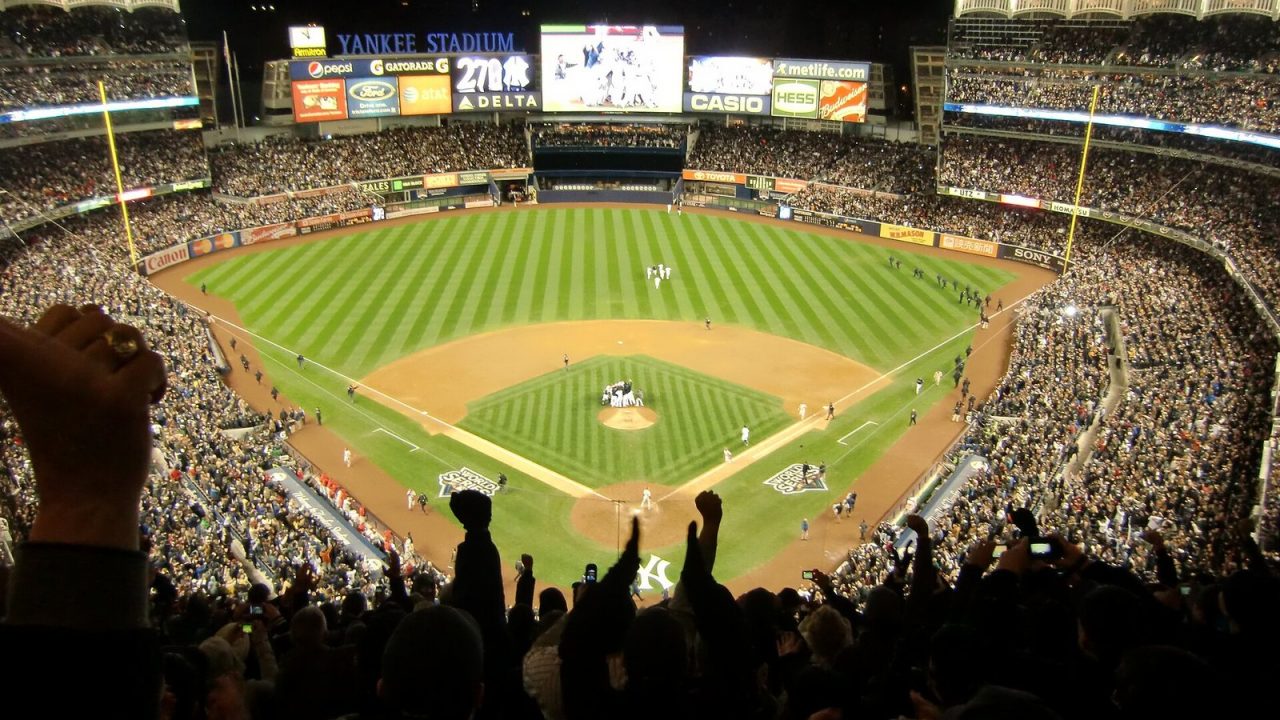
The World Series is the oldest championship round in North American professional sports still played today, and it has a vocabulary all its own: the Fall Classic, the Commissioner’s Trophy, Game 7. Through the 2025 season, 121 World Series have been played. They have produced dynasties, curses, droughts that lasted most of a century, and moments every fan can picture.
This guide explains where the Series came from, how its format has changed, how home-field advantage has been decided over the years and which franchises have won it most often.
The First World Series: 1903
By 1903, Major League Baseball had two rival leagues. The National League had been operating since 1876, and the American League had declared itself a major league in 1901, raiding NL rosters for talent. After a period of bitter competition, the leagues made peace, and the champions of each agreed to play a postseason series.
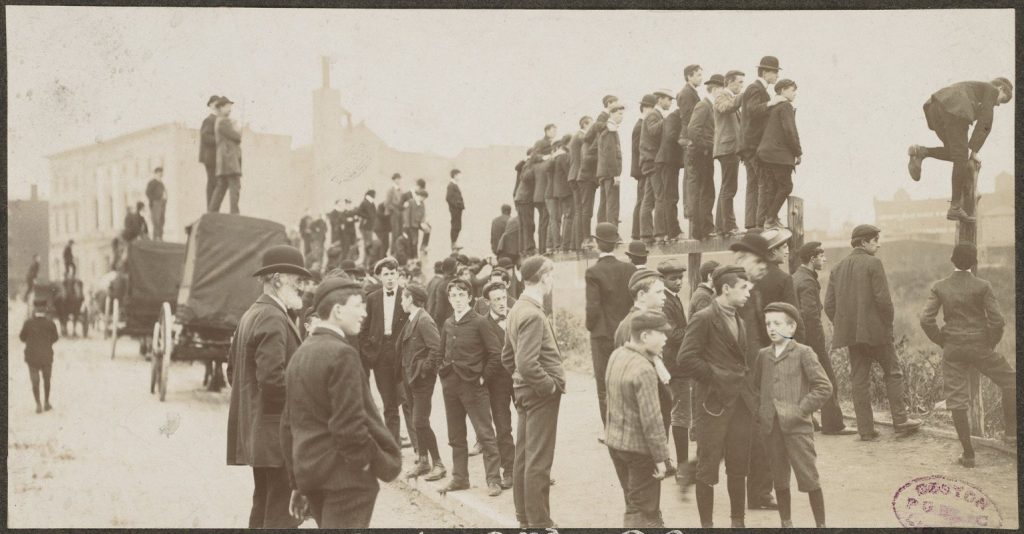
That first modern World Series matched the AL’s Boston Americans (the franchise now known as the Red Sox) against the NL’s Pittsburgh Pirates. It was a best-of-nine series, and Boston won it five games to three. The event was a success, but it was not yet an institution. For more on how the two leagues came to be, see our short history of Major League Baseball.
The Years Without a World Series
Only twice since 1903 has the World Series not been played.
1904: a refusal
In 1904, the New York Giants won the National League, but owner John T. Brush refused to let his team play the American League champion. Brush and manager John McGraw regarded the AL as an inferior league, and Brush also objected that there were no firm rules on revenue sharing, game sites and other operations. The refusal created pressure for formal rules governing the postseason, and the Series resumed the following year.
1994: the strike
The second gap came 90 years later. A players’ strike halted the 1994 season, and when no agreement was reached, Commissioner Bud Selig canceled the rest of the season, including the postseason. It was the first time since 1904 that no World Series was played, and the cancellation remains one of the most damaging events in the sport’s modern history.
How the Format Has Changed
Best-of-seven, with best-of-nine exceptions
Today’s World Series is a best-of-seven: the first team to win four games is champion. That has been the standard for almost the entire history of the event, but there were four exceptions. The 1903 Series and the three Series of 1919, 1920 and 1921 were best-of-nine, requiring five wins.
The 1919 best-of-nine Series is the most infamous, because several Chicago White Sox players were later banned for their involvement in fixing it against the Cincinnati Reds.
The 2-3-2 pattern
A best-of-seven World Series is played in a 2-3-2 home pattern: the team with home-field advantage hosts Games 1 and 2, the other team hosts Games 3, 4 and 5, and the series returns for Games 6 and 7 if needed. Holding home-field advantage therefore means hosting up to four of the seven games.
The pattern has a long history. It was first used in 1924, and in 1925 it was made permanent at the urging of Brooklyn owner Charles Ebbets. Its appeal is practical: it limits travel to two trips between cities while still giving the higher seed the potential extra home game. Because it front-loads two games in one park, a team that wins both at home can head into the middle three with a real cushion, while a road team that splits the first two has effectively taken home-field advantage for itself.
Why a seven-game series?
A longer series reduces the role of chance. In a single game, a weaker team can win with one great pitching performance or one lucky bounce. Over seven games, depth matters: the third and fourth starters pitch, the bullpen gets tested repeatedly, and lineups have time to adjust. That is why upsets still happen in the Fall Classic but are less common than in the shorter rounds that precede it.
How teams reach the Series
For most of the 20th century, the pennant winners went straight to the World Series. A structured playoff with League Championship Series began in 1969, wild cards followed in the 1990s, and the current 12-team bracket with a Wild Card Series began in 2022. Our guide to the MLB postseason format explains every round that now comes before the Fall Classic.
Home-Field Advantage Over the Years
Who hosts Game 1 and Game 7 has been decided in three different ways:
| Period | How home-field advantage was decided |
|---|---|
| Through 2002 | Alternated between the American and National Leagues each year |
| 2003–2016 | Awarded to the league that won that year’s All-Star Game |
| Since 2017 | Awarded to the pennant winner with the better regular-season record |
The All-Star Game rule was introduced after the 2002 All-Star Game ended in a tie, as a way to make the exhibition matter. It was criticized for years because it let a midsummer exhibition, featuring players from teams with no chance at the pennant, decide something so important. The current rule rewards regular-season performance instead.
The Most Successful Franchises
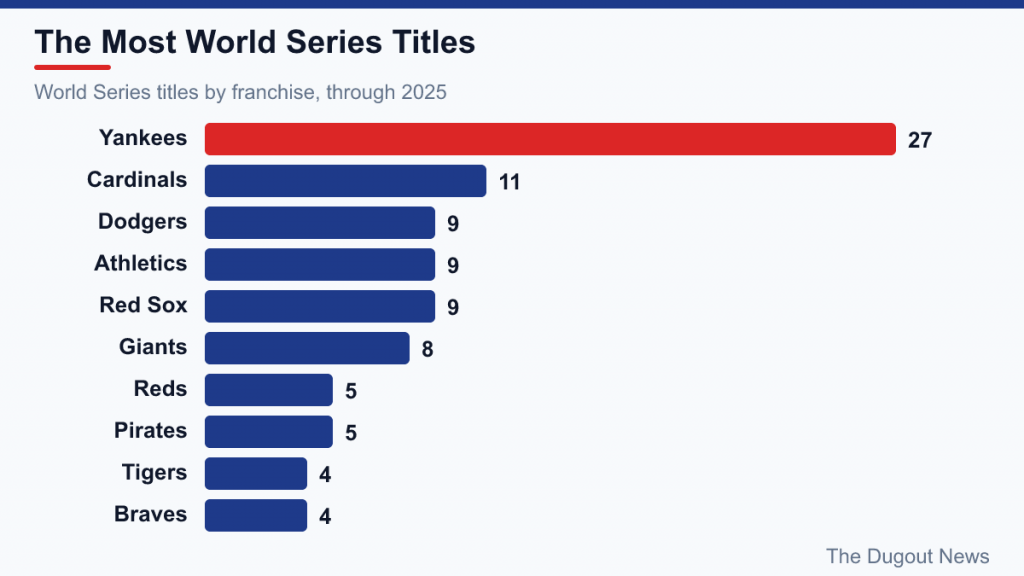
Here are the franchises with at least four World Series titles, through the 2025 Series. Titles include those won under earlier names and in earlier cities.
| Franchise | Titles | Appearances |
|---|---|---|
| New York Yankees | 27 | 41 |
| St. Louis Cardinals | 11 | 19 |
| Brooklyn/Los Angeles Dodgers | 9 | 23 |
| Philadelphia/Kansas City/Oakland Athletics | 9 | 14 |
| Boston Americans/Red Sox | 9 | 13 |
| New York/San Francisco Giants | 8 | 20 |
| Cincinnati Reds | 5 | 9 |
| Pittsburgh Pirates | 5 | 7 |
| Detroit Tigers | 4 | 11 |
| Boston/Milwaukee/Atlanta Braves | 4 | 10 |
The Yankees standard
The Yankees’ 27 championships put them far ahead of every other franchise. Their dynasties include four straight titles from 1936 to 1939 and an unmatched five in a row from 1949 to 1953. Only two other runs of three or more consecutive titles exist: the Oakland Athletics from 1972 to 1974 and the Yankees again from 1998 to 2000.
The Cardinals and the National League
The St. Louis Cardinals hold the most titles of any National League franchise with 11. The Dodgers have the most appearances of any NL team, though for decades their Brooklyn teams were known for losing to the Yankees in October.
The Dodgers’ recent run
The Los Angeles Dodgers won back-to-back titles in 2024 and 2025. In 2024 they beat the Yankees, clinching at Yankee Stadium. In 2025 they beat the Toronto Blue Jays in seven games, winning Game 7 in 11 innings at Rogers Centre in Toronto after trailing in the game. That brought the franchise’s total to nine.
Droughts and Franchises Still Waiting
Some of the most memorable World Series wins mattered because of how long the winners had waited:
- Boston Red Sox: 86 years between titles, from 1918 to 2004, a span fans blamed on the “Curse of the Bambino” after the sale of Babe Ruth to the Yankees.
- Chicago White Sox: 88 years, from 1917 to 2005.
- Chicago Cubs: 108 years, from 1908 to 2016, the longest drought in the sport’s history.
Several franchises have never won the World Series as of 2025, including the Milwaukee Brewers, San Diego Padres, Tampa Bay Rays and Colorado Rockies, each of whom has reached it at least once. The Seattle Mariners have never appeared in a World Series.
Traditions and Terms
- The Commissioner’s Trophy is awarded to the winning team. It is presented on the field after the clinching game.
- World Series MVP: an award given to the outstanding player of the Series.
- Game 7: the deciding game of a seven-game Series, often considered the most dramatic game in the sport.
- The Fall Classic: a long-standing nickname for the World Series.
- Sweep: winning the Series four games to none.
Why it is called the “World” Series
The name is often misunderstood. It dates to the event’s early years, when it was called the “World’s Championship Series,” a typical bit of American sporting bravado. A popular story says it was named after a newspaper called the New York World, but there is no good evidence for that claim. Today one MLB team plays in Canada, and the Toronto Blue Jays, who joined the American League in 1977, have won the Series twice, so the event has at least been international.
Iconic World Series Moments
Every fan has a favorite, but a few moments come up again and again:
- Don Larsen’s perfect game (1956): the only perfect game in World Series history, thrown by the Yankees right-hander against the Brooklyn Dodgers.
- Bill Mazeroski’s walk-off (1960): the Pirates’ second baseman ended Game 7 against the Yankees with a ninth-inning walk-off home run.
- Carlton Fisk’s home run (1975): the Red Sox catcher’s 12th-inning walk-off at Fenway Park won Game 6 against Cincinnati 7–6, though the Reds took Game 7.
- Kirk Gibson’s pinch-hit homer (1988): a hobbled Gibson won Game 1 for the Dodgers against Oakland with a two-out, ninth-inning home run.
- Joe Carter’s walk-off (1993): a three-run, bottom-of-the-ninth home run that won Game 6 and clinched the title for Toronto.
How to Read World Series History
When comparing franchises, keep a few things in mind. The number of teams has grown through expansion to 30 today, and the number of playoff rounds has grown with it, so winning a title now requires surviving more rounds. Early dynasties went straight from the pennant to the World Series. That does not make modern titles more or less impressive, just different. And franchise totals include eras when teams played in different cities under different names, which is why the Athletics’ nine titles span Philadelphia and Oakland and the Giants’ eight span New York and San Francisco.