Instant Replay in MLB: Manager Challenges and Reviewable Plays
How MLB replay review works: its 2008 start, the 2014 challenge system, how many challenges managers get, what can and cannot be reviewed, and who decides.
For most of baseball history, an umpire’s call was final, right or wrong. Arguments were part of the show, and managers kicked dirt and got ejected, but the call stood. That changed in stages starting in 2008, and today replay review is a routine part of every MLB game. A manager who thinks his runner beat a tag can ask for a second look, and umpires in a central replay facility will make the final decision.
This guide explains how the replay system developed, how challenges work, what can and cannot be reviewed, and how to read a replay situation when you see one in a game.
How Replay Came to MLB
2008: home run calls only
MLB’s first replay system was narrow. On August 28, 2008, Commissioner Bud Selig instituted replay review for boundary home run calls: whether a ball cleared the fence, whether it was fair or foul at the pole, and whether fan interference affected it. Only the umpire crew chief could initiate a review.
The system made its debut on September 3, 2008, at Tropicana Field, when a home run by Alex Rodriguez that passed near the foul pole was reviewed and upheld. The first overturned call came on September 19, 2008, when a hit by Carlos Peña was changed to a home run. From 2008 through 2010, replay was used 123 times and 48 calls were overturned.
2014: the challenge system
Calls for broader replay grew louder after several high-profile missed calls, and in January 2014 MLB approved a major expansion. For the first time, managers could challenge a wide range of plays, not just home runs. Reviews moved to a central facility in New York City, where umpires watch broadcast and stadium camera angles and make the final ruling.
The rules were refined in 2015: managers were allowed to challenge from the dugout, a manager kept his challenge after every overturned call rather than only the first, tag-ups became reviewable, and postseason games and the All-Star Game gave managers two challenges per game.
How a Manager’s Challenge Works
How many challenges
Under the current system, each manager begins a regular-season game with one challenge. If the challenge succeeds and the call is overturned, the manager keeps his challenge and can use it again. If the call stands, the challenge is gone. In the postseason, managers get two challenges per game.
The time limit
Speed matters. A manager has to decide quickly whether to challenge, and teams use dedicated video staff who watch replays in the clubhouse and signal the dugout. A 2020 rule change shortened the time to make a challenge from 30 seconds to 20 seconds. A manager who wants to hold play while he waits for his video staff must signal within a short window, and replay reviews are generally expected to be completed within two minutes, with some exceptions.
That is why you often see managers stroll slowly onto the field, or an infielder stand on the base waiting: they are buying time for a phone call from the video room.
Crew chief reviews
Once a manager is out of challenges, he is not completely out of options. From the eighth inning on, the umpire crew chief may initiate a review on his own, typically when a manager asks him to. Umpires can also review home run calls at any time, without a challenge.
What happens during a review
- The manager signals a challenge to the umpire, or the crew chief calls for a review.
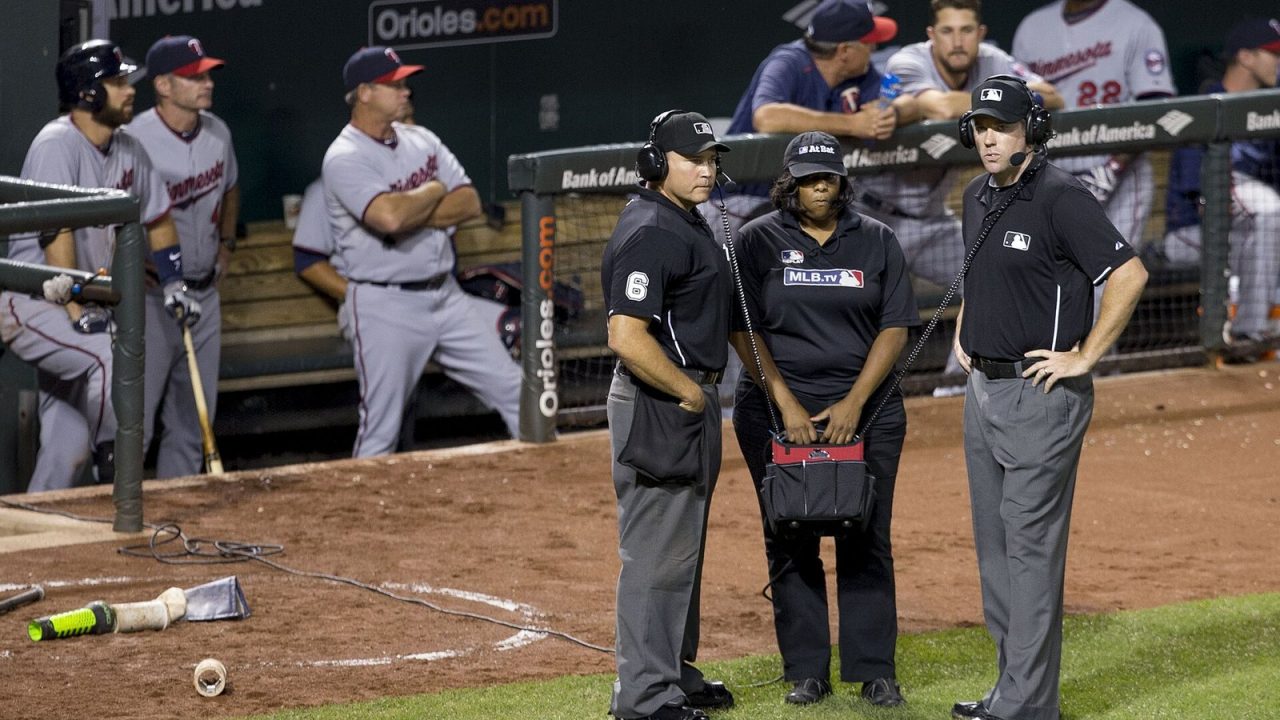
- The umpires on the field put on headsets connected to the replay center in New York.
- Replay officials in New York review the available camera angles.
- The call is confirmed (clear evidence that the original call was correct), stands (not enough evidence to overturn it), or is overturned (clear and convincing evidence that it was wrong).
- If overturned, the replay officials also decide where runners should be placed, based on where they would have ended up with the correct call.
The difference between “confirmed” and “stands” matters for understanding the result, but either way the challenge is lost.
What Can Be Reviewed
Most plays that involve a clear question of fact, such as whether a ball arrived before a runner, can be reviewed. The main categories include:
- Home run and boundary calls, including fan interference.
- Fair or foul calls on balls hit to the outfield.
- Force plays and tag plays at any base, including whether a runner left the base during a tag.
- Catch or trap calls in the outfield.
- Hit by pitch.
- Time plays, which decide whether a run scored before the third out.
- Whether a runner passed another runner, and whether a runner touched a base.
- Tag-ups on fly balls.
- Home plate collisions and slide-rule violations on double plays.
- Scorekeeping issues, such as the count, the number of outs or the score.
What Cannot Be Reviewed
Some calls are judgment calls that MLB has kept outside the manager challenge system:
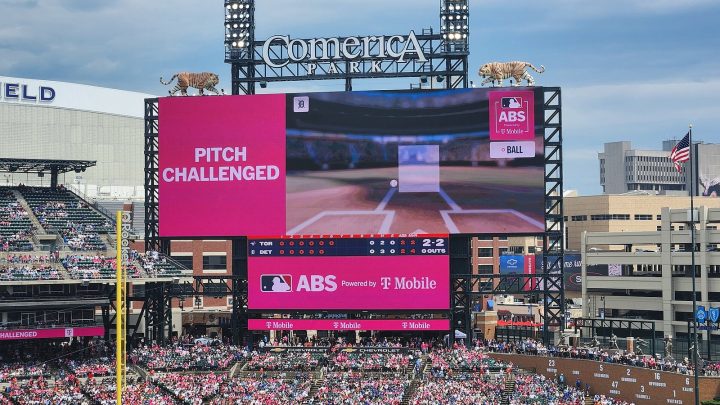
- Balls and strikes. These are not part of the manager challenge system. Starting in 2026, they are handled separately through the Automated Ball-Strike challenge system, in which only the batter, pitcher or catcher can challenge a pitch.
- Check swings.
- The infield fly rule. Whether a fly ball can be caught with ordinary effort is a judgment call; our guide to the infield fly rule explains why.
- Trap plays in the infield.
- Foul tips.
- Obstruction and most interference calls, which depend on the umpire’s judgment.
- Mound visit counts.
If you are unsure why a call is or is not reviewable, ask whether it depends on a measurable fact (safe or out, fair or foul) or on an umpire’s judgment of intent or effort. Facts are generally reviewable; judgment calls usually are not.
How Often Calls Are Overturned
Early data showed that managers’ challenges overturned calls fairly often. At the 2014 All-Star break, the first year of the expanded system, manager challenges had resulted in overturned calls 52 percent of the time; including umpire-initiated reviews, the overturn rate was about 48 percent. The average review in that period took one minute and 50 seconds.
Those numbers have varied over time, and a high or low overturn rate does not by itself prove much. Teams have learned to challenge selectively, and umpires know their calls on close plays will be checked.
Strategy: When Should a Manager Challenge?
Because a manager starts with only one challenge and keeps it only if he wins, every challenge carries an opportunity cost. Smart challenge strategy follows a few principles:
- Trust the video room. The video staff sees more angles than the manager. Most challenges are made only after the video room signals confidence.
- Weigh the leverage. A wrong safe call on a stolen base in the late innings of a close game is more important than one in the second inning of a blowout.
- Remember the late-inning backstop. From the eighth inning on, the crew chief can review plays even if a manager is out of challenges, which makes saving a challenge for the late innings slightly less necessary.
- Do not challenge just to argue. Losing a challenge on a long-shot call leaves the team exposed if a clearer mistake happens later.
Replay and the Rest of the Rulebook
Replay changed more than how calls are reviewed. It forced umpires and teams to think more precisely about rules that were once applied loosely. The neighborhood play at second base, where middle infielders were given leeway for not quite touching the bag on a double play, became a problem once every play could be checked frame by frame. Rules on slides into second base and collisions at home plate were also written with replay in mind.
Replay also introduced a new kind of out: the runner who overslides a base by an inch while the fielder keeps the tag applied. Before replay, those plays were nearly impossible to call; now they can be overturned. If you are new to force plays, tag plays and other baserunning basics, our guide to baseball rules for beginners is the place to start.
Replay Timeline at a Glance
| Year | Change |
|---|---|
| 2008 | Replay introduced for boundary home run calls, initiated only by the crew chief |
| 2014 | Expanded replay with manager challenges and a central replay center in New York |
| 2015 | Challenges from the dugout, challenge retained after every overturned call, tag-ups reviewable, two challenges in the postseason |
| 2020 | Time to decide on a challenge cut from 30 seconds to 20 |
| 2026 | Balls and strikes become challengeable through the separate ABS system |
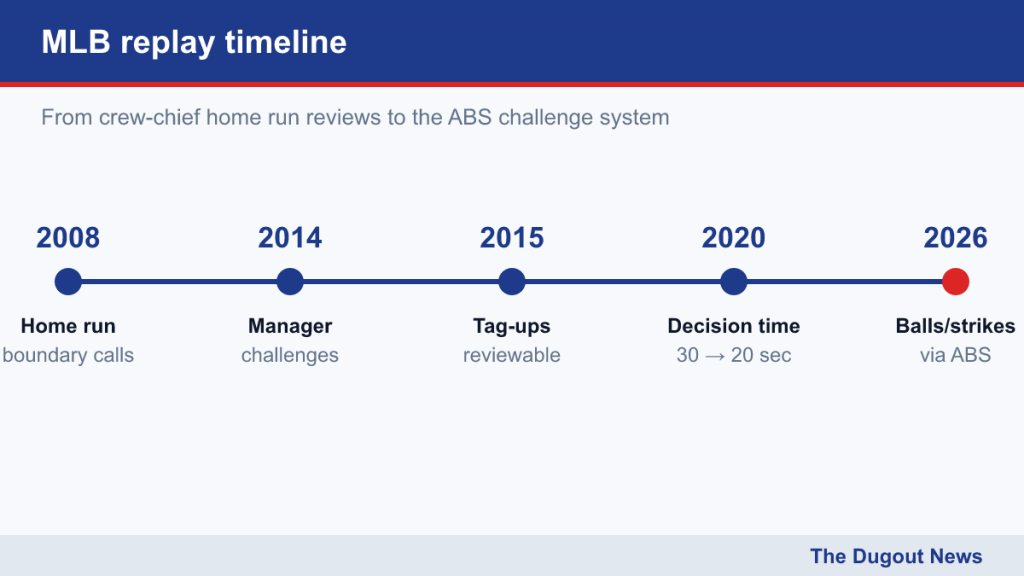
The common thread is gradual expansion. MLB started with the narrowest, most clear-cut calls and widened the system as the technology and procedures proved themselves, while keeping judgment calls in the hands of the umpires on the field.
Frequently Asked Questions
Who makes the final decision on a review?
Umpires working at the replay center in New York make the final call, not the umpires on the field.
Can a manager argue the result of a review?
No. Arguing a replay decision can lead to an ejection.
Can a manager challenge a pitch?
Not through the replay system. As of 2026, pitch calls can be challenged only by players through the ABS challenge system, which has its own rules and its own limit on challenges. For background on how the zone itself is defined, see our explainer on the strike zone.
Does the umpire who made the call watch the replay?
The on-field umpires communicate with the replay center through headsets, but the ruling comes from the replay officials who review the video.