The Infield Fly Rule Explained (And Why It Exists)
When the infield fly rule applies, what the umpire calls, what runners can do, why the rule exists and the famous 2012 Wild Card Game call.
Few rules in baseball have a reputation quite like the infield fly rule. It is famous for confusing casual fans, it pops up at the most dramatic moments, and it has been the subject of law-review articles and endless bar arguments. Yet the idea behind it is simple, and once you understand the problem it solves, the rule makes a great deal of sense.
This guide explains exactly when the rule applies, what the umpire does, what runners can and cannot do once it is called, the odd cases near the foul lines, and the 2012 postseason call that made it front-page news.
The Problem the Rule Solves
Imagine runners on first and second with one out. The batter hits a lazy pop-up to the shortstop. Normally, the runners stay close to their bases, because if the ball is caught they must return (tag up) before advancing, and if they stray too far they can be doubled off.
Now imagine the shortstop deliberately lets the ball fall to the ground. Suddenly every runner is forced to advance, because the batter has become a runner heading to first. The runners, who were standing on their bases, have no chance to reach the next base in time. The shortstop picks up the ball, throws to third for one force out and the throw goes to second for another. An easy pop-up has become a double play, and the offense was punished for doing exactly what it should have done.
That is the trap the infield fly rule was designed to prevent. The runners are caught in an impossible position: if they stay, they can be forced out on a deliberate drop; if they run, they can be doubled off on a catch. The rule removes the dilemma by making the batter out automatically, which removes the force and lets runners stay safely on their bases.
When the Infield Fly Rule Applies
The Official Baseball Rules define an infield fly in the “Definitions of Terms” section as:
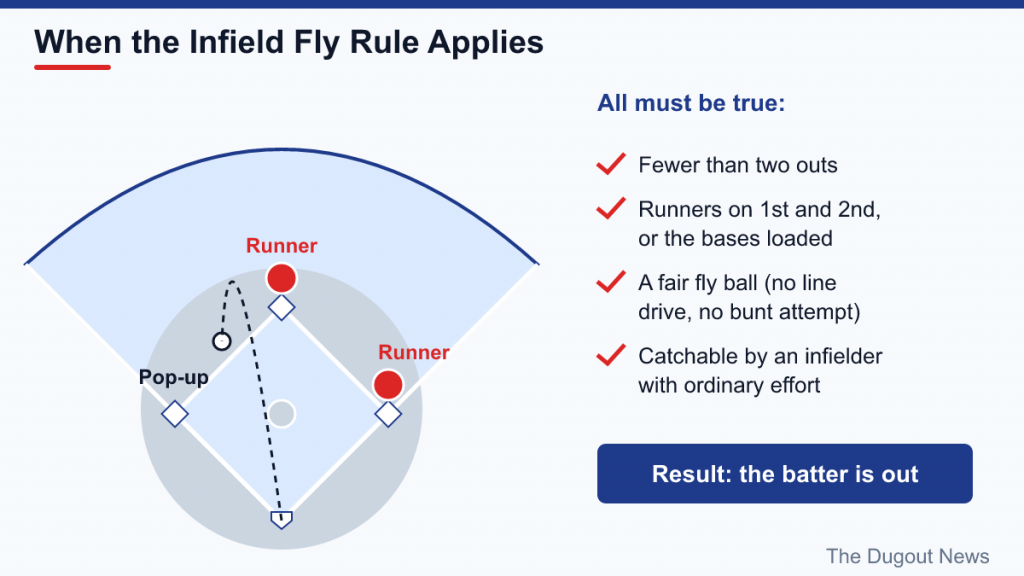
“a fair fly ball (not including a line drive nor an attempted bunt) which can be caught by an infielder with ordinary effort, when first and second, or first, second and third bases are occupied, before two are out.”
Break that down into a checklist. All of these must be true:
- Fewer than two outs. With two outs, there is no double-play trap, because any single out ends the inning.
- Runners on first and second, or the bases loaded. These are the situations in which there is a force at third base and a dropped ball could produce two cheap force outs. With only a runner on first, a deliberate drop could at most trade the batter for the runner, so the rule does not apply.
- A fair fly ball. Not a line drive and not a bunt attempt. Line drives were excluded because a fielder cannot easily choose to drop them, and bunts because pop-up bunts are a normal risk of the play.
- Catchable by an infielder with ordinary effort. This is a judgment call by the umpire.
The rules add that the pitcher, catcher and any outfielder who positions himself in the infield on the play count as infielders for this purpose.
“Ordinary Effort” and the Umpire’s Judgment
The phrase “ordinary effort” is where controversies start. The rulebook comment makes two important points:
- The umpire decides whether the ball could ordinarily have been handled by an infielder, not by an arbitrary boundary like the infield grass or the base lines. A pop-up can be an infield fly even if it lands on the outfield grass.
- The umpire must call it an infield fly even if an outfielder handles it, as long as an infielder could have caught it as easily.
The rulebook also says the infield fly “is in no sense to be considered an appeal play,” that “the umpire’s judgment must govern,” and that the decision should be made immediately. Ordinary effort is described elsewhere in the rules as an objective standard for a fielder at that position, taking into account conditions like the weather and the field.
So the question is never “Is this ball on the infield dirt?” but “Would a typical infielder at this position catch this pop-up routinely?” If you want a refresher on who plays where, our guide to the nine baseball positions covers the infield spots in detail.
What the Umpire Signals
When it seems apparent that a ball will be an infield fly, the rules instruct the umpire to “immediately declare ‘Infield Fly’ for the benefit of the runners.” If the ball is near a foul line, the umpire declares “Infield Fly, if Fair.”
In practice, umpires usually point straight up with the right arm, index finger raised, while calling it out loud. Umpires also often remind each other before a pitch that the rule is in effect, a quiet signal many fans never notice.
The call is designed to happen while the ball is still in the air, so runners know the batter is already out and there is no force. That is why the timing of the call matters so much, as the 2012 example below shows.
What Happens After the Call
This is the part that confuses many fans: the ball is still alive. Calling an infield fly does not stop play. Here is how it works:
- The batter is out whether the ball is caught or not.
- If the ball is caught, it is treated like any caught fly ball. Runners must retouch (tag up) their bases before advancing, and can be doubled off if they do not.
- If the ball is dropped, the batter is still out, so there is no force. Runners may stay where they are, and they do not need to tag up. They may also try to advance at their own risk, in which case they must be tagged out.
The rulebook states it directly: “The ball is alive and runners may advance at the risk of the ball being caught, or retouch and advance after the ball is touched, the same as on any fly ball.”
A sharp baserunner can occasionally take advantage of a defense that relaxes after the call. If a fielder lets the ball drop and does not pay attention, a runner may be able to take the next base. More often, though, a runner who forgets the ball is live gets tagged out wandering off the bag.
The scorer credits the putout on an uncaught infield fly to the fielder who could have made the catch.
The Foul Line Cases
Because fair or foul is not decided until the ball is touched or passes a base, an infield fly near the line has special handling:
- If a declared infield fly falls untouched and bounces foul before passing first or third base, it is simply a foul ball. The batter is not out and returns to hit.
- If a declared infield fly falls untouched outside the baseline and bounces fair before passing first or third base, it is an infield fly, and the batter is out.
- If the ball becomes a foul ball, “it is treated the same as any foul,” so if it is caught in foul territory, it is an ordinary caught foul fly.
That is why umpires add “if fair” to the call on pop-ups near the lines.
A Related Rule: The Intentional Drop
The infield fly rule covers pop-ups. A separate rule, 5.09(a)(12), covers a related trick on line drives. If an infielder intentionally drops a fair fly ball or line drive with first base occupied (alone or along with other bases) and fewer than two outs, the ball is dead, the batter is out and the runners return to their bases.
Note the word “intentionally.” If a fielder simply lets the ball fall untouched, the intentional-drop rule does not apply, unless the infield fly rule is in effect. And when an infield fly has been called and an infielder deliberately drops the ball, the rulebook comment says the infield fly rule takes precedence, so the ball remains in play.
A Brief History
The rule dates back to the 1890s. The National League introduced it in 1895 to stop infielders from intentionally dropping pop-ups to set up force plays; at first it applied only with one out. The modern version took shape in 1901, line drives were excluded in 1904 and bunt attempts were excluded in 1920. The basic structure has changed little since.
The 2012 NL Wild Card Game Call
The most famous infield fly call in modern history came in the first-ever National League Wild Card Game, in October 2012, between the St. Louis Cardinals and the Atlanta Braves. It was the first year of the one-game wild-card playoff; our guide to the MLB postseason format explains how that round later became a best-of-three series.
In the eighth inning, with one out and runners on first and second, Braves shortstop Andrelton Simmons hit a fly ball into shallow left field. Cardinals shortstop Pete Kozma drifted out to make the play, with left fielder Matt Holliday also coming in. At the last moment Kozma peeled away, and the ball dropped between them.
Left field umpire Sam Holbrook called “infield fly” just before the ball landed, so Simmons was out. Instead of the bases loaded with one out, the Braves had runners on second and third with two outs. They did not score in the inning, and St. Louis won 6–3 to eliminate Atlanta.
The call sparked fury in the stands. Fans threw bottles and debris onto the field, delaying the game by about 20 minutes. The Braves protested, but MLB executive Joe Torre denied the protest on the grounds that the call was a matter of umpire judgment.
The debate centered on two questions: was a ball that deep in the outfield really catchable with ordinary effort by an infielder, and was the call made too late? The rulebook supports the umpire’s authority on the first point, since the boundary of the infield is not the test, but the timing issue explains why many fans and analysts felt the call missed the spirit of the rule. The rule is designed to inform runners while the ball is in the air; a late call leaves them guessing anyway.
Quick Reference and Common Mistakes
| Situation | Infield fly possible? |
|---|---|
| Runner on first only, one out | No |
| Runners on first and second, no outs | Yes |
| Bases loaded, one out | Yes |
| Runners on second and third, one out | No (no force at third without a runner on first) |
| Any situation with two outs | No |
| Line drive or bunt pop-up | No |
- Mistake: thinking the ball is dead. It is alive. Runners can advance at their own risk.
- Mistake: thinking the rule only applies on the dirt. Location is not the test; ordinary effort by an infielder is.
- Mistake: thinking runners must tag up if the ball drops. They only need to tag up if it is caught.
For the broader basics of outs, force plays and tagging, see our baseball rules for beginners guide.