The Designated Hitter Rule: How It Works and How It Became Universal
What the designated hitter does, how the AL adopted it in 1973, why the NL held out until 2022, and how the two-way "Ohtani rule" works.
For nearly half a century, Major League Baseball played under two sets of rules. In the American League, a designated hitter batted in place of the pitcher. In the National League, pitchers swung the bat themselves. Fans argued about it constantly: purists defended the strategy of the pitcher batting, while others pointed out that most pitchers were nearly automatic outs. That debate ended in 2022, when the DH became universal.
This guide explains what the designated hitter is, how the rule works in practice, how it spread from one league to both, and the special provision known as the “Ohtani rule.” If you are still learning the defensive side of the game, our guide to the nine baseball positions covers who plays where.
What the Designated Hitter Does
The designated hitter is a player who bats in the lineup but does not play the field. In MLB, the DH bats in place of the pitcher. The rule is set out in Rule 5.11 of the Official Baseball Rules.
In practice that means a team’s lineup still has nine batters, but its defense has ten players involved in total: nine fielders, including the pitcher, plus the DH who only hits. The pitcher concentrates entirely on pitching, and the team gets a ninth real hitter instead of a usually weak-hitting pitcher.
The basic mechanics
- The DH must be named in the starting lineup before the game. A team cannot decide to add a DH partway through.
- The DH can bat anywhere in the batting order, not just ninth.
- The DH can be replaced by a pinch-hitter, who then becomes the new DH.
- The DH does not take a defensive position. If he does move into the field, the team loses the DH for the rest of the game (more on that below).
How the DH Changes Strategy
The DH sounds like a small adjustment, but it changes how managers run a game in several ways.
Pitchers stay in longer
Without a DH, a manager whose starter is pitching well but whose team trails late may still pinch-hit for him to try to score runs. With a DH, that decision disappears: the pitcher never comes to bat, so he can be left in or removed based purely on how he is pitching.
Fewer double switches
The double switch was the classic National League maneuver. When bringing in a new pitcher, a manager would also replace a position player so the new pitcher could take a lineup spot that would not bat for a while. With a DH, the pitcher is not in the batting order at all, so the double switch becomes rare.
A home for hitters who cannot field
The DH creates a lineup spot for players who can hit but are poor or limited defenders, and for veterans whose bodies can no longer handle a full-time position. Teams also use the DH slot to rest regulars: a shortstop might DH for a day to get a partial break while still batting.
Less bunting by pitchers
Pitchers who batted often bunted to move runners along, since swinging away rarely worked. With the DH, that type of sacrifice bunt has largely vanished from the majors.
How the DH Was Born: The American League in 1973
The idea of having someone bat for the pitcher is surprisingly old. In 1891, Pittsburgh’s William Chase Temple and New York’s J. Walter Spalding proposed ways to replace the pitcher in the batting order, but the idea was voted down. Connie Mack raised it again in 1906, and National League president John Heydler pushed for it in the late 1920s without success.
The breakthrough came in the early 1970s, when offense was low and American League attendance lagged. On January 11, 1973, AL owners voted 8–4 to adopt the designated hitter on a three-year trial basis. The National League declined.
The first DH to come to the plate was Ron Blomberg of the New York Yankees, on April 6, 1973, at Fenway Park against the Boston Red Sox. He drew a bases-loaded walk. The trial became permanent, and the American League kept the DH from then on.
Decades of a Split Rule
From 1973 through 2021, the two leagues played different games. The National League seriously considered the DH in 1980 but voted it down. That split forced MLB to come up with rules for games between the leagues.
World Series
- 1973–1975: no DH in the World Series.
- 1976–1985: the DH was used in all games in even-numbered years and not at all in odd-numbered years.
- 1986–2021: the DH was used only in games played in the American League team’s ballpark.
Interleague play
When regular-season interleague play began in 1997, the home team’s league rule applied. AL pitchers rarely batted, so they occasionally had to take swings in NL parks, and NL teams had to find a DH when visiting AL parks.
The split also shaped roster building. American League teams often kept a full-time DH, while National League teams valued versatile bench players and pitchers who could handle a bat.
2020 and 2022: The DH Goes Universal
The first time the National League used the DH during its own regular season was 2020, as part of the temporary rules for the pandemic-shortened season. In 2021, NL pitchers went back to batting.
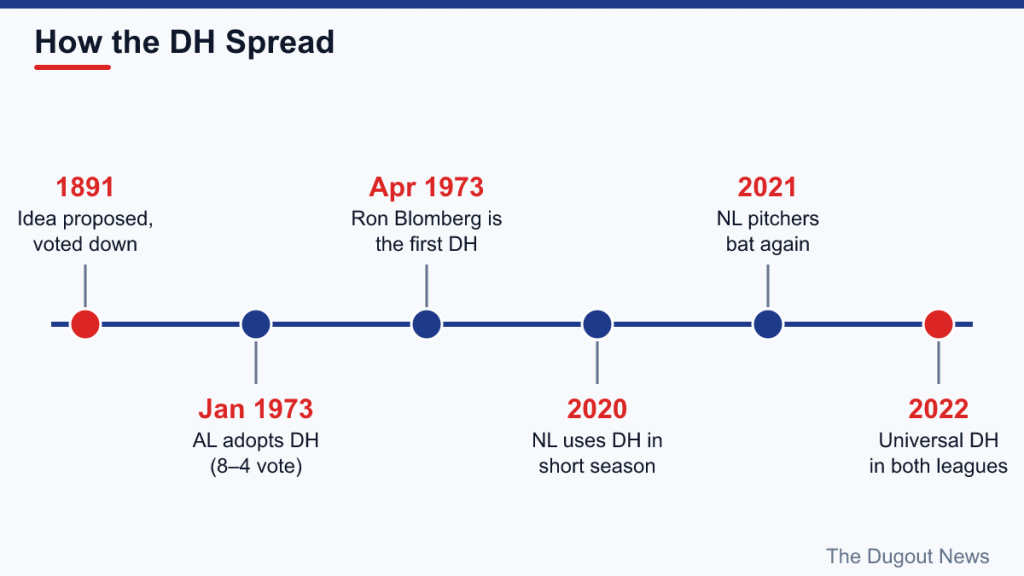
The permanent change came with the collective bargaining agreement that ended the 2021–22 lockout. The universal DH was agreed in early 2022, and the new CBA was ratified on March 10, 2022. Since the 2022 season, both leagues have used the designated hitter in every game, and interleague and World Series games no longer need special rules.
Several factors pushed the change: pitchers’ hitting had become very weak, there was concern about pitchers getting injured while batting or running the bases, and the players’ union favored a rule that created more jobs for hitters.
The “Ohtani Rule” for Two-Way Players
Shohei Ohtani’s career as both an elite pitcher and an elite hitter created a problem the original DH rule never anticipated. Under the old rule, when a pitcher hit for himself, the team lost the DH. If he was removed as a pitcher, he left the game entirely, taking his bat with him.
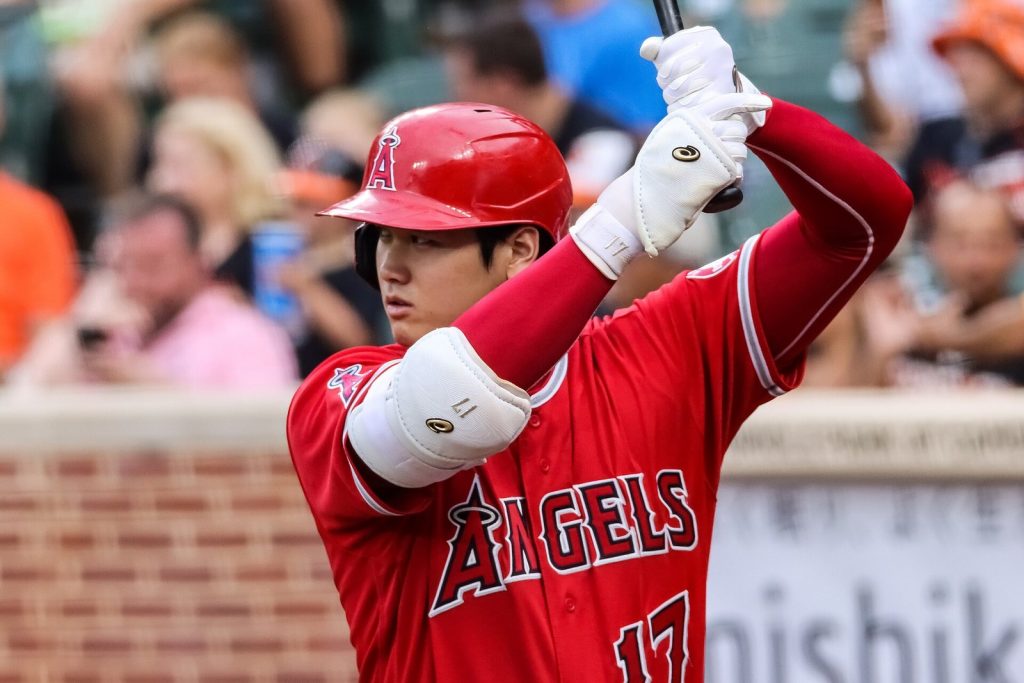
Starting with the 2022 season, MLB added a provision for this situation. A player who is listed in the lineup as both the starting pitcher and the DH can continue as the DH after he is taken out as the pitcher. In effect, the team treats him as two players: one pitching, one hitting. When he leaves the mound, a reliever replaces him as pitcher, and he keeps batting.
The rule only works if the player starts the game in both roles. A relief pitcher cannot enter the game and also become the DH.
When a Team Loses the DH
The DH can be lost during a game, and this is where many fans get confused. Under Rule 5.11, the designated hitter role is terminated for the rest of the game in situations such as these:
- The DH moves into a defensive position. The pitcher must then bat in the spot of the player who was replaced in the field, unless the manager makes other substitutions.
- The pitcher moves to another defensive position, or a pinch-hitter bats for any player and then becomes the pitcher.
- The pitcher bats for himself, or a player already in the field moves to the mound.
The two-way provision described above is the main exception. In everyday games it rarely comes up, but late in long extra-inning games, when benches are empty and position players start pitching, managers sometimes have to give up the DH.
The Greatest Designated Hitters
Some players built Hall of Fame careers largely as designated hitters, which changed how voters viewed the role.
- Edgar Martínez spent most of his career as the Seattle Mariners’ full-time DH and was inducted into the Hall of Fame in 2019. The award given each year to the best DH is named after him.
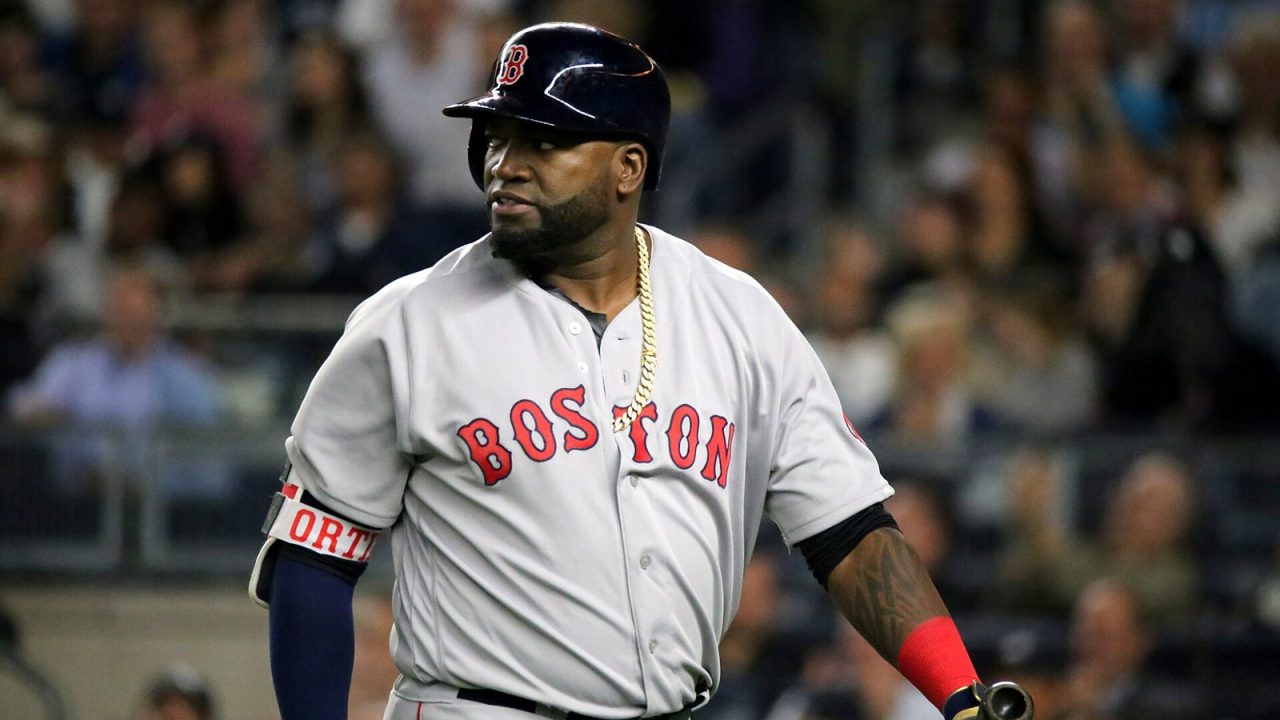
- David Ortiz, the Boston Red Sox slugger, was elected in 2022, his first year on the ballot. He was the first primarily full-time DH elected in his first year of eligibility and won the Edgar Martínez Award eight times.
For years, some voters argued a DH contributed too little to be a Hall of Famer because he did not field. The elections of Martínez and Ortiz showed that an elite bat alone can carry a legendary career.
The DH Outside MLB
Other levels and leagues treat the DH differently.
- College baseball (NCAA): the DH bats for the pitcher. A player who both pitches and hits can be listed as a combined pitcher/DH.
- High school (NFHS): the DH may bat for any defensive player, not only the pitcher.
- Japan: the Pacific League adopted the DH in 1975. The Central League, which held out much longer, voted in August 2025 to adopt it starting in 2027.
Frequently Asked Questions
Does the DH have to bat ninth?
No. The DH can bat anywhere in the order, and many are among the best hitters on their team.
Can a team choose not to use a DH?
Yes. A team may let its pitcher bat, but then it forfeits the DH for that game. It is almost never done in modern MLB except with a two-way player.
Is the DH a defensive position number?
No. Scorers simply write “DH” for the position, since the DH does not field.