Jackie Robinson and the Breaking of Baseball’s Color Line
How Jackie Robinson went from the Kansas City Monarchs to Brooklyn on April 15, 1947, and why every MLB player now wears number 42 on that date.
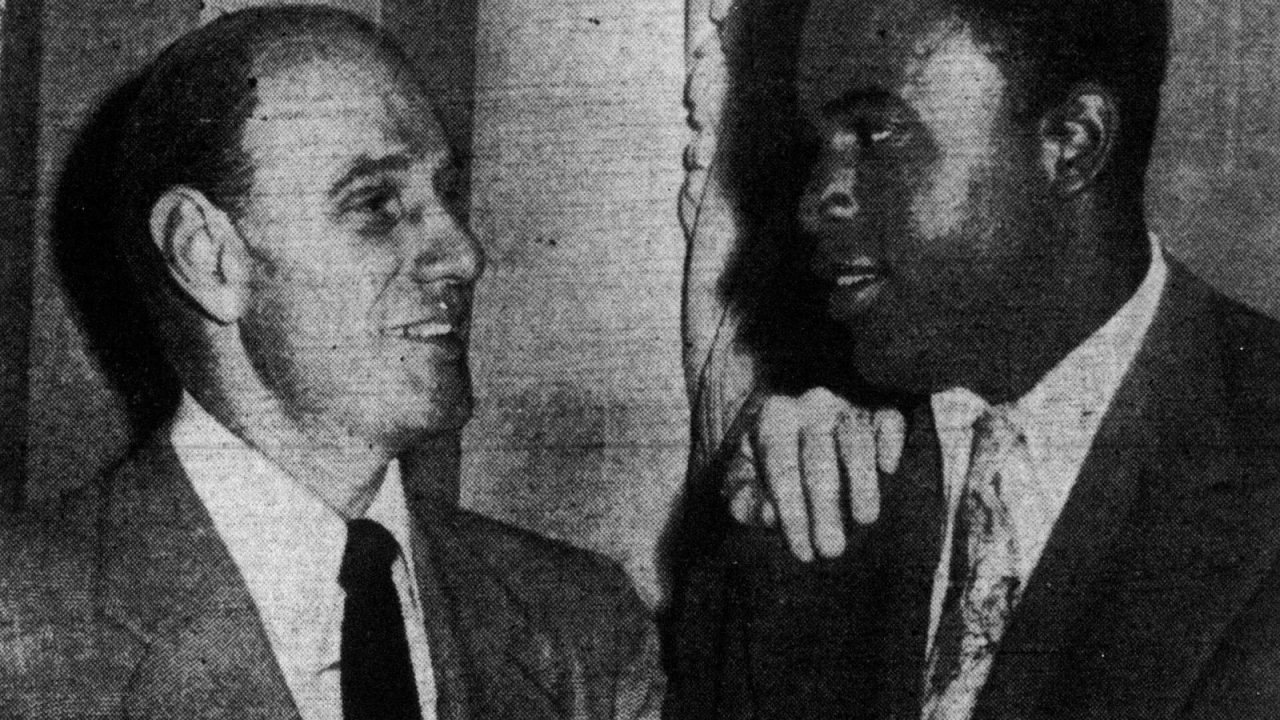
On April 15, 1947, Jackie Robinson took the field at first base for the Brooklyn Dodgers. With that appearance, he became the first Black player in the modern major leagues and ended a color line that had kept Black players out of the American and National Leagues for more than half a century. It is one of the most important moments in American sports, and its effects reached well beyond the ballpark.
Robinson’s story is often told as a single day. In reality it was a long road with careful planning, enormous pressure and a decade of outstanding play that followed. This article walks through that road, from his years as a multi-sport star to the league-wide retirement of his number 42. For the wider context of how the major leagues developed, see our short history of Major League Baseball.
The Color Line Before 1947
Black players appeared in organized baseball in the 19th century, but by the late 1880s an unwritten agreement among owners had pushed them out. There was never a formal rule in the major league rulebook barring Black players. Instead, an informal “gentlemen’s agreement” kept every team all-white, and league leadership did nothing to change it for decades.
Excluded from the majors, Black players built their own professional world. Independent barnstorming clubs drew crowds across the country, and in 1920 Rube Foster organized the Negro National League. Over the following decades the Negro leagues produced stars such as Josh Gibson, Satchel Paige, Oscar Charleston and Buck Leonard, players whose talent was widely recognized by white major leaguers who faced them in exhibitions. The talent existed. What was missing was the willingness of a major league club to sign it.
Jackie Robinson Before Baseball Fame
Jack Roosevelt Robinson was born on January 31, 1919, in Cairo, Georgia, and grew up in Pasadena, California. At UCLA he became the school’s first athlete to earn varsity letters in four sports: baseball, basketball, football and track. He won the 1940 NCAA title in the long jump. Baseball, ironically, was not considered his best sport at the time.
During World War II Robinson served in the U.S. Army from 1942 to 1944, rising to second lieutenant with the 761st Tank Battalion. In 1944 he refused an order to move to the back of a military bus, which led to a court-martial. He was acquitted and received an honorable discharge later that year. The episode showed early on the quality that would define him in Brooklyn: a fierce sense of dignity combined with discipline under pressure.
In 1945 Robinson joined the Kansas City Monarchs of the Negro American League, one of the most famous franchises in Black baseball. In 47 games he hit .387 with five home runs and 13 stolen bases. That season put him in front of the scouts who mattered most.
Branch Rickey’s Plan
Branch Rickey, the president and general manager of the Brooklyn Dodgers, had decided to integrate his team. He was motivated by a mix of conviction and competitive calculation: he believed segregation was wrong, and he knew the Negro leagues held talent his rivals were ignoring. His scouts evaluated a number of Negro league players under the cover story of forming a new Black team.
Rickey was looking for more than a great player. He wanted someone who could withstand the abuse that would follow without retaliating, because he believed any public confrontation would be used as an excuse to end the experiment. On August 28, 1945, he met Robinson in Brooklyn for about three hours. Rickey famously role-played the insults and provocations Robinson would face and asked for a commitment not to fight back, at least at first. Robinson agreed.
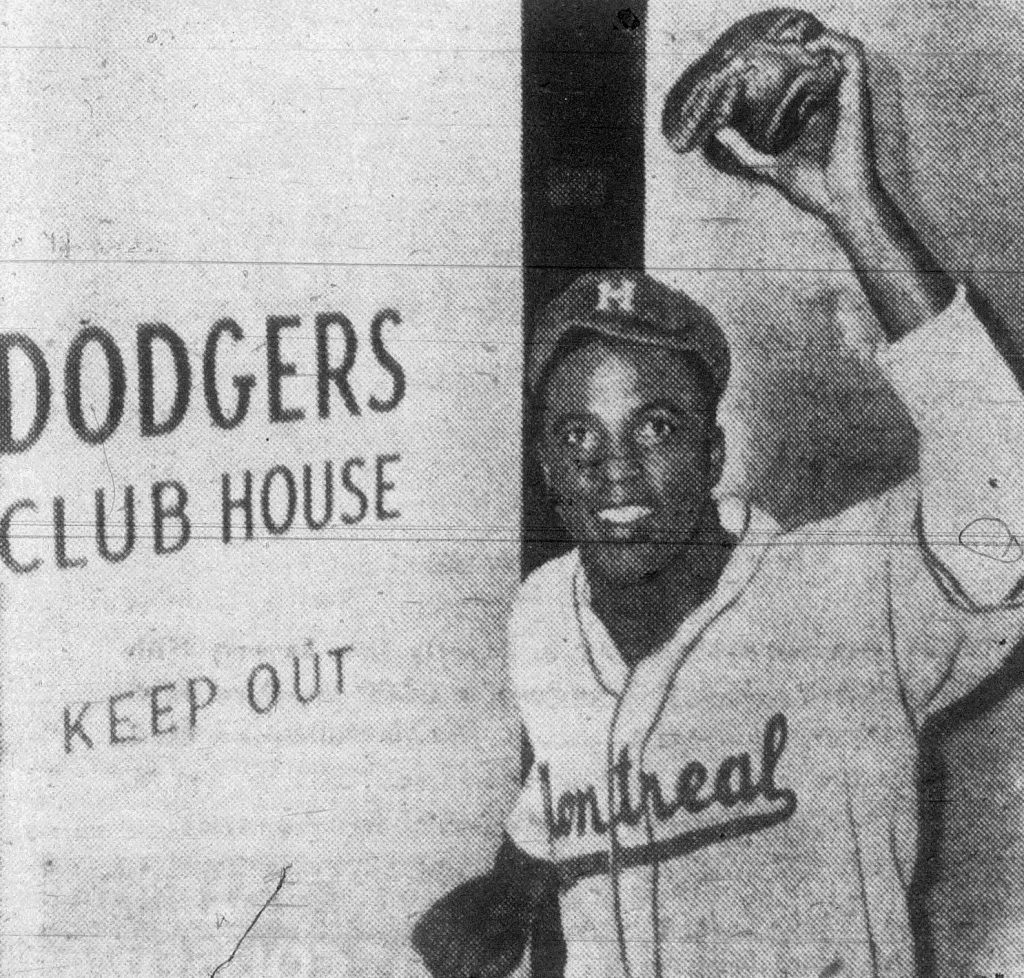
The signing was announced on October 23, 1945, with Robinson assigned to the Montreal Royals, the Dodgers’ top minor league affiliate. Starting in Montreal gave him a season to adjust in a city where he would be relatively well received.
Montreal, 1946: The Proving Ground
Robinson’s year with the Royals was a triumph. He led the International League with a .349 batting average and was named the league’s Most Valuable Player. Montreal fans embraced him, and the Royals had a dominant season. The performance made it impossible to argue he was not ready for the majors.
Spring training in 1947 was still difficult. Some Dodgers players circulated a petition opposing Robinson’s promotion. Manager Leo Durocher shut it down, making clear that a player who could help the team win would play. Days before the season opened, the Dodgers purchased Robinson’s contract from Montreal.
April 15, 1947, and the Rookie Season
Robinson debuted at Ebbets Field on April 15, 1947, playing first base, a position he had barely played before. The pressure that season was relentless. He faced racist taunting from opposing dugouts and stands, beanballs, hate mail and threats. There were reports that members of the St. Louis Cardinals discussed striking rather than taking the field against him; the National League made clear that any players who did so would be suspended.
Robinson responded as he had promised Rickey: by playing. His aggressive baserunning, in particular, unsettled opponents and thrilled crowds. He would take a big lead, dance off the bag and force pitchers and fielders into mistakes. At the end of the season he received the first Rookie of the Year award ever given by the Baseball Writers’ Association of America. At that point a single award covered both leagues. In 1987 the Rookie of the Year awards in both leagues were renamed the Jackie Robinson Award.
His success also opened the door for others. Later that same season, Larry Doby debuted with the Cleveland Indians as the first Black player in the American League. In 1948 Satchel Paige, by then 42 years old, joined Cleveland and helped the club win the World Series. Integration was slow and uneven across the majors, but the first barrier had fallen.
A Hall of Fame Career in Brooklyn
Robinson was far more than a symbol. After 1948, with the initial period of restraint behind him, he played with open competitive fire and argued with umpires and opponents like any other star. He moved primarily to second base and became one of the best all-around players in the National League.
Key achievements
- 1949 NL MVP: He led the league in batting average (.342) and stolen bases (37) and drove in a career-high 124 runs.
- Six All-Star selections: every season from 1949 through 1954.
- Six World Series: the Dodgers won six pennants in his ten seasons, and in 1955 they finally beat the New York Yankees for the franchise’s first championship.
- Steals of home: he stole home 19 times in his major league career, a signature play that captured his daring.
After the 1956 season, which ended with a Game 7 loss to the Yankees in the World Series, Robinson retired rather than accept a trade to the New York Giants. The Baseball Hall of Fame’s player page lists career totals including a .313 batting average, 141 home runs and 200 stolen bases across his 1945 season with the Monarchs and his decade in Brooklyn. He was elected to the Hall of Fame in 1962, his first year on the ballot, receiving 77.5 percent of the vote.
Number 42 and Jackie Robinson Day
Robinson remained an outspoken voice for civil rights after his playing days. He died on October 24, 1972, in Stamford, Connecticut, at age 53. His legacy has been honored in ways no other player has matched.
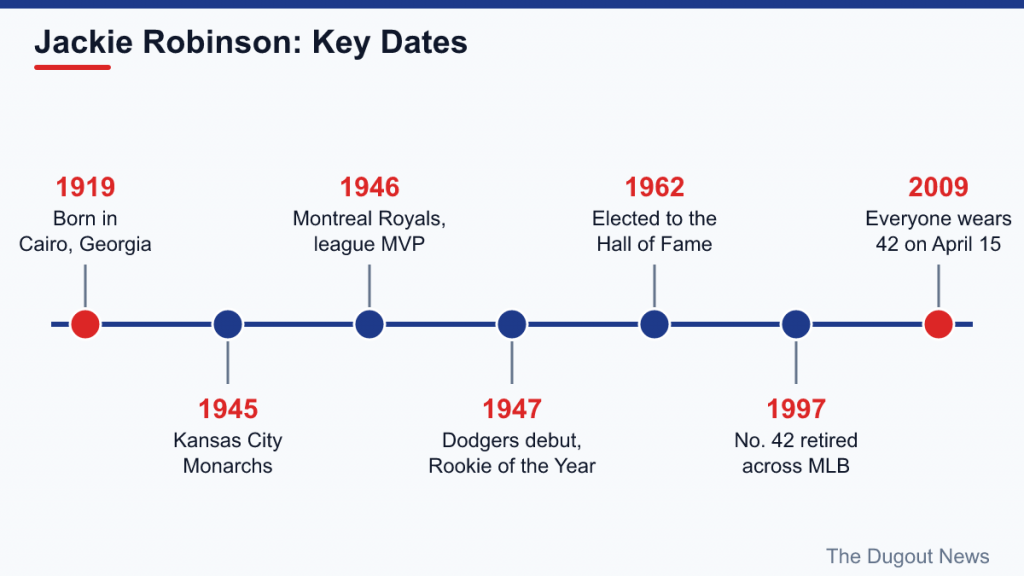
On April 15, 1997, the 50th anniversary of his debut, Major League Baseball retired number 42 across every team. It was the first time a number had been retired league-wide in one of the four major North American sports leagues. Players already wearing 42 were allowed to keep it until they changed teams or numbers. The last of them was Yankees closer Mariano Rivera, who wore it until he retired after the 2013 season.
Jackie Robinson Day began on April 15, 2004. In 2007, for the 60th anniversary, Ken Griffey Jr. asked Rachel Robinson for permission to wear 42, and MLB invited players across the league to do the same. Since 2009, every uniformed player, manager, coach and umpire has worn 42 on April 15, so the date’s games are played by entire rosters wearing the same number.
Robinson also received the nation’s two highest civilian honors after his death: the Presidential Medal of Freedom, awarded by President Ronald Reagan in 1984, and the Congressional Gold Medal, presented to his widow, Rachel Robinson, in 2005.
Common Misconceptions
- “He was the first Black major leaguer ever.” He was the first in the modern era. Moses Fleetwood Walker played openly as a Black man for the Toledo Blue Stockings of the American Association, then a major league, in 1884, before the color line hardened.
- “There was a rule banning Black players.” There was no written major league rule. The exclusion was an informal agreement enforced by owners and league officials.
- “He played second base on Opening Day 1947.” He debuted at first base. Second base became his main position later.
- “Integration happened quickly after 1947.” It did not. Some teams took more than a decade to field a Black player.
Why Robinson Still Matters
Robinson’s debut came before the 1954 Brown v. Board of Education decision and before many of the defining events of the civil rights movement. Millions of Americans watched a Black man succeed on equal terms in the national pastime, under impossible scrutiny. Dr. Martin Luther King Jr. later credited Robinson with making his own work possible.
There was a cost, too. As Black players moved into the majors, the Negro leagues lost their stars and their fans, and the leagues collapsed within a few years. In 2020 MLB formally recognized seven Negro leagues from 1920 to 1948 as major leagues, a way of acknowledging the players who never got the chance Robinson did.
When you see every player wearing 42 each April, it is a reminder of both things: how much one player changed, and how long the game took to let him.