Defensive Shifts and MLB’s Shift Restrictions Explained
Why teams shifted against pull hitters, how the shift spread, what MLB's 2023 infield positioning rule requires, its penalties and what is still legal.
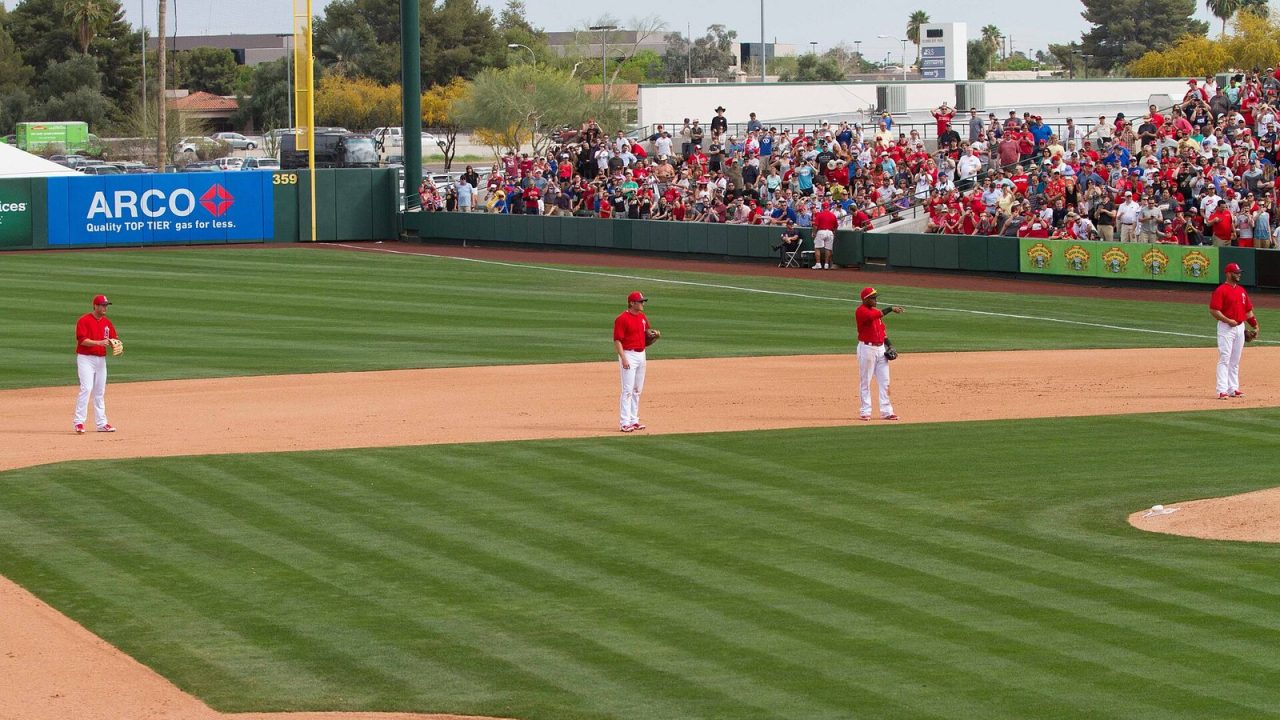
For years, one of the strangest sights in baseball was a left-handed slugger stepping to the plate while three infielders crowded the right side of the diamond, leaving a vast, empty space where the shortstop normally stood. The defensive shift turned routine singles into outs and became the symbol of baseball’s analytics era.
In 2023, Major League Baseball restricted it. This guide explains why teams shifted, how the strategy grew, exactly what the infield positioning rule requires, what happens when a team breaks it, and how much freedom defenses still have.
What Is a Defensive Shift?
A shift is any defensive alignment that moves fielders away from their standard positions to where a particular hitter is most likely to hit the ball. In the traditional alignment, the second baseman and first baseman play on the right side of second base, and the shortstop and third baseman on the left. For a refresher on those roles, see the nine baseball positions explained.
The classic, extreme shift targeted left-handed pull hitters, who hit most of their ground balls to the right side. The defense would:
- Move the shortstop to the right of second base, or the third baseman over to the shortstop’s normal spot.
- Station the second baseman in shallow right field, essentially playing a short outfielder.
- Leave the left side of the infield thin or nearly empty.
Against right-handed pull hitters, teams used mirror-image versions, though less often.
A Short History of the Shift
The shift is much older than modern analytics. It is said to have been used against Cy Williams, a left-handed slugger, in the 1920s. Its most famous early version was the “Boudreau shift,” devised by Cleveland player-manager Lou Boudreau against Boston’s Ted Williams in the 1940s. Boudreau moved most of his fielders to the right of second base, leaving only the third baseman and left fielder on the left side. Williams largely refused to change his approach, and Boudreau later described the shift as more of a psychological ploy than a tactical one.
For decades afterward, shifts were occasional, used against a handful of extreme pull hitters. That changed as teams gained access to detailed data showing exactly where each batter hit the ball. Shifts became more and more common from the late 2000s onward, and over the following decade they turned into a routine part of many teams’ defensive plans, used against far more hitters than just the most extreme sluggers.
Why Shifts Worked
The logic was simple: put fielders where the ball goes. A hard ground ball that once rolled through the right side for a single might now be fielded by a second baseman standing in shallow right field. Left-handed hitters who pulled grounders consistently saw many hits disappear.
Critics argued that the shift made the game less exciting. Fewer ground balls became hits, and some fans felt the game had become an endless cycle of strikeouts, walks and home runs with fewer balls in play producing action. Restricting the shift was a way to give some of those hits back and put more weight on infielders’ range.
The 2023 Rule: Infielder Positioning
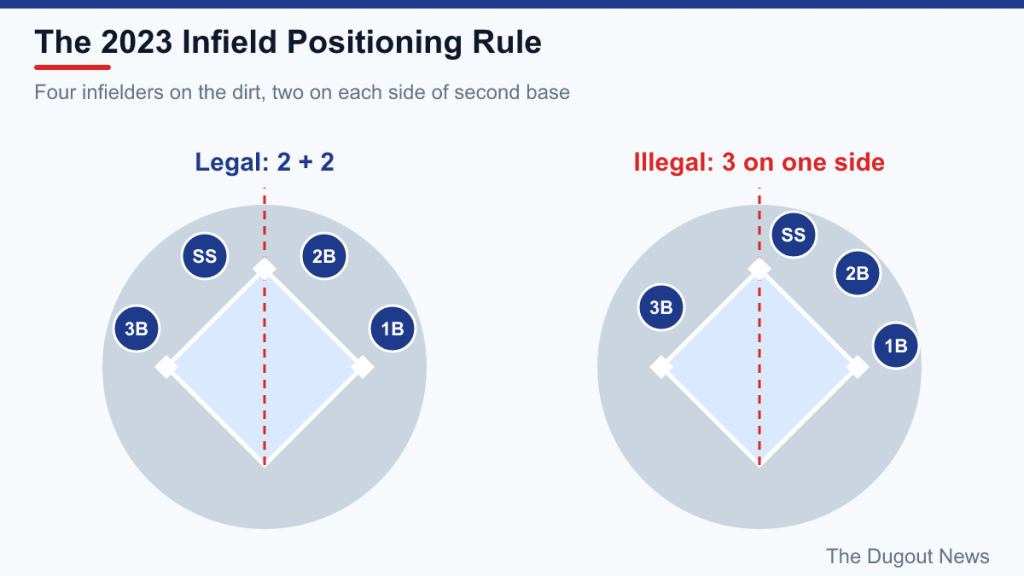
Beginning with the 2023 season, Rule 5.02(c) of the Official Baseball Rules has governed “Infielder Positioning.” It has three requirements.
1. Four Infielders on the Dirt
When the pitcher is on the rubber and begins his delivery, the defense must have at least four players, in addition to the pitcher and catcher, with both feet completely in front of the outer boundary of the infield dirt. In practice, this means four infielders cannot drift back onto the outfield grass.
2. Two on Each Side of Second Base
When the pitcher releases the pitch, at least two of those four infielders must be positioned with both feet entirely on each side of second base. Three infielders on one side is no longer allowed.
3. No Switching Sides
From the first pitch to the first batter of a half-inning, the two infielders on each side of second base may not switch sides or move to the other side of the infield for the rest of that inning. That prevents teams from flipping a fast shortstop to the right side against a left-handed pull hitter.
There is one exception: infielders may switch sides or positions when there is a substitution for a defensive player. An ordinary pitching change, in which a new pitcher not already in the game replaces the pitcher, does not open that window. Any replacement infielder is then bound by the same rule for the rest of the half-inning.
The rulebook comment explains the purpose: to prevent the defense from having more than two infielders on either side of second base “in an effort to anticipate where the batter will hit the ball prior to delivery of the pitch.” If an umpire believes a fielder is trying to get around the rule, he can assess the penalty.
The Penalty for an Illegal Alignment
The penalty depends on what happens on the play:
- If the violating infielder is the first player to touch the batted ball, the batter is awarded first base and each runner advances one base, unless the batter reached base safely and all other runners advanced at least one base anyway, in which case the play stands.
- In any other case, the pitch is called a ball and the ball is dead, unless the batter reaches first base on a hit, an error, a walk, a hit batter or otherwise and all other runners advance at least one base, in which case the play stands.
- The offense can decline the penalty. If a play such as a sacrifice fly or sacrifice bunt follows the violation, the offensive manager can tell the plate umpire immediately after the play that he prefers to take the result.
Because the manager may choose the play, umpires let action continue when they spot a violation during a play.
Scoring Effects
The scoring rules were updated too. A batter awarded first base because of a shift violation is not charged with an at-bat, a run that scores when the batter is awarded first with the bases loaded counts as a run batted in, and a runner who reaches on a shift violation cannot score an earned run.
What Defenses Can Still Do
The rule limits infield alignments, but defenses still have plenty of freedom:
- Shading within each side. A shortstop can play directly behind second base, as long as both of his feet are on his side of the bag. A second baseman can play up the middle or deep near the edge of the dirt.
- Depth on the dirt. Infielders can play in, at normal depth or back near the edge of the infield dirt.
- Outfield positioning. The rule applies to infielders only. Outfielders can still be positioned anywhere, shading heavily toward a pull side or playing deep or shallow.
- Personnel choices. Teams can still decide which infielders play on each side at the start of an inning, putting a strong-armed defender where the batter usually hits the ball.
What is no longer allowed: three infielders on one side of second base, an infielder standing on the outfield grass when the pitch is released, a four-man outfield that pulls an infielder off the dirt, or an infielder switching sides between batters within an inning.
What Happened After the Ban
The rule arrived alongside the pitch timer and bigger bases, explained in our pitch clock guide, so it is hard to isolate the effect of each change. Researchers have tried. A 2024 quasi-experimental study by statistician Lee Kennedy-Shaffer found that the shift restrictions modestly increased batting average on balls in play and on-base percentage for left-handed batters, by about nine points. The same study found that some individual hitters who had been shifted heavily gained much more, in a few cases more than 70 points in on-base metrics, while others saw little change.
In other words, the ban helped, but it did not transform offense overnight. Hitters who hit hard ground balls to the pull side benefited most; for many others, the difference was small. Meanwhile, the rule’s other goal, rewarding athletic infielders who cover ground, has been met by design: infielders now have to make plays on balls that once went straight to a shifted fielder.
How Hitters and Defenders Adjusted
For Infielders
- Range matters more. Without an extra fielder on the pull side, second basemen and shortstops must cover more ground.
- The shortstop’s role grew. With no one able to slide over from the left side, a shortstop with range and a strong arm is more valuable.
- Positioning remains data-driven. Teams still use spray charts to position fielders within the rules.
For Hitters
- Ground balls have more value. Pull hitters no longer need to lift every ball over the shift.
- Bunting against the shift is less useful. The once-popular tactic of bunting toward an empty third-base side has fewer opportunities.
Common Misconceptions
- “Shifts are completely banned.” No. Defenses can still shade and position players within the rules, and outfield shifts are untouched.
- “The infielder only has to have one foot on the dirt.” Both feet must be completely in front of the outer boundary of the infield dirt.
- “Teams can switch infielders between batters.” Not within a half-inning, unless there is a qualifying substitution.
- “A violation always means a ball.” Only if the violating infielder did not field the ball. If he did, the batter gets first base, and in either case the offense may take the play instead.
Why the Rule Matters
The infield positioning rule reflects a broader tension in modern baseball: how much should data-driven strategy be allowed to reshape the game? MLB decided that extreme shifts had gone too far and that traditional alignments produced a more watchable, more athletic sport. Whether you love or hate the change, it is now one of the rules that shapes every pitch, and every ground ball through the right side of the infield is a small reminder of it.