The MLB Pitch Clock Explained: Timers, Pickoff Limits and Bigger Bases
How MLB's pitch timer works, from the 15- and 18-second clocks and batter rules to disengagement limits, bigger bases and the effect on game length.
For most of its history, baseball proudly had no clock. That changed in 2023, when Major League Baseball introduced a pitch timer along with a package of related rules: limits on pickoff throws, larger bases and restrictions on defensive shifts. Few rule changes in the sport’s modern history have had such an immediate, visible effect. Games got shorter almost overnight, and the running game came back to life.
This guide explains how the pitch timer works, what pitchers, hitters and catchers must do, how the disengagement rule changed the battle between pitchers and baserunners, why the bases got bigger and what the numbers show about the results. (The shift restrictions get their own article later in this series.)
Why MLB Added a Clock
Game times had been creeping upward for decades. Pitchers stepped off the rubber, hitters adjusted their batting gloves after every pitch, and dead time between pitches piled up. According to figures reported by the Associated Press, the average nine-inning game in 2022 lasted 3 hours, 3 minutes and 44 seconds.
The idea of a timer was not new. The Official Baseball Rules have long contained a rule requiring a pitcher to deliver the ball within 12 seconds when the bases are empty, but that rule clearly had not stopped the slowdown. MLB also experimented extensively before adopting a clock at the top level:
- The Arizona Fall League became the first professional league to use a pitch clock, in 2014.
- A 20-second clock was introduced at Double-A and Triple-A in 2015.
- MLB used a 20-second clock in spring training games in 2019.
Those experiments, plus further testing in the minor leagues, shaped the version that arrived in the majors in 2023.
How the Pitch Timer Works
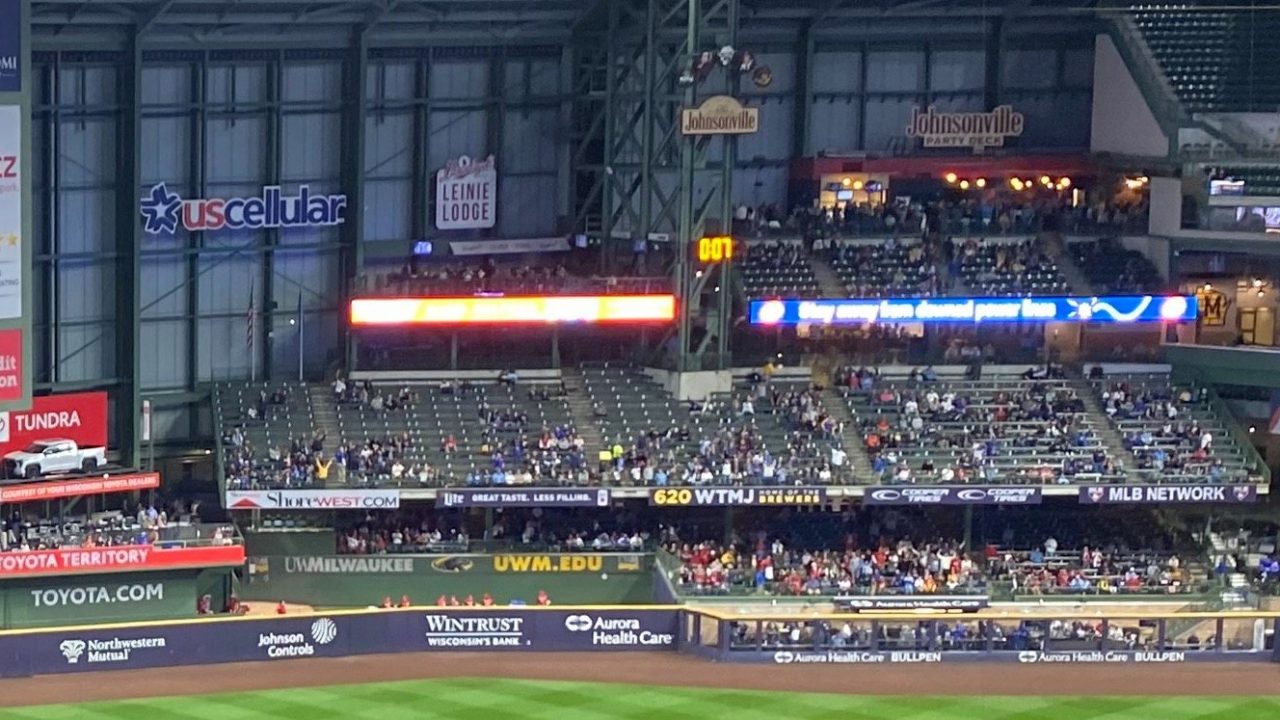
The pitch timer is displayed on clocks placed so that pitchers, hitters and umpires can all see it. The key numbers:
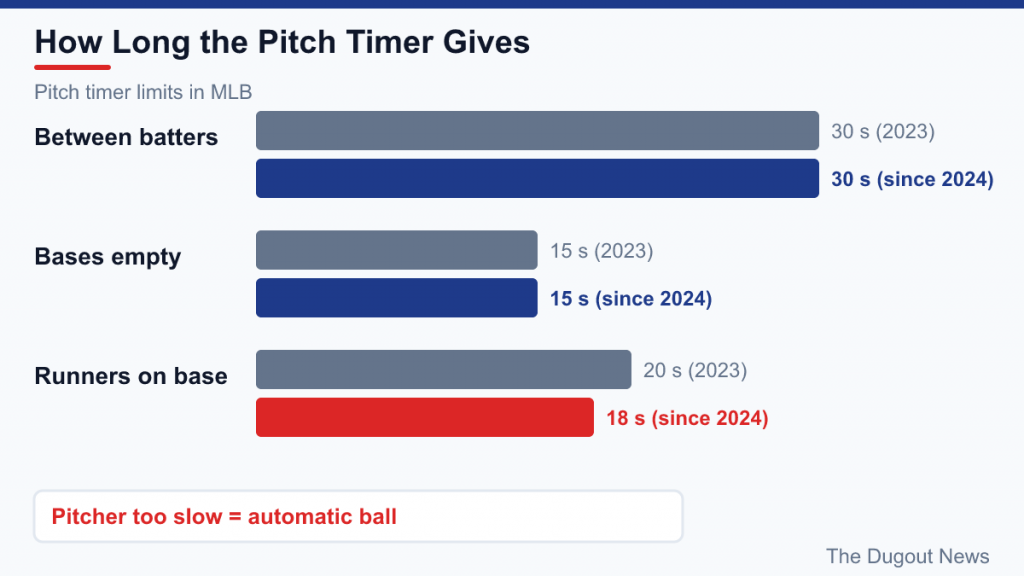
| Situation | 2023 | Since 2024 |
|---|---|---|
| Between batters | 30 seconds | 30 seconds |
| Between pitches, bases empty | 15 seconds | 15 seconds |
| Between pitches, runner(s) on base | 20 seconds | 18 seconds |
The reduction from 20 to 18 seconds with runners on base was approved in December 2023 and took effect for the 2024 season.
The pitcher must begin his motion to deliver the pitch before the timer expires. If he does not, the umpire calls an automatic ball.
The clock starts once the pitcher has the ball and the catcher and batter are ready. Umpires also have discretion to grant extra time when circumstances warrant it, so the timer is not applied blindly after unusual delays.
The Batter’s Responsibilities
The clock is not only for pitchers. The batter must be in the batter’s box and alert to the pitcher by the time the timer reaches 8 seconds. If he is not, the umpire calls an automatic strike.
That single rule ended the old habit of stepping out, adjusting gloves and stepping back in after every pitch. During the first season, MLB also issued clarifications to stop gamesmanship from both sides:
- A pitcher may not come set before the batter is alert. Umpires give a warning and then call an automatic ball for further violations.
- A batter may not try to bait a pitcher into a quick-pitch violation by stepping out of the box as the pitcher comes set. Umpires give a warning and then call an automatic strike.
Catchers can be charged with violations too, although they have been called far less often than pitchers or batters.
Violation Counts
Players adjusted quickly. According to figures compiled on Wikipedia from MLB data, there were 1,048 pitch timer violations in 2023 (747 by pitchers, 286 by hitters and 15 by catchers) and 602 in 2024 (465 by pitchers, 133 by batters and 4 by catchers), even with the shorter runners-on timer in 2024.
Disengagements: The Pickoff Limit
A pitch timer alone would have had a loophole. With runners on base, a pitcher could reset the clock indefinitely by stepping off the rubber or throwing over to first. MLB closed that loophole with a disengagement limit.
A disengagement is a pickoff attempt, a fake pickoff, or stepping off the rubber. The rules work like this:
- A pitcher gets two disengagements per plate appearance without penalty. Each one resets the timer.
- The count resets if a runner advances during the plate appearance.
- Mound visits, injury timeouts and offensive timeouts do not count as disengagements.
- A third disengagement is allowed, but if the pitcher does not pick off the runner on that attempt, it is a balk and every runner advances one base.
The effect is subtle but powerful. After two pickoff throws, a runner knows the pitcher is unlikely to throw over again unless he is very confident of getting the out. That lets the runner take a bigger lead, which is a major reason stolen base attempts rose so sharply.
Mound Visits
The 2023 rules also addressed mound visits within the framework of the timer. Each team has a limited number of mound visits per game; if a team has used all five of its visits before the ninth inning, it receives one extra visit in the ninth.
Bigger Bases
Also new in 2023: first, second and third base grew from 15 inches square to 18 inches square. The current Official Baseball Rules specify bags 18 inches square, between three and five inches thick.
The change is usually discussed for two effects:
- More room around the bag. A bigger base gives the fielder and the runner more space at the moment they arrive together, a frequent spot for tangled feet, particularly at first base.
- A small boost to the running game. Because the bases are bigger, the gap a runner must cover between first and second, and between second and third, shrank by a few inches. A few inches matter on close stolen base attempts.
What Happened: Game Length and Stolen Bases
The results showed up immediately. Through the first 400 games of 2023, games were about 30 minutes shorter than the first 400 games of 2022.
By the end of the season, according to final figures reported by the Associated Press, the average nine-inning game had dropped to 2 hours, 39 minutes and 49 seconds, down about 24 minutes from 2022 and the lowest average since 1985. The AP also reported that only nine games lasted three and a half hours or longer in 2023, compared with 390 in 2021. Postseason games in 2023 were 21 minutes shorter on average than in 2022.
The running game changed just as dramatically. The AP reported a record stolen base success rate of 80.2 percent in 2023, along with a significant increase in steals and attempts per game. Two players topped 65 steals that season: Ronald Acuña Jr. led the National League with 73 and Esteury Ruiz led the American League with 67, an AL rookie record. Acuña also became the first player with 40 home runs and 70 stolen bases in a season.
Several forces combined to revive base stealing: the disengagement limit, which made pitchers reluctant to throw over; the pitch timer, which gave pitchers less time to vary their rhythm and hold runners; and the bigger bases, which shortened the distance slightly.
How the Clock Changed Strategy
For Pitchers
- Tempo matters. Pitchers who once took long breaks between pitches had to speed up. Many now use the full clock deliberately, while others work quickly to keep hitters off balance.
- PitchCom is essential. The electronic signaling system, approved in 2022, lets catchers send signs instantly, which helps batteries avoid wasting time on complicated sign sequences.
- Holding runners is harder. With only two free disengagements, pitchers vary their timing by holding the ball in the set position or using slide steps rather than throwing over repeatedly.
For Hitters
- Routines got shorter. Hitters can no longer step out and reset after every pitch.
- Be ready by eight. A hitter who is not set and alert by the 8-second mark gives away a free strike, which can flip a count.
For Baserunners
- Count the disengagements. Smart runners and base coaches track how many disengagements a pitcher has used. After two, the runner can lengthen his lead.
- Steal more, and earlier. Teams that had largely abandoned the stolen base found it worthwhile again.
Common Misconceptions
- “The clock runs during the whole game.” No. The timer runs between pitches and between batters. It stops when the pitcher starts his motion and resets for each pitch.
- “A pitcher can only throw to first twice.” Not quite. He can attempt a third pickoff, but if it fails, it is a balk.
- “Stepping off doesn’t count.” It does. Stepping off the rubber is a disengagement, just like a pickoff throw.
- “Violations end the at-bat.” They do not. A pitcher’s violation adds a ball to the count; a hitter’s adds a strike. Either can end a plate appearance only if it produces ball four or strike three.
- “The clock is the same with runners on.” No. Since 2024, it is 15 seconds with the bases empty and 18 with runners on.
The Bigger Picture
The 2023 rule package was arguably the biggest set of on-field changes in decades, alongside the universal designated hitter that arrived in 2022. The goal was not just shorter games but more action: more balls in play, more stolen bases and fewer long pauses. The clock now shapes how pitchers work, how hitters prepare and how runners take their leads.
If you want to see the effect for yourself, look at the time of game listed at the bottom of a modern box score. Our guide to reading a baseball box score explains where to find it, and our overview of how the MLB season works covers the rest of the calendar the clock now governs.