How to Read a Baseball Box Score, Line by Line
A line-by-line guide to the baseball box score: the line score, batting and pitching lines, the notes section and pitcher decisions like W, L and S.
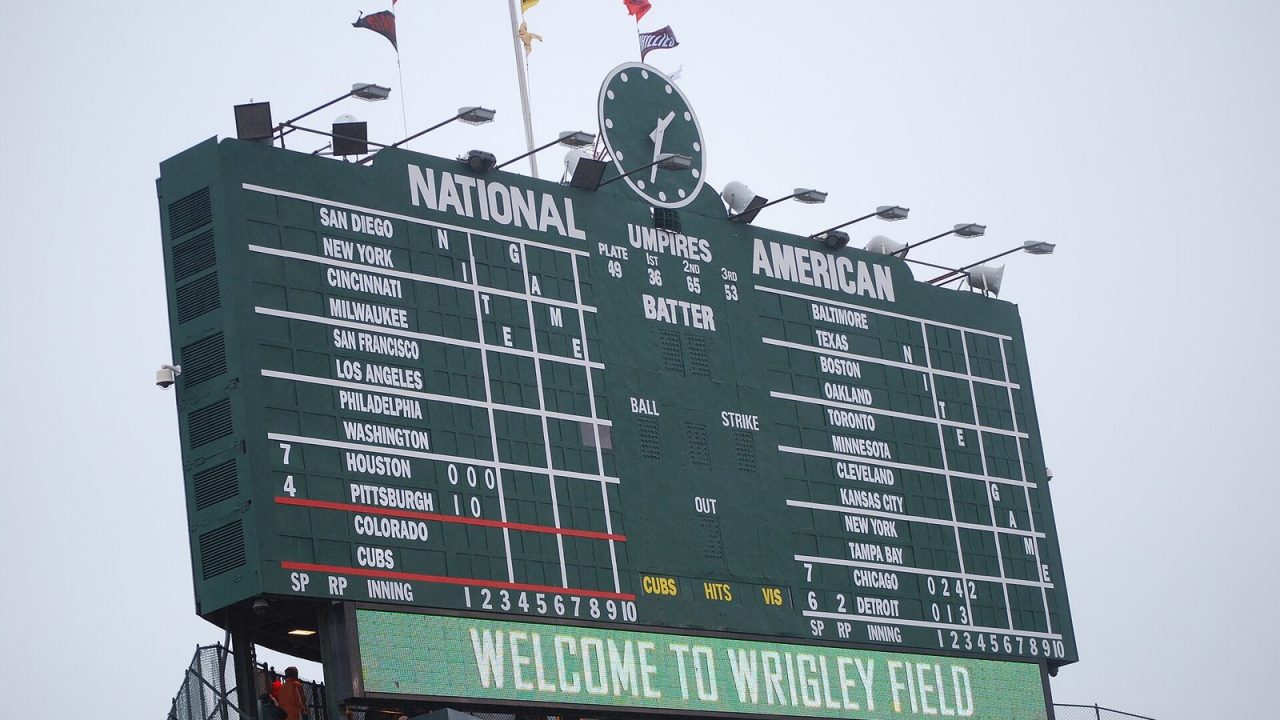
A box score is baseball’s most efficient storytelling device. In a block of numbers no bigger than a paperback page, it tells you who played, who hit, who pitched, how the runs scored and how long the game took. Fans have been reading them over breakfast for more than a century and a half; the Baseball Hall of Fame credits the pioneering writer Henry Chadwick with creating the box score in 1858.
The format can look like a wall of abbreviations at first. This guide walks through each part in the order you usually meet it, using a made-up example game between two generic teams so the numbers stay simple. Nothing here comes from a real game.
The Line Score: The Game at a Glance
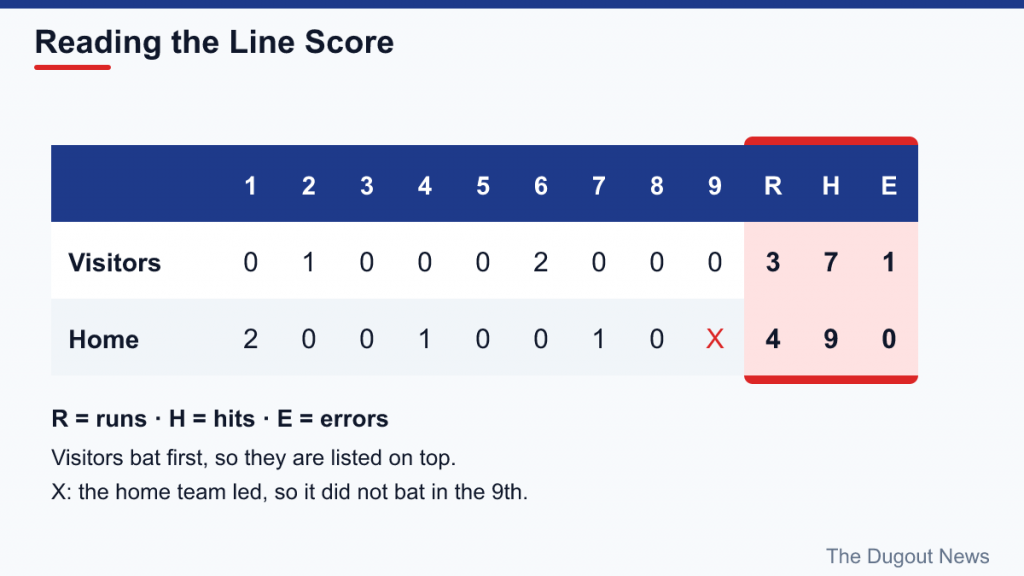
Most box scores open with the line score, a two-row chart that shows runs inning by inning. The visiting team is always on top, because it bats first, and the home team is underneath.
| Team | 1 | 2 | 3 | 4 | 5 | 6 | 7 | 8 | 9 | R | H | E |
|---|---|---|---|---|---|---|---|---|---|---|---|---|
| Visitors | 0 | 1 | 0 | 0 | 0 | 2 | 0 | 0 | 0 | 3 | 7 | 1 |
| Home | 2 | 0 | 0 | 1 | 0 | 0 | 1 | 0 | X | 4 | 9 | 0 |
The three columns on the right are the headline: R for runs, H for hits and E for errors committed by that team’s fielders. In this example the home team won 4–3 on nine hits without an error.
Notice the X in the bottom of the ninth. The home team was already ahead after the visitors batted in the top of the ninth, so it never needed to bat again. If the home team scores the winning run in its final turn at bat (a walk-off), the official score report also records how many outs there were when the winning run scored, and many box scores print that as a note such as “two outs when winning run scored.” For a refresher on why the home team skips its last at-bat, see our baseball rules for beginners guide.
The line score already tells a story: an early home lead, a two-run sixth that let the visitors tie it, and a go-ahead run for the home team in the seventh.
The Batting Lines
Next come the batting tables, visitors first. Each team’s hitters are listed in batting order with their position, followed by a row of numbers. The classic columns are:
- AB (at-bats): official times at bat. This is not the same as plate appearances. Under the Official Baseball Rules, a batter is not charged with an at-bat for a sacrifice bunt, a sacrifice fly, a walk, being hit by a pitch, or being awarded first base because of interference, obstruction or a shift-restriction violation.
- R (runs): times the player crossed home plate.
- H (hits): safe hits of any kind.
- RBI (runs batted in): runs that scored because of the batter’s action, such as a hit, sacrifice, productive out or a bases-loaded walk.
- BB (bases on balls): walks.
- SO or K (strikeouts).
Many modern box scores add LOB (runners the batter left on base) and a running season batting average (AVG) for each player. Here is a short excerpt from our invented home team:
| Batter | AB | R | H | RBI | BB | SO |
|---|---|---|---|---|---|---|
| Leadoff, CF | 4 | 1 | 2 | 0 | 1 | 0 |
| Second hitter, SS | 5 | 1 | 1 | 1 | 0 | 2 |
| Cleanup, DH | 3 | 1 | 2 | 2 | 1 | 0 |
| a-Pinch hitter, PH | 1 | 0 | 0 | 0 | 0 | 1 |
The leadoff hitter came to the plate five times but has only four at-bats, because his walk does not count as an at-bat. The cleanup hitter drove in two runs with two hits. The small letter “a” before the pinch hitter points to a footnote, which is explained below.
Positions use standard abbreviations: C, 1B, 2B, 3B, SS, LF, CF, RF, P and DH, plus PH for pinch hitter and PR for pinch runner. A player who changed positions during the game is listed with both, for example “LF-RF.” If you need a refresher on who does what, see the nine baseball positions explained.
Substitutes are indented under the player they replaced. The Official Baseball Rules recommend marking substitute batters with lowercase letters and substitute runners with numbers, explained in footnotes such as “a-struck out for the catcher in the 8th.”
The Notes Section: Extra-Base Hits and More
Under each batting table is a compact list of details that do not fit in the columns. The most common items:
- 2B, 3B, HR: doubles, triples and home runs, usually with the player’s season total in parentheses and, for homers, the inning, the pitcher and the number of runners on base.
- TB: total bases (a single counts one, a double two, and so on).
- RBI: each player’s RBI with season totals.
- SF and S (or SH): sacrifice flies and sacrifice bunts.
- GIDP (or GDP): grounded into a double play.
- SB and CS: stolen bases and caught stealing.
- HBP: hit by pitch.
- E: errors, with the fielder and often the type, such as “E: Shortstop (throwing).”
- DP: double plays turned by the defense, often with the fielders involved, such as “6-4-3.”
- Team LOB: the number of runners the team stranded.
The “6-4-3” style uses the scoring numbers for positions: 1 is the pitcher, 2 the catcher, 3 the first baseman, 4 the second baseman, 5 the third baseman, 6 the shortstop, 7 the left fielder, 8 the center fielder and 9 the right fielder. A 6-4-3 double play went shortstop to second baseman to first baseman.
What “Left on Base” Really Counts
Team LOB includes every runner who reached base and neither scored nor was put out. According to the scoring rules, it also includes a batter-runner whose batted ball led to another runner being retired for the third out. Individual LOB numbers, shown next to a batter’s name, count something different: the runners stranded when that batter made an out. Because of that, individual LOB figures do not add up to the team total.
The Pitching Lines
Below the batting tables come each team’s pitchers in the order they appeared. The standard columns:
- IP (innings pitched)
- H (hits allowed)
- R (runs allowed)
- ER (earned runs allowed)
- BB (walks)
- SO (strikeouts)
- HR (home runs allowed)
Many outlets also add pitch counts and season ERA.
| Pitcher | IP | H | R | ER | BB | SO | HR |
|---|---|---|---|---|---|---|---|
| Starter (W) | 6.0 | 5 | 3 | 2 | 2 | 7 | 1 |
| Reliever A (H) | 1.2 | 1 | 0 | 0 | 1 | 2 | 0 |
| Reliever B (H) | 0.1 | 0 | 0 | 0 | 0 | 1 | 0 |
| Closer (S) | 1.0 | 1 | 0 | 0 | 0 | 1 | 0 |
Reading Innings Pitched
The decimal in IP is not a decimal at all. Each out is one-third of an inning, so “1.2” means one inning and two outs (1⅔ innings) and “0.1” means one out. The official scoring rules spell this out: a starter pulled with one out in the sixth is credited with 5⅓ innings. In our example, the four pitchers combined for 6 + 1⅔ + ⅓ + 1 = 9 innings, exactly as many as the home team spent on defense.
Runs vs. Earned Runs
Notice that the starter allowed three runs but only two were earned. That gap almost always means an error or passed ball was involved. The official scorer reconstructs the inning as if the misplay had not happened and charges the pitcher only with runs that would have scored anyway. In our invented game the home team made no errors, so the culprit would be a passed ball by the home catcher, listed in the game notes. Earned runs, not total runs, are what feed a pitcher’s ERA.
Pitcher Decisions: W, L, S, H and BS
Letters in parentheses next to pitchers’ names show the decisions:
- W (win): generally the pitcher who was in the game (or was removed during the half-inning) when his team took a lead it never gave up. A starter must complete at least five innings in a game of six or more innings to earn the win; otherwise the scorer credits a reliever.
- L (loss): the pitcher responsible for the run that gave the winning team a lead it never surrendered.
- S or SV (save): credited to the pitcher who finishes a win without earning the win, records at least one out, and either enters with a lead of three runs or fewer and pitches at least an inning, enters with the potential tying run on base, at bat or on deck, or pitches at least three innings.
- H or HLD (hold): a statistic widely shown in box scores for relievers who protect a save situation and leave without giving up the lead. It is not one of the decisions the Official Baseball Rules require the scorer to report.
- BS (blown save): a reliever who enters in a save situation and lets the lead slip away.
Decisions are usually followed by season records, such as “(W, 8-4)” or “(S, 21).” A pitcher can receive a blown save and still pick up the win if his team retakes the lead while he is the pitcher of record.
The Game Notes at the Bottom
The final block holds details that apply to the whole game:
- WP and PB: wild pitches and passed balls.
- HBP: who hit whom, for example “by Reliever A (Second hitter).”
- Balk: pitchers charged with balks.
- Pitches-strikes: pitch counts for each pitcher.
- Batters faced: useful when a pitcher left without recording an out in an inning.
- Umpires (plate umpire first), T (time of game, weather delays subtracted) and Att (attendance).
How to Check That a Box Score Adds Up
The Official Baseball Rules include a test called “proving” a box score. A box balances when a team’s at-bats, walks, hit batters, sacrifice bunts, sacrifice flies and batters awarded first base on interference, obstruction or shift violations add up to the same number as that team’s runs, plus runners left on base, plus the opposing team’s putouts.
The logic is simple: every batter who comes to the plate must end up in one of three places. He scores, he is left on base, or he is put out. If those totals do not match, there is a mistake somewhere. Few fans prove box scores today, but trying it once is a great way to understand how every column connects.
Common Box Score Mistakes and Questions
- “Why doesn’t AB match the number of times he batted?” Walks, hit-by-pitches, sacrifices and interference awards are plate appearances but not at-bats.
- “Why is a hitter credited with an RBI on an out?” RBIs are credited on productive outs such as a groundout that scores a runner from third. They are not credited when a batter grounds into a force double play.
- “Why did a pitcher allow runs that were not his fault?” Runners who reach base against a pitcher stay his responsibility even after he leaves. If a reliever allows them to score, the runs are charged to the pitcher who put them on base.
Putting It Together
Read a box score from top to bottom and you can retell the game. The line score shows when the runs came. The batting lines and notes show who produced them, and with what kind of hits. The pitching lines show how deep the starter went, how the bullpen held up and who earned each decision. The final notes add the context: the time, the crowd and the umpires.