Baseball Rules for Beginners: How the Game Actually Works
New to baseball? Learn how innings, outs, balls and strikes, fair and foul balls, force outs and scoring really work, explained step by step.

Baseball has a reputation for being complicated, and the official rulebook does run to well over a hundred pages. But the core of the game is simple enough to explain in one sitting. One team tries to score runs by hitting a ball and running around four bases. The other team tries to stop them by getting three outs. Everything else, from the strike zone to the infield fly rule, is a refinement of that basic contest.
This guide walks through the game the way a newcomer actually experiences it: what you see on the field, how a half-inning unfolds, how runs score and how a game ends. The rules described here follow the Official Baseball Rules used by Major League Baseball. Youth leagues, high school and college play use slightly different rulebooks, but the fundamentals are the same everywhere.
The Field: Diamond, Infield and Outfield
A baseball field is built around a square of four bases set 90 feet apart in MLB. Because the square is tilted so one corner points at the batter, it looks like a diamond, which is where the nickname comes from. Going counterclockwise from home plate, the bases are first, second and third, and then back to home.
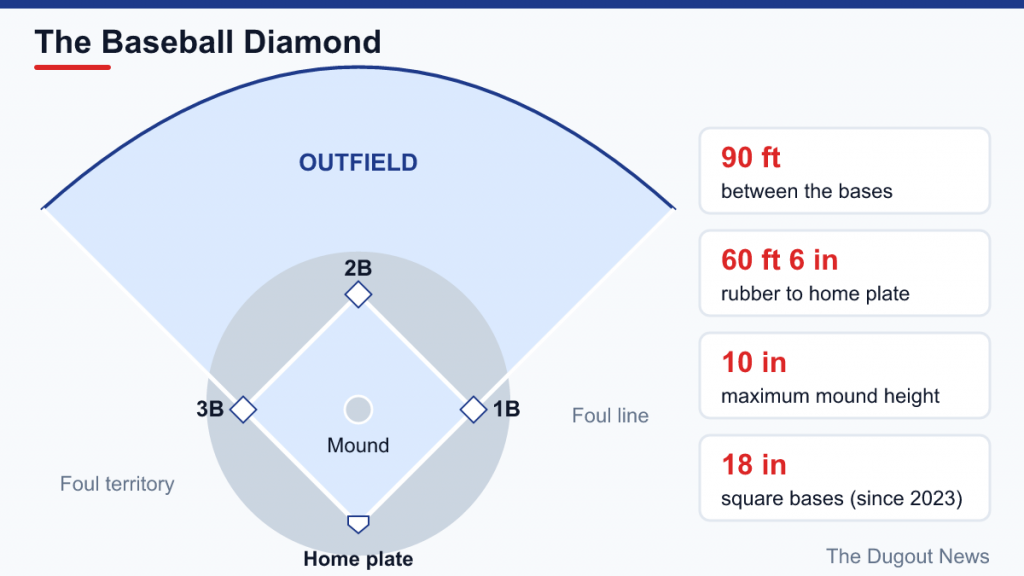
In the middle of the diamond sits the pitcher’s mound. The front edge of the pitcher’s rubber is 60 feet, 6 inches from the back point of home plate, and in the major leagues the mound can be no higher than 10 inches. Since 2023, MLB bases have been 18 inches square, slightly larger than the 15-inch bases still used in many amateur rulebooks.
The area inside and just around the bases, mostly dirt, is the infield. The large grass area beyond it is the outfield, which ends at the outfield wall. Two white lines run from home plate past first and third base all the way to the wall. These are the foul lines, and the territory between them is fair territory. Everything outside them is foul territory. Outfield fence distances are not standardized, so every ballpark plays a little differently.
Innings, Outs and the Flow of a Game
A regulation MLB game lasts nine innings. Each inning is split into two halves. In the top half, the visiting team bats while the home team plays defense. In the bottom half, the teams switch. A half-inning ends when the defense records three outs, no matter how many runs have scored.
This structure has an important consequence: there is no game clock. A half-inning can take three pitches or forty minutes. The pitch clock introduced in 2023 limits the time between pitches, but the only way to end an inning is to get three outs.
The defense always has nine players on the field: a pitcher, a catcher, four infielders (first baseman, second baseman, shortstop and third baseman) and three outfielders (left, center and right). The batting team sends one hitter at a time to the plate in a fixed batting order, or lineup. Once the ninth hitter bats, the order loops back to the top. Since 2022, both MLB leagues use a designated hitter, a player who bats in place of the pitcher and does not play the field.
Balls, Strikes and the Count
Every plate appearance is a duel between pitcher and batter. The umpire behind the plate judges each pitch the batter does not hit into play.
A strike is recorded when the batter swings and misses, when the batter takes a pitch that passes through the strike zone, or when the batter hits a foul ball with fewer than two strikes. The strike zone is the area over home plate between roughly the midpoint of the batter’s torso and the hollow just below the kneecap. A ball is a pitch outside the zone that the batter does not swing at.
The number of balls and strikes is called the count, always given balls first. A “2-1 count” means two balls and one strike. Two outcomes end a plate appearance based on the count alone:
- Three strikes and the batter is out on a strikeout.
- Four balls and the batter is awarded first base on a walk (officially a “base on balls”).
One wrinkle confuses many beginners: with two strikes, a foul ball does not count as a third strike. The batter can keep fouling off pitches indefinitely. The exceptions are a foul bunt with two strikes, which is a strikeout, and a caught foul tip, a batted ball that goes sharply and directly into the catcher’s glove. A foul tip counts as a strike and can be strike three.
Fair Balls, Foul Balls and Batted-Ball Outs
When the batter hits the ball, the first question is whether it is fair or foul. In simple terms, a ball is fair if it lands in fair territory beyond first or third base, is in fair territory as it passes those bases, or settles or is touched in fair territory between home and those bases. The foul lines themselves are fair, and so are the foul poles. A fly ball that hits the foul pole is a home run.
A foul ball is dead unless a fielder catches it in the air. A caught foul fly is an out, just like a caught fair fly. Runners on base may try to advance after any caught fly ball, but only after they “tag up,” meaning they touch their original base after the catch.
On a fair ball, the batter becomes a runner and must race to first base. The defense has several ways to get outs:
- Fly out or line out: a fielder catches the ball before it touches the ground.
- Ground out: a fielder fields a grounder and throws to first, where a teammate touches the base while holding the ball before the runner arrives.
- Tag out: a fielder holding the ball touches a runner who is not on a base.
- Force out: a fielder touches a base with the ball before a runner who is required to advance to it gets there.
Force Outs Versus Tag Plays
The difference between a force play and a tag play explains why fielders sometimes step on a base and sometimes chase a runner.
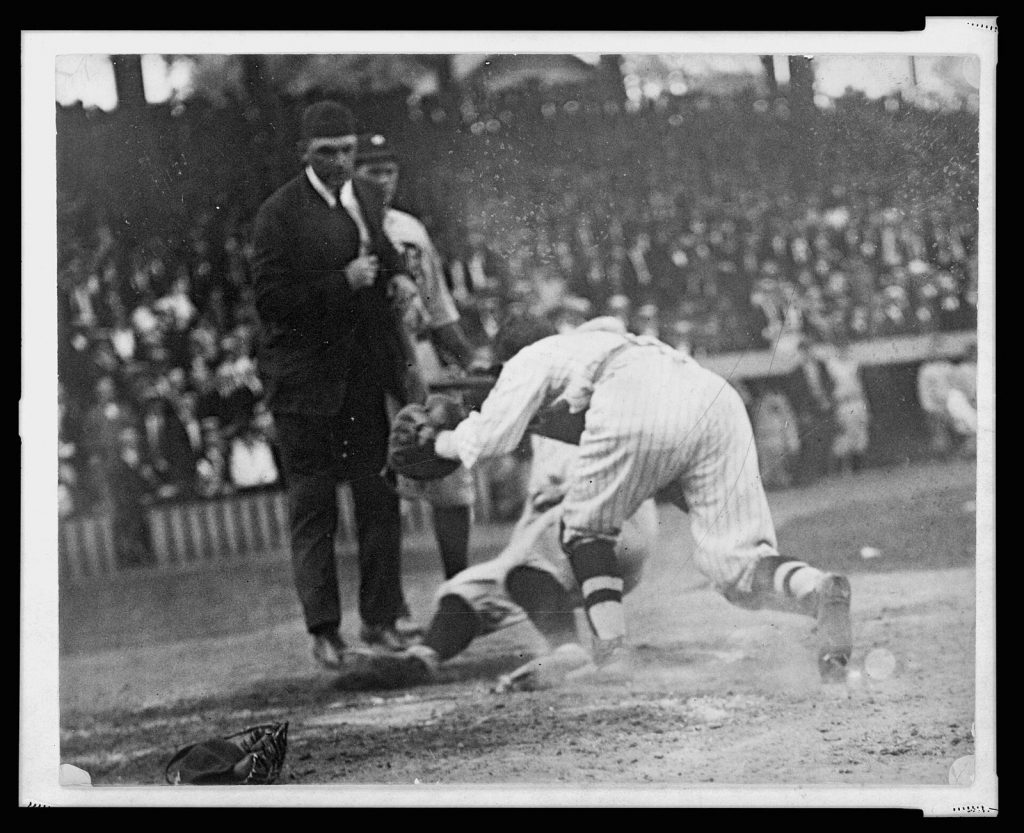
A runner is forced to advance when the batter becomes a runner and the runner’s base is needed. With a runner on first and a ground ball, the batter must go to first, so the runner on first must leave for second. The defense can retire that runner simply by touching second base with the ball. With runners on first and second, both are forced. With the bases loaded, every runner is forced, and the defense can get an out at any base, including home.
If a runner is not forced, such as a runner on second with first base empty, the defense must tag him with the ball. That is why a ground ball with only a runner on second usually produces a throw to first: the runner can stay put or advance at his own risk.
A double play is two outs on one play. The classic version is a grounder to the shortstop with a runner on first: the shortstop throws to the second baseman covering second for one force out, and the second baseman relays to first for another. Double plays are rally killers, and teams position their infielders to turn them.
The Most Common Ways to Reach Base
Outs are the currency of baseball, and getting on base without making one is the batter’s main job. These are the most common ways it happens:
- Single, double, triple: hits on which the batter safely reaches first, second or third base.
- Home run: the batter circles all four bases, usually by hitting the ball over the fence in fair territory.
- Walk: four balls before three strikes.
- Hit by pitch: the batter is struck by a pitch and awarded first base, provided he did not swing and did not simply lean into it.
- Error: a fielder misplays a ball that, in the official scorer’s judgment, should have produced an out.
- Fielder’s choice: the defense chooses to retire a different runner, so the batter reaches first without being credited with a hit.
There are rarer routes too, such as catcher’s interference, or the dropped third strike: if the catcher fails to catch strike three cleanly and first base is open (or there are two outs), the batter may run to first. The pitcher still gets credit for a strikeout.
How Runs Score
A run scores when a runner legally touches first, second, third and home, in that order, before the third out of the inning. Runners can advance on hits, walks that force them along, stolen bases, wild pitches, passed balls, balks, errors and sacrifices.
The timing of the third out matters. If the third out is a force out, or the batter is put out before reaching first, no run can score on that play even if a runner crossed the plate first. If the third out is a tag play on a different runner, a run counts if the scoring runner touched home before the tag.
A sacrifice fly is a caught fly ball that lets a runner on third tag up and score. A sacrifice bunt deliberately gives up an out to move a runner forward. Neither counts as an at-bat, so neither hurts the batter’s batting average.
Runners can also move up on their own. A stolen base happens when a runner advances while the pitcher delivers, without the help of a hit or error. Pitchers try to keep runners close by throwing over to the base, but since 2023 MLB has limited pitchers to two “disengagements” (pickoff attempts or step-offs) per plate appearance, which has made stealing more common again.
How a Baseball Game Ends
The team with more runs after nine innings wins. If the home team already leads after the top of the ninth, the bottom of the ninth is not played. In a box score, this is marked with an “X” in the home team’s ninth-inning slot.
If the home team takes the lead in the bottom of the ninth or any extra inning, the game ends immediately. This is a walk-off, named because the losing team simply walks off the field. On a walk-off hit, the batter generally gets credit only for as many bases as needed to bring home the winning run, except on a home run over the fence, where everyone scores.
If the score is tied after nine innings, the game goes to extra innings until one team leads at the end of a complete inning. In the MLB regular season, each extra half-inning begins with a runner placed on second base, a rule introduced in 2020 and made permanent in 2023. The postseason does not use the automatic runner. A game shortened by weather becomes official once five innings are completed, or four and a half if the home team leads.
When you watch, track just three things: outs, the count and which bases are occupied. Those explain almost every decision on the field, and broadcasts show all three in the small diamond graphic in the corner of the screen.