How the MLB Draft Works: Draft Lottery, Rounds and Bonus Pools
Who is eligible for the MLB Draft, how the draft lottery sets the top picks, how many rounds there are, and how slot values and bonus pools work.
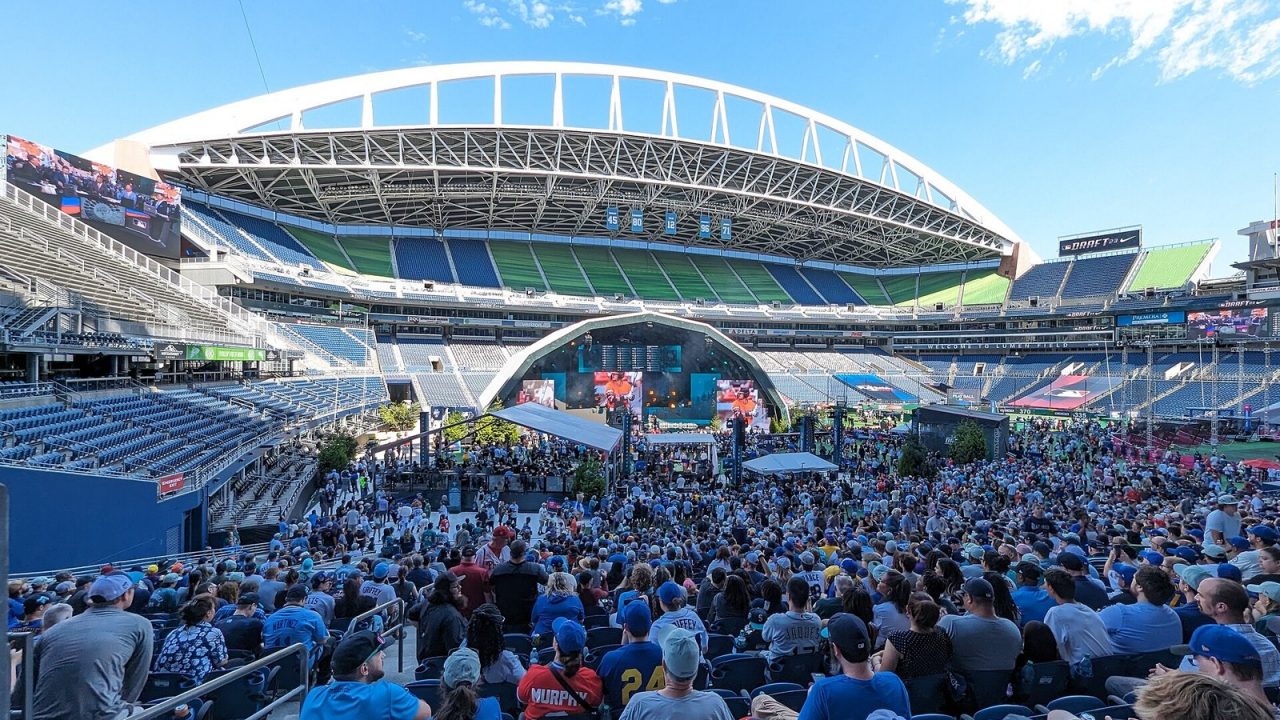
Every summer, Major League Baseball’s 30 clubs select hundreds of amateur players in the First-Year Player Draft. Unlike the NFL or NBA drafts, where top picks often step straight into the starting lineup, almost every MLB draftee begins in the minor leagues, and many never reach the majors. Even so, the draft is the main pipeline of young talent into professional baseball.
The MLB draft has its own unusual features: it includes high school players as well as college players, it uses a lottery to set the top picks, and it limits what teams can spend through a system of slot values and bonus pools. This guide explains how all of it works.
A Brief History
Before 1965, amateur players were free to sign with any team, and wealthy clubs could outbid everyone else for top prospects. The first draft was held June 8–9, 1965, in New York City. With the first overall pick, the Kansas City Athletics selected Rick Monday, an outfielder from Arizona State.
The draft has grown and shrunk over the years:
- Through 2011, it could run up to 50 rounds, with more than 1,500 players selected.
- From 2012 through 2019, it was capped at 40 rounds.
- In 2020, an agreement between MLB and the players’ union during the pandemic shortened it to just five rounds.
- Since 2021, it has been 20 rounds, a format ratified in the 2022 collective bargaining agreement.
Since 2021, the draft has been held in July during All-Star week, rather than in early June as it was for decades.
Who Is Eligible?
To be drafted, a player must be a resident of, or attend school in, the United States, Canada or a U.S. territory such as Puerto Rico, and he must never have signed a professional contract. Beyond that, eligibility depends on where he plays:
| Player type | When eligible |
|---|---|
| High school | After graduation, as long as he has not attended college |
| Four-year college | Three years after first enrolling, or at age 21, whichever comes first |
| Junior or community college | At any time |
The college rule is why most four-year college players are drafted after their junior year. It also creates a strategic choice for high school stars: sign out of high school, or go to a four-year college knowing they cannot be drafted again for three years. Junior colleges offer a middle path, since players there can be drafted every year.
Players from other countries, such as the Dominican Republic, Venezuela or Japan, are not part of the draft. They sign with clubs through the separate international amateur signing system.
The Draft Lottery
For most of its history, the draft order was simply the reverse of the previous season’s standings. That gave the worst team the top pick and, critics argued, rewarded teams for losing. The 2022 collective bargaining agreement introduced a draft lottery, first used for the 2023 draft.
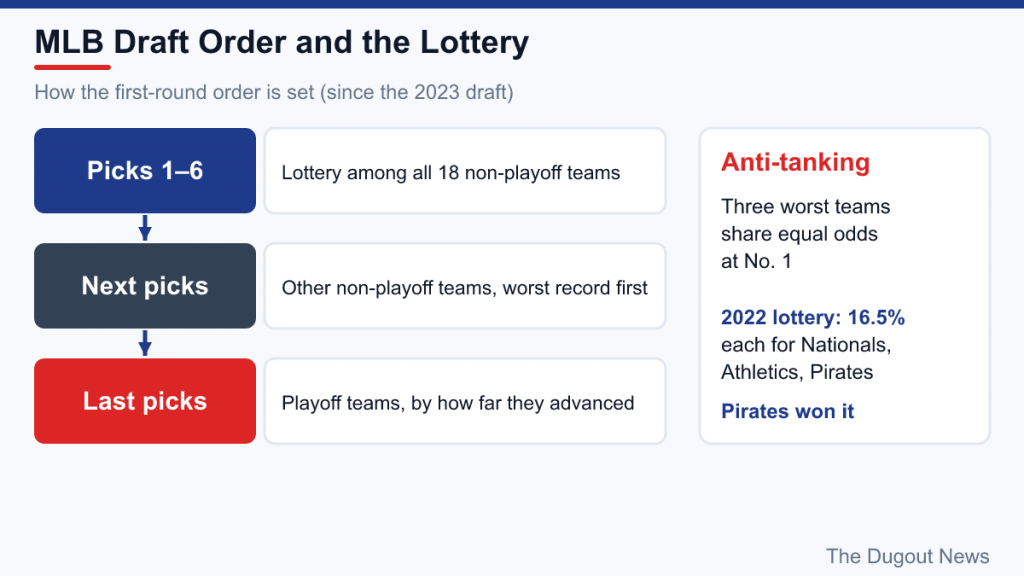
How It Works
- All 18 teams that missed the postseason are entered into a lottery for the first six picks.
- Odds are weighted by record, but the three worst teams have equal odds at the No. 1 pick. That removes the incentive to finish dead last instead of third-worst.
- After the six lottery picks, the remaining non-playoff teams pick in reverse order of their records.
- Postseason teams follow, ordered by how far they advanced in the playoffs, with revenue-sharing status and record as further factors.
Anti-Tanking Limits
To stop teams from losing year after year for high picks, the lottery has eligibility limits. A club that receives revenue-sharing money cannot get a lottery pick in more than two consecutive drafts, and clubs that pay into revenue sharing face a stricter limit. A non-playoff team that is ineligible for the lottery can pick no earlier than 10th overall.
The First Lottery
The first lottery was held on December 6, 2022, in San Diego. The Washington Nationals, Oakland Athletics and Pittsburgh Pirates each had a 16.5 percent chance at the top pick. Pittsburgh won it and used the pick on pitcher Paul Skenes in the 2023 draft.
For more on how the season and postseason that determine this order work, see our guides to how the MLB season works and the MLB postseason format.
Rounds and Extra Picks
The 20 standard rounds are supplemented by extra selections, so the total number of picks is usually a bit above 600. The 2023 draft, for example, had 614 selections. Extra picks come from several sources:
- Competitive Balance Rounds: additional picks awarded to certain clubs under the collective bargaining agreement’s competitive balance formula. These are the only draft picks MLB teams are allowed to trade.
- Compensation for free agents: a team that loses a player who rejected a qualifying offer can receive a compensation pick. Where that pick falls depends on the team’s revenue-sharing and luxury-tax status and on the size of the contract the player signs elsewhere.
- Compensation for unsigned picks: if a team fails to sign a player chosen in the first three rounds, it receives a compensatory pick in the following year’s draft.
Teams can also lose picks: signing certain free agents who rejected qualifying offers, exceeding the competitive balance tax, or overspending their draft bonus pool can cost a club selections.
Slot Values and Bonus Pools
The most important rules of the modern draft are about money. Since 2012, MLB has used a system of slot values and bonus pools to control signing bonuses.
Slot Values
Every pick in the first 10 rounds has an assigned dollar value, called its slot value. Values decline with each pick and rise each year in line with baseball’s revenues. For 2024, for example, the first overall pick carried a slot value of $10,570,600, and the 30th pick in the first round $2,971,300.
Bonus Pools
A team’s bonus pool is the sum of the slot values of its picks in the first 10 rounds. Teams with more or higher picks have bigger pools. In 2024, pools ranged from about $18.3 million for Cleveland, which held the top pick, to about $5.9 million for Houston.
Teams can pay any individual player more or less than his slot value, as long as their total spending stays within the pool. That creates strategy:
- A team might sign its first-round pick for less than slot, an “under-slot” deal, and use the savings to sign a later pick for more than slot.
- Over-slot money is often used to persuade a talented high school player to sign rather than go to college.
- If a pick in the first 10 rounds does not sign, his slot value is removed from the team’s pool.
After the 10th round, slot values do not apply in the same way. Bonuses of up to $150,000 for picks in rounds 11 through 20 do not count against the pool; any amount above that does. The same $150,000 figure applies to undrafted players signed after the draft.
Penalties for Overspending
According to the rules as described in 2024 explainers, teams that exceed their pool face escalating penalties:
| Amount over pool | Penalty |
|---|---|
| 0–5% | 75% tax on the overage |
| More than 5–10% | 75% tax plus loss of a first-round pick |
| More than 10–15% | 100% tax plus loss of a first- and second-round pick |
| More than 15% | 100% tax plus loss of two first-round picks |
Because losing a first-round pick is so costly, the 5 percent line works as a practical ceiling: a team can pay a modest tax for a little extra flexibility, but going further puts future picks at risk.
Signing Drafted Players
Drafted players are not automatically professionals. Their teams hold their rights until a signing deadline, which has been in early August since 2021. Teams may offer drafted players only minor league contracts, with limited exceptions for players with scholarships in other sports.
A few other signing details matter:
- The MLB Draft Combine: players who attend the combine and complete a medical evaluation must be offered at least 75 percent of their slot value.
- Going back to school: a high school player who does not sign can attend a four-year college and become eligible again later under the college rules. A college player who does not sign can return to school and re-enter a future draft.
- Undrafted players: those not selected become free agents and can sign with any club until one week before the next draft.
From Draft Pick to the Minor Leagues
Once signed, most draftees report to their organization’s training complex or a lower minor league affiliate. College players, who are older and more experienced, often move faster through the minors; high school picks typically need several years of development. Each organization has affiliates from Triple-A down to complex-level teams, and players climb through them as they improve.
The path is long and uncertain. Many players, even high picks, never reach the majors, and late-round picks sometimes become stars. That uncertainty is one reason teams value the draft so highly: it is a cheap way to acquire talent that might be worth many times its signing bonus.
Common Questions
- Why don’t MLB draftees play in the majors right away? The jump from amateur to major league baseball is enormous. Even elite college players usually need minor league seasons to develop.
- Can teams trade draft picks? Only Competitive Balance Round picks can be traded.
- Can players be drafted more than once? Yes. A player who does not sign can be drafted again in a later year when he becomes eligible.
- Are international players drafted? No. Players from outside the U.S., Canada and U.S. territories sign through the international signing period instead.
- Does the worst team always get the first pick? No. Since 2023, the lottery decides the top six picks, and the three worst teams share the best odds equally.