How to Keep Score at a Baseball Game With a Paper Scorecard
A step-by-step guide to scoring a baseball game on paper: position numbers, hit and out symbols, tracking runners, errors, double plays and totals.
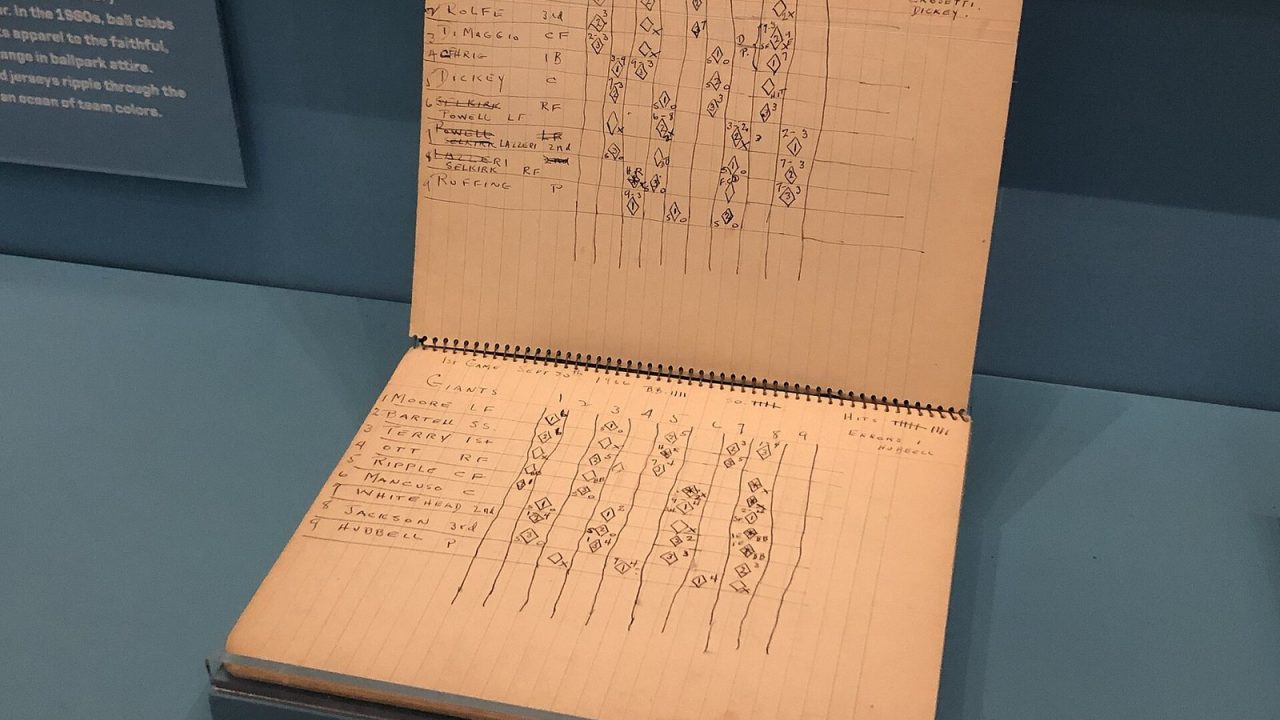
A paper scorecard turns watching a ballgame into an active job. You pay closer attention, you notice how runs are actually built, and when the game is over you have a record you can read back years later. Scorekeeping looks intimidating because every scorebook seems to use slightly different marks, but the core system is simple and has barely changed in a century. Once you learn about a dozen symbols and the position numbers, you can score almost any play.
This guide is about recording a game yourself. If you want to decode the finished summary printed in newspapers and on websites, our walkthrough on how to read a baseball box score covers that side.
What a Scorecard Looks Like
Most scorecards, whether sold at the stadium or printed at home, share the same grid. Each team gets its own sheet. Down the left side are rows for the batting order, with space for the player’s name, uniform number and defensive position. Across the top are columns for the innings, usually nine to eleven, plus extra columns at the right for totals such as at-bats, runs, hits and runs batted in.
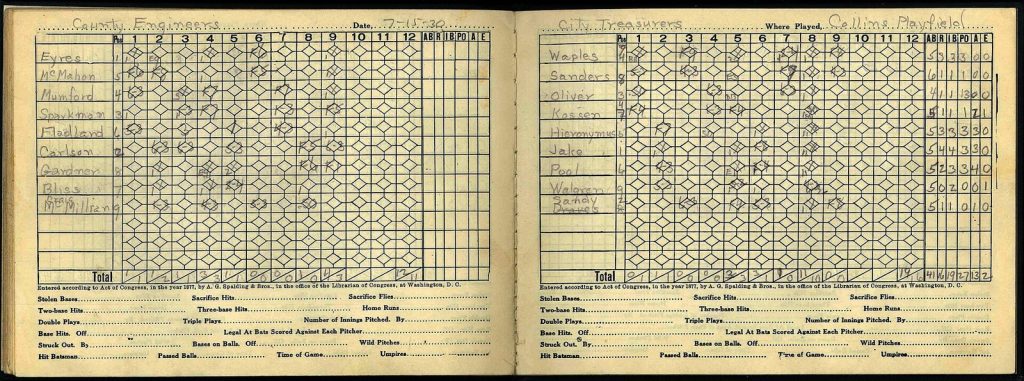
Each box where a batter’s row meets an inning column represents one plate appearance. Many cards print a small diamond inside each box, which you use to trace the batter’s progress around the bases. Below the batting grid there is usually a section for pitchers, with columns for innings pitched, hits, runs, earned runs, walks and strikeouts.
Before the first pitch, fill in the lineups. Write each player’s name in order, along with his position number (explained below). Leave room under each name for substitutes; pinch-hitters and defensive replacements are added on the line below the player they replace, often with a note of the inning they entered.
The Position Numbers: The Foundation of Scoring
Every defensive position has a number, and those numbers are the language of scorekeeping. Instead of writing “shortstop to first baseman,” you write 6-3. The numbers are standard everywhere:
| Number | Position |
|---|---|
| 1 | Pitcher |
| 2 | Catcher |
| 3 | First baseman |
| 4 | Second baseman |
| 5 | Third baseman |
| 6 | Shortstop |
| 7 | Left fielder |
| 8 | Center fielder |
| 9 | Right fielder |
The one that trips up beginners is shortstop. It is 6, not 5, even though the shortstop stands between second and third. The numbering is a long-standing convention rather than a strict left-to-right sweep, so just memorize it once: third base is 5, shortstop is 6. The designated hitter has no defensive number; most scorers simply write “DH” in the position column. For a refresher on what each fielder actually does, see our guide to the nine baseball positions.
Recording Outs
Outs are the most common thing you will write, so start there.
Ground outs and throws
Write the fielders who handled the ball in order, separated by hyphens. A grounder to the shortstop who throws to first is 6-3. A ground ball the second baseman fields and throws to first is 4-3. If the first baseman fields it and steps on the bag himself, write 3U, meaning “unassisted.” If the first baseman fields it and flips to the pitcher covering, that is 3-1.
Fly outs, line outs and pop-ups
A caught fly ball gets the fielder’s number, often preceded by F: F8 for a fly out to center, F9 to right. Many scorers use L for line drives (L6 for a liner caught by the shortstop) and P for pop-ups (P2 for a catcher’s pop-up in foul territory). Some people skip the letters and just write the number, adding a little arc above it for a fly ball. Pick a style and stay consistent.
Strikeouts: K and the backwards K
The strikeout symbol is K. A batter who swings and misses at strike three gets a regular K. A batter who takes a called third strike gets a backwards K, written as a mirrored letter. The distinction is purely informational, but it tells you later whether a pitcher was getting swings and misses or freezing hitters.
If strike three gets away from the catcher and the batter reaches first, you still record the K (the pitcher gets credit for the strikeout), then add WP for a wild pitch or PB for a passed ball, and draw the batter’s line to first.
Numbering the outs
Write a small 1, 2 or 3 in the corner of the box (many people circle it) to mark which out of the inning that play was. At the end of each half-inning, draw a heavy slash or line under the last batter so you know where the next inning begins.
Recording Hits, Walks and Other Ways to Reach Base
When a batter reaches base, you mark how he got there and then trace his path on the diamond.
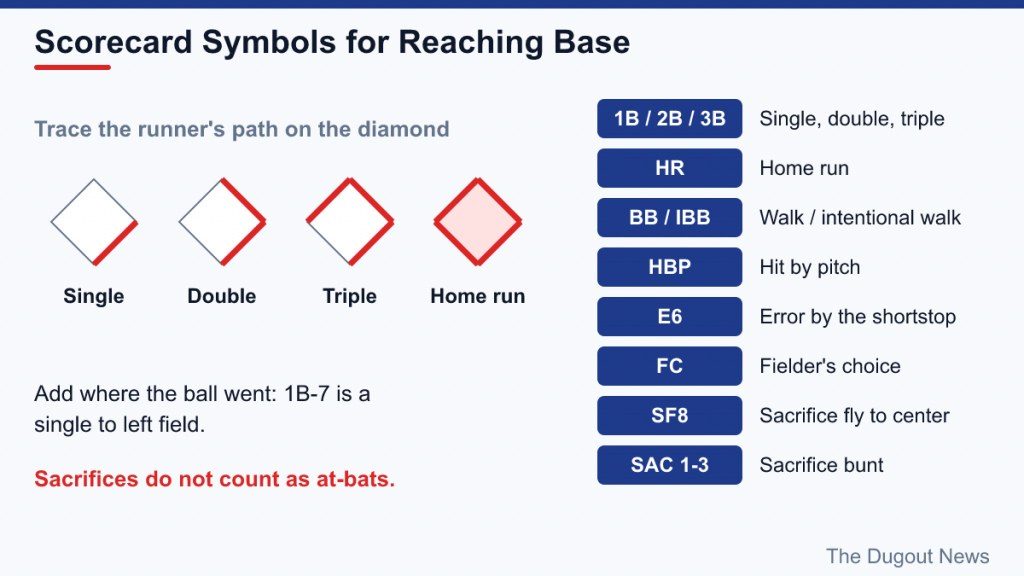
- Single: 1B, or a single short line from home toward first on the diamond.
- Double: 2B, or two lines.
- Triple: 3B, or three lines.
- Home run: HR, with the full diamond traced and often filled in.
- Walk: BB (base on balls). An intentional walk is IBB.
- Hit by pitch: HBP.
- Error: E plus the fielder’s number, such as E6 for an error on the shortstop.
- Fielder’s choice: FC, when the batter reaches because the defense chose to retire another runner.
Many scorers add where the hit went. A single to left can be written 1B-7 or with a small line pointing toward left field. That detail costs a second and makes your card far more informative. A double down the right-field line might be written 2B-9, and a home run to center HR-8.
For a catcher’s interference award, use CI; the batter goes to first and is not charged with an at-bat. For a sacrifice bunt, write SAC or SH plus the fielding sequence (SAC 1-3, for example), and for a sacrifice fly, SF plus the fielder (SF8). Sacrifices also do not count as at-bats, which matters when you total up later.
Tracking Runners Around the Bases
This is where the little diamond earns its place. Each time a runner advances, extend his line in his original box, the box from the inning where he came to bat. You do not move him into another batter’s box; instead, you note in his box what moved him.
The usual method is to write the uniform number or lineup spot of the batter who drove him forward next to the base he reached. Suppose the leadoff hitter singles, and then the number-three hitter doubles him to third. In the leadoff man’s box you draw the line to third and write a small “3” (for the third batter) beside it. If the cleanup hitter then flies out to right deep enough for him to score, you finish the diamond, fill it in to show a run, and write SF9 in the cleanup hitter’s box with an RBI note.
Stolen bases and other advances
- SB: stolen base, written next to the base taken (SB beside second, for instance).
- CS: caught stealing, with the fielders involved, such as CS 2-6 when the catcher throws to the shortstop covering second.
- WP / PB: wild pitch or passed ball advances.
- BK: a balk, which moves every runner up one base. Our explainer on the balk rule covers why.
- PO: picked off, again with the fielders, such as PO 1-3.
A runner thrown out on the bases gets the out number written beside the base where he was retired, plus the fielding sequence. When a runner scores, color in the diamond or put a dot in the center. At a glance, filled diamonds show you exactly where every run came from.
Double Plays, Triple Plays and Fielder’s Choices
Multi-out plays look complicated but follow the same logic. The classic 6-4-3 double play is a ground ball to the shortstop, who throws to the second baseman covering the bag, who relays to first. In the batter’s box you write DP 6-4-3 (some write GDP for “grounded into double play”). In the box of the runner who was forced at second, you mark that out at second with its out number.
Other common double plays include 4-6-3 (second baseman to shortstop to first), 5-4-3 (the “around the horn” play starting at third), and 1-6-3 (pitcher starting it). A line drive caught by the shortstop who then doubles a runner off second might be written L6 for the batter and 6U for the runner, or DP 6-4 if he throws to the second baseman.
The fielder’s choice deserves care. If a runner is on first and the batter grounds to short, and the shortstop throws to second to force the runner, the batter reaches first on a fielder’s choice. Write FC 6-4 in the batter’s box and mark the out in the runner’s box. The batter is charged with an at-bat but no hit. Triple plays are rare enough that you will want to write TP plus the full sequence and maybe a note in the margin; you may not see one for years.
Substitutions, Pitching Changes and the Pitcher Section
When a pinch-hitter comes in, write his name below the player he replaced and draw a thick vertical line in the inning column where he entered. That line tells you which plate appearances belong to which player. If he stays in the game on defense, note his new position number.
Pitching changes are recorded the same way on the other team’s sheet: draw a line between the last batter the old pitcher faced and the first batter the new one faced. In the pitching section at the bottom, give each pitcher a row and fill in his totals after he leaves.
Innings pitched are counted in thirds. A pitcher who records two outs in the sixth after completing five innings has pitched 5 2/3 innings, which box scores usually write as 5.2. Earned runs are a judgment call involving errors and passed balls; the official scorer at the ballpark makes that decision, and you can check it afterward. Our guide to ERA, WHIP and FIP explains how earned runs work.
Totaling Up at the End of the Game
When the final out is made, count across each batter’s row:
- AB (at-bats): plate appearances minus walks, hit-by-pitches, sacrifice bunts, sacrifice flies and catcher’s interference.
- R (runs): filled-in diamonds.
- H (hits): singles, doubles, triples and home runs.
- RBI: runs batted in, which you should be noting as you go.
Then add the totals for each inning at the bottom of the inning columns: runs, hits, errors and runners left on base. A simple check of your work is the “proof” of the box score: for each team, plate appearances should equal runs scored plus runners left on base plus outs made by the opponent’s defense (usually 27 for a full nine innings, fewer if the home team did not bat in the ninth). If the numbers do not balance, something went unrecorded.
Common Scoring Mistakes and How to Avoid Them
- Writing 5 for shortstop. It is 6. Third base is 5.
- Moving a runner into another batter’s box. A runner’s whole journey stays in the box from the inning he batted.
- Forgetting the out numbers. Without them, it is easy to lose track during a busy inning.
- Counting sacrifices as at-bats. They are not, and neither are walks or hit-by-pitches.
- Trying to decide errors yourself mid-play. Make a note with a question mark and check the official ruling on the scoreboard or a box score later. Scorers sometimes change hit-or-error calls after the game.
- Falling behind during a rally. Use shorthand and come back to clean it up. A quick “?” in a box is better than a blank you cannot reconstruct.
Frequently Asked Questions
Is there one official set of symbols?
No. The position numbers and core abbreviations (K, BB, HBP, E, FC, SB, DP) are close to universal, but there is no single required method for fans. Professional official scorers fill out standardized reports, but fans’ scorecards vary widely. What matters is that your own card is consistent and readable to you.
What pen should I use?
Many longtime scorers prefer a pencil with an eraser, because scoring changes and late substitutions happen. If you use a pen, a fine tip helps fit the small boxes.
Can I score from TV or radio?
Absolutely. Radio is a classic way to practice, because broadcasters describe each play in detail, including the fielders involved. TV is easier for spotting where hits landed.
Where can I get a scorecard?
Many ballparks sell scorecards or programs that include one, and free printable scoresheets are easy to find online. A blank grid you draw yourself works fine too.