The Nine Baseball Positions Explained: Roles, Numbers and Skills
A guide to all nine baseball positions: their scoring numbers, responsibilities and typical skills, plus the DH, utility players and premium spots.
Nine players take the field for the defensive team, and each one has a defined job. Some positions demand a strong arm, others quick feet, others the ability to read a fly ball off the bat or call a game for a pitcher. Understanding what each spot asks of a player helps explain lineup decisions, trades and why certain players are so valuable even when they are not great hitters.
This guide covers every position, the number used to identify it in scoring, and the skills that tend to define it. If you are completely new to the game, start with our baseball rules for beginners and come back here.
Position Numbers: Baseball’s Shorthand
Official scorers and fans who keep scorebooks identify fielders by number rather than name. The numbers are fixed and have nothing to do with jersey numbers:
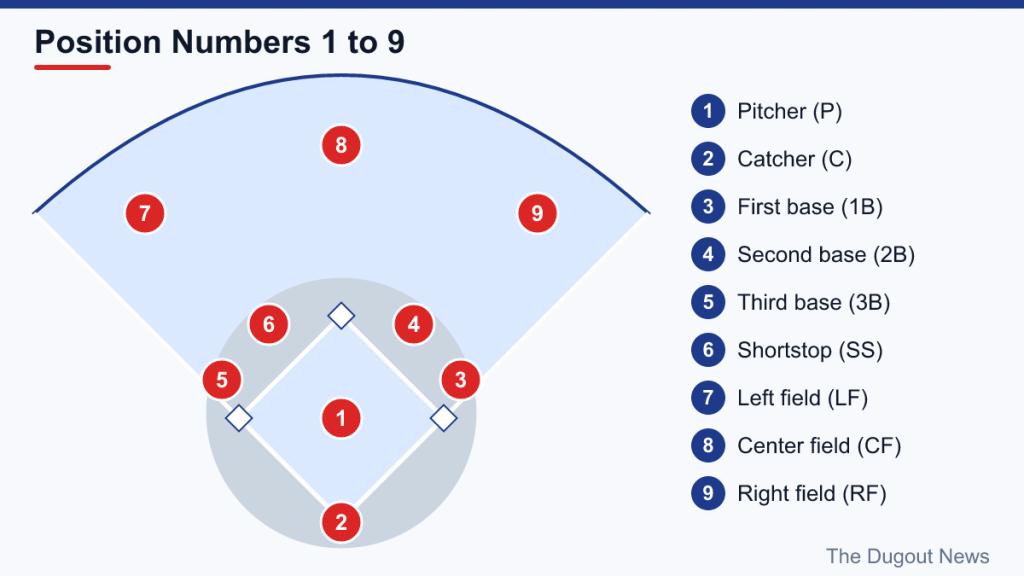
| Number | Position | Abbreviation |
|---|---|---|
| 1 | Pitcher | P |
| 2 | Catcher | C |
| 3 | First baseman | 1B |
| 4 | Second baseman | 2B |
| 5 | Third baseman | 3B |
| 6 | Shortstop | SS |
| 7 | Left fielder | LF |
| 8 | Center fielder | CF |
| 9 | Right fielder | RF |
That is why a common double play is described as “6-4-3”: the shortstop fields the ball, throws to the second baseman covering second, who relays to the first baseman. A ground ball to third that is thrown to first is “5-3,” and a fly ball caught in center is “F8.” The quirk that shortstop is 6 and third base is 5 comes from the early game, when the shortstop was treated more like a short outfielder and was numbered after the basemen.
Positions also fall into broad groups. The pitcher and catcher form the battery. The first baseman, second baseman, shortstop and third baseman are the infield. Left, center and right are the outfield. Second base and shortstop are together called the middle infield, and the corners (first and third) are the corner infield.
The Battery: Pitcher (1) and Catcher (2)
Pitcher
The pitcher starts every play by delivering the ball to the batter, which makes the position the most influential on the field. A starting pitcher typically works every fifth or sixth day and aims to cover as many innings as possible; relievers come out of the bullpen for shorter stints, often just one inning. Beyond throwing, pitchers must field balls hit back at them, cover first base on grounders to the right side, back up throws to third and home, and hold runners close to their bases.
The key traits are command (putting the ball where intended), the quality of the pitch mix and durability. Velocity matters, but movement, deception and sequencing matter just as much.
Catcher
The catcher crouches behind home plate and handles every pitch that isn’t hit. The job includes receiving the ball in a way that helps borderline pitches get called strikes (pitch framing), blocking pitches in the dirt to keep runners from advancing, throwing out base stealers, fielding bunts and pop-ups, and guarding home plate on throws from the field.
Catchers are also the on-field strategists. They work with the pitcher on pitch selection and location, know each hitter’s tendencies and often position teammates. The physical toll of squatting for nine innings, plus foul tips and collisions, means catchers need regular rest days. Good defensive catchers are scarce, which is why teams will accept a light bat behind the plate.
The Infield: First Base (3) to Shortstop (6)
First baseman
The first baseman receives most of the infield’s throws for outs, so the job rewards reliable hands, footwork around the bag and the ability to scoop throws out of the dirt. First basemen also field grounders hit to their side and hold runners on with a runner on first. Because the position needs less range and arm strength than others, it is often filled by big sluggers and by players who have moved off more demanding positions. Left-handed throwers have a slight advantage there, since their glove hand faces the infield.
Second baseman
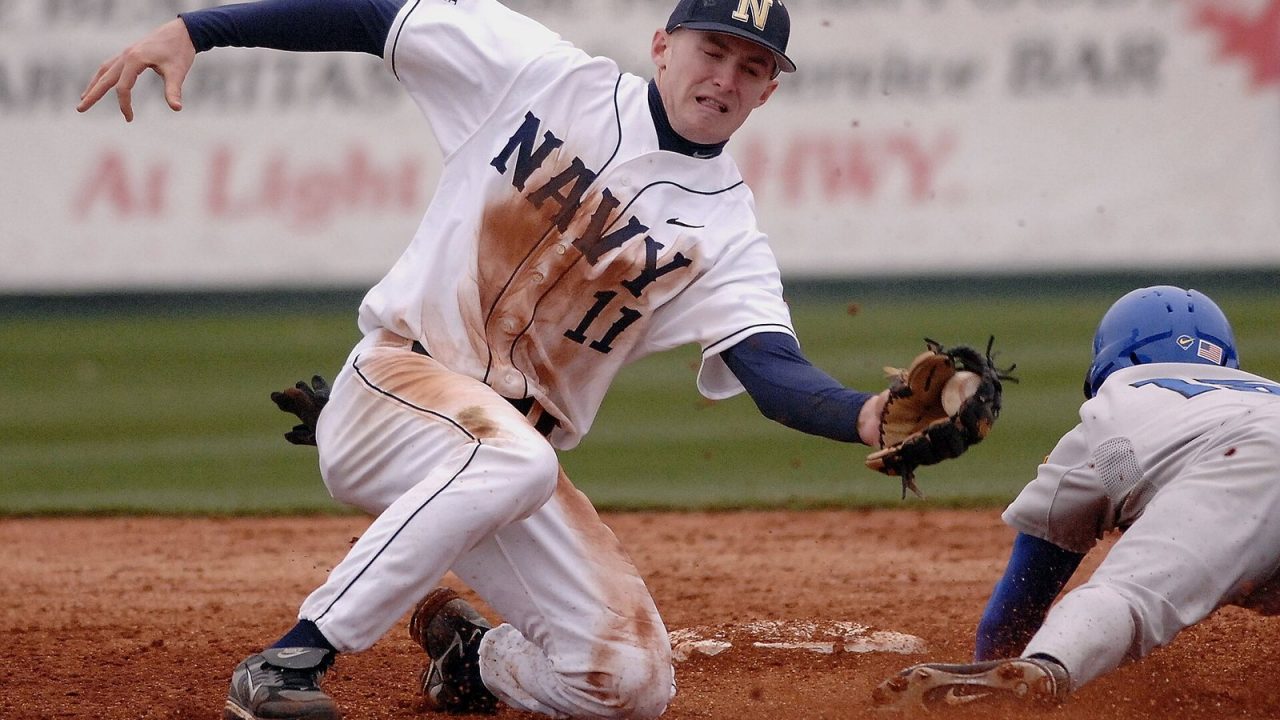
The second baseman covers the area between first and second and is the pivot man on many double plays, receiving a throw at second and turning to fire to first, often with a runner sliding in. Quick hands and footwork matter more than a powerful arm, since the throw to first is relatively short. Second basemen also take relay throws from right field and cover second on steal attempts.
Third baseman
Third base is called the “hot corner” because right-handed hitters pull hard ground balls and line drives there with little reaction time. The position needs quick reflexes, a strong and accurate arm for the long throw across the diamond, and the ability to charge bunts and slow rollers.
Shortstop
The shortstop plays between second and third and typically handles more ground balls than any other infielder. The job requires range in both directions, a strong arm to make throws from deep in the hole, and the agility to turn double plays as either feeder or pivot. Shortstops also act as cutoff men on many outfield throws and often coordinate infield positioning.
The Outfield: Left (7), Center (8) and Right (9)
Left fielder
Left field usually demands the least arm strength of the three outfield spots, since throws to third and home are shorter. Left fielders still need to read line drives that slice toward the foul line and play balls off the wall. Teams often put their best outfield bat with a weaker glove in left.
Center fielder
The center fielder covers the most ground of anyone on the field and is the captain of the outfield: on balls between fielders, center field has priority. Speed, good first steps and accurate routes are essential. A great defensive center fielder can save many runs a season by turning would-be extra-base hits into outs.
Right fielder
Right field typically requires the strongest outfield arm, because the throw from right to third base is the longest common throw in the game. Right fielders also deal with balls that curve toward the line off left-handed hitters’ bats.
All outfielders back up one another and the infield. A ball that gets past an infielder should find an outfielder already moving behind him.
Premium Positions: Why Shortstop and Catcher Matter So Much
Analysts often describe a “defensive spectrum,” an idea popularized by Bill James, that ranks positions from easiest to hardest to fill defensively. In broad terms it runs from designated hitter and first base at the easy end, through the corner outfield spots and third base, to second base, center field, shortstop and catcher at the demanding end.
The logic is about supply. Many players can stand at first base adequately, so a first baseman has to hit a lot to justify his spot. Far fewer players have the range, hands and arm to play shortstop at a major league level, or the receiving, blocking and game-management skills to catch every day. A shortstop or catcher who is only an average hitter can therefore be more valuable than a first baseman who hits much better.
The spectrum also explains career paths. Players often move from right to left as they age or lose speed: a shortstop may shift to third or second, a center fielder to a corner, and almost anyone can end up at first base or DH late in his career. Moving the other direction, toward a harder position, is rare.
Value metrics such as WAR build this in with a positional adjustment, giving extra credit to catchers, shortstops and center fielders and subtracting value from first basemen and designated hitters.
Designated Hitters and Utility Players
Designated hitter
The designated hitter (DH) bats in place of the pitcher but does not play the field. The American League adopted the DH in 1973, and the National League followed in 2022, making it universal across MLB. Today the DH spot is often filled by a pure slugger, by a regular who needs a day off his feet, or rotated among several players.
Utility players
A utility player can handle several positions, usually around the infield and sometimes the outfield too. With active rosters limited to 26 players, a bench player who can cover shortstop, second base and center field gives a manager flexibility for injuries, rest days and late-game substitutions. Some modern utility players are everyday regulars who simply move around based on matchups.
Two-way players
Very rarely, a player both pitches and hits at a high level. MLB rules allow a player to be designated as a two-way player if he meets thresholds for innings pitched and games played as a position player or DH, which affects how teams count him against roster limits on pitchers.
Common Misconceptions About Positions
- “The worst fielder goes to right field.” That’s a youth-league habit. In MLB, right fielders usually need strong arms, and the position is not a dumping ground.
- “First base is easy.” It is less demanding than shortstop, but footwork, scooping throws and handling bunts all require skill, and mistakes there are very visible.
- “Catchers just catch.” Receiving is only one part of a job that includes game planning, framing, blocking and controlling the running game.
- “Defensive positions are fixed.” Teams constantly adjust alignment by hitter and situation, even within the 2023 rules that limit extreme infield shifts.
The more you watch, the more you’ll notice the small movements before each pitch: the shortstop taking a step toward the hole, the center fielder shading a pull hitter, the catcher shifting his setup. Those adjustments are where much of baseball’s defense actually happens.