A Short History of Major League Baseball: From 1876 to Today
The story of Major League Baseball from the 1876 National League to today: rival leagues, the World Series, integration, expansion, strikes and analytics.
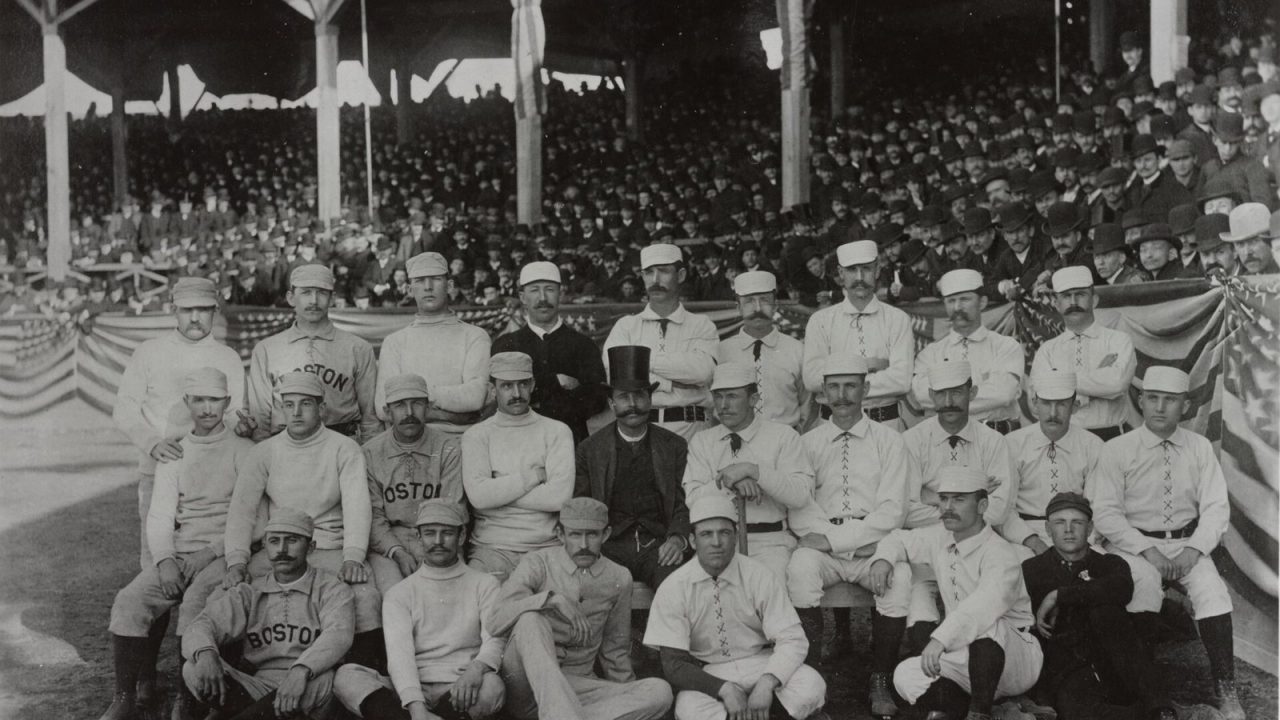
Major League Baseball has been played for a century and a half, through world wars, depressions, labor fights and a pandemic. Its history is long and tangled, but it can be told as a series of eras, each defined by a big change in how the game was organized or played. This overview walks through them in order, from the founding of the National League to the rule changes of the 2020s.
The Founding Era: The National League (1876–1900)
Professional baseball existed before 1876, but the National League, founded that year, was the first league built to last. Its first game was played on April 22, 1876, in Philadelphia. Unlike earlier loose associations, the NL was organized around club owners, who controlled schedules, player contracts and membership.
The late 19th century was chaotic. Rival leagues came and went, franchises folded or moved, and the rules themselves were still evolving: the pitching distance, the number of balls for a walk and the rules on foul balls all changed during this period. By the end of the century, though, the basic shape of the modern game was in place.
Two Leagues and the World Series (1901–1919)
The American League began as a minor league and declared itself a major league for the 1901 season. For two years it fought the NL for players, luring stars with better contracts. The war ended with the National Agreement of 1903, under which the two leagues recognized each other’s contracts.
That same year, the two league champions met in the first World Series. The Boston Americans (later the Red Sox) upset the Pittsburgh Pirates five games to three in a best-of-nine series. The Series was not played in 1904, because New York Giants owner John T. Brush refused to let his NL champions face the AL champion, and nothing yet required it. From 1905 onward, the World Series became an annual fixture.
The Dead-Ball Era
The first two decades of the 20th century are known as the dead-ball era, roughly 1900 to 1919 or 1920. Scoring was low, home runs were rare, and offense relied on bunts, stolen bases and hit-and-run plays. Balls stayed in play for long stretches, becoming soft, dirty and hard to see. Pitchers routinely posted earned run averages that look astonishing today.
The Live-Ball Era and the Commissioner (1920–1946)
Two shocks in 1920 changed the game. First, Cleveland shortstop Ray Chapman died after being hit by a pitch during the 1920 season. Afterward, both leagues began requiring umpires to put new, white baseballs into play whenever a ball became scuffed or dirty. Cleaner balls, along with restrictions on doctored pitches, helped end the dead-ball era.
Second, the Black Sox scandal broke: eight Chicago White Sox players were accused of conspiring to lose the 1919 World Series. Embarrassed owners wanted a strong leader to restore trust, and on November 12, 1920, federal judge Kenesaw Mountain Landis became the first Commissioner of Baseball, with sweeping authority to act in the game’s best interests. He banned the accused players and served until his death in 1944.
The 1920s and 1930s became an age of sluggers. Babe Ruth, sold from the Red Sox to the Yankees before the 1920 season, transformed the home run from a rarity into the game’s main attraction, and teams built their offenses around power. Radio broadcasts spread the game to millions of new fans.
During this era, Black players were barred from the major leagues by an unwritten color line. They built their own professional circuits: Rube Foster helped found the Negro National League in 1920, and Negro Leagues stars such as Josh Gibson, Satchel Paige and Oscar Charleston were among the best players of their time. In December 2020, MLB officially recognized seven Negro Leagues from 1920 to 1948 as major leagues.
Integration and Relocation (1947–1960)
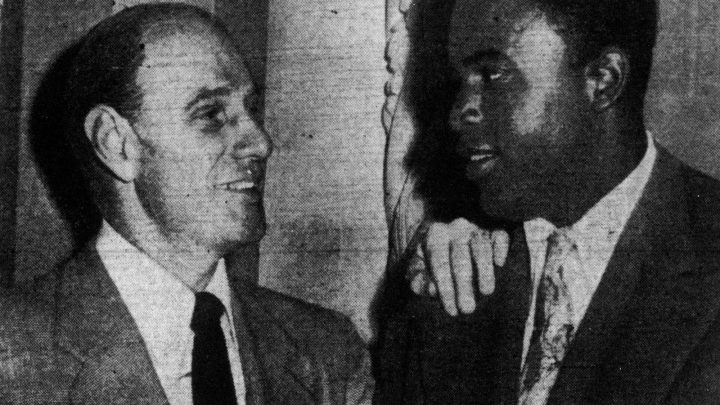
On April 15, 1947, Jackie Robinson took the field for the Brooklyn Dodgers, breaking the color line. Less than three months later, Larry Doby became the first Black player in the American League, with Cleveland. Integration was slow and uneven, with some teams waiting more than a decade, but it transformed the game. It also, in time, led to the decline of the Negro Leagues, whose best players moved to the majors.
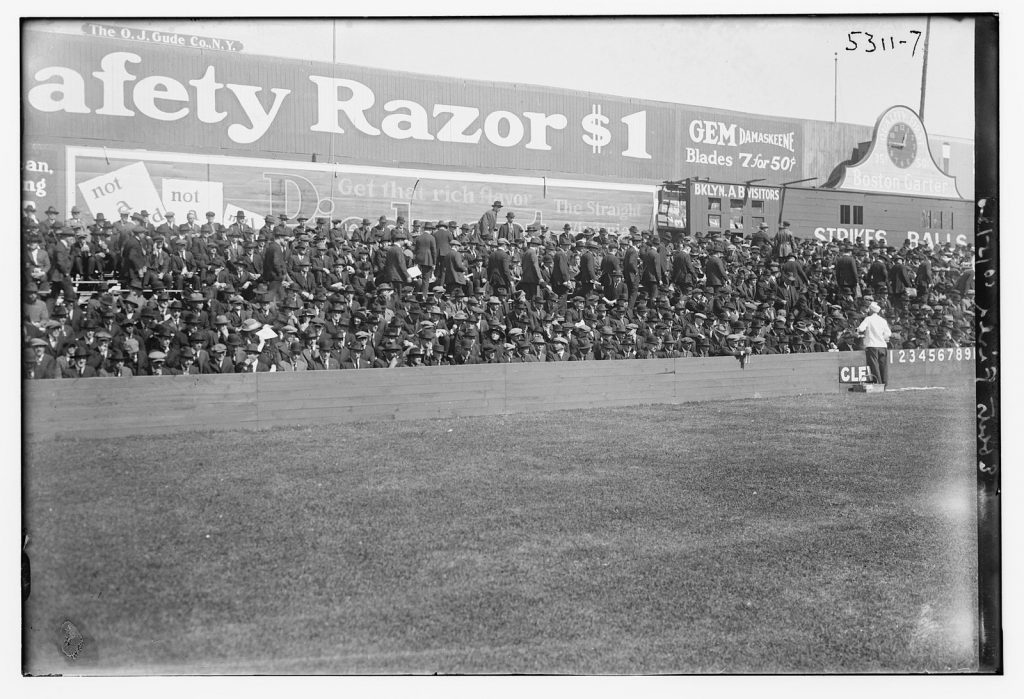
The 1950s brought the first franchise moves in half a century as the country’s population shifted west and south:
- The Boston Braves moved to Milwaukee in 1953.
- The Brooklyn Dodgers moved to Los Angeles and the New York Giants to San Francisco in 1958, bringing major league baseball to the West Coast.
Expansion and Divisions (1961–1993)
For the first six decades of the 20th century, the majors had 16 teams. Expansion changed that:
| Year | What happened |
|---|---|
| 1961 | The AL added the Los Angeles Angels and a new Washington Senators; the original Senators moved to Minnesota as the Twins. |
| 1962 | The NL added the Houston franchise (later the Astros) and the New York Mets. |
| 1969 | Each league added two teams and split into East and West divisions, creating the League Championship Series. |
| 1977 | The Toronto Blue Jays and Seattle Mariners joined the AL. |
| 1993 | The Florida Marlins and Colorado Rockies joined the NL. |
| 1998 | The Arizona Diamondbacks and Tampa Bay Devil Rays were added, and the Milwaukee Brewers switched to the NL. |
The 1998 additions brought MLB to its current total of 30 teams. In 1973, the American League adopted the designated hitter, beginning a split between the leagues that lasted almost half a century.
The Labor Era
The relationship between owners and players changed dramatically in the 1970s. Players won the right to free agency in the middle of the decade, ending the system in which a club could control a player’s career indefinitely. Salaries rose, and the players’ union became one of the most powerful in sports.
The result was a series of work stoppages. Two stand out:
- 1981: a strike from June 12 to July 31 wiped out 713 games and forced a split-season format.
- 1994–95: a strike that began August 12, 1994, and ended April 25, 1995, canceled more than 900 games, including the entire 1994 postseason. For the first time in 90 years, there was no World Series.
The 1994 season also introduced a new format of three divisions per league plus a wild card team. Because of the strike, the wild card first reached the postseason in 1995.
The Modern Era: Interleague Play to Analytics (1995–Present)
The game that returned after the strike kept changing:
- Interleague play began on June 12, 1997, when the San Francisco Giants beat the Texas Rangers 4–3 in Arlington. When the Houston Astros moved to the American League in 2013, each league had 15 teams, which made interleague games necessary all season long.
- More wild cards: Wild card games or series have been played in each league since 2012, and the postseason expanded to 12 teams in 2022. Our guide to the MLB postseason format explains the current structure.
- Technology and analytics: Front offices increasingly turned to statistical analysis to evaluate players. Statcast tracking systems were installed in all 30 ballparks starting in 2015, measuring every pitch, swing and throw.
- Recognition of the Negro Leagues: After the 2020 decision to recognize them as major leagues, MLB integrated Negro Leagues statistics into its official records on May 28, 2024. Josh Gibson became the all-time leader in career batting average.
The Rule Changes of the 2020s
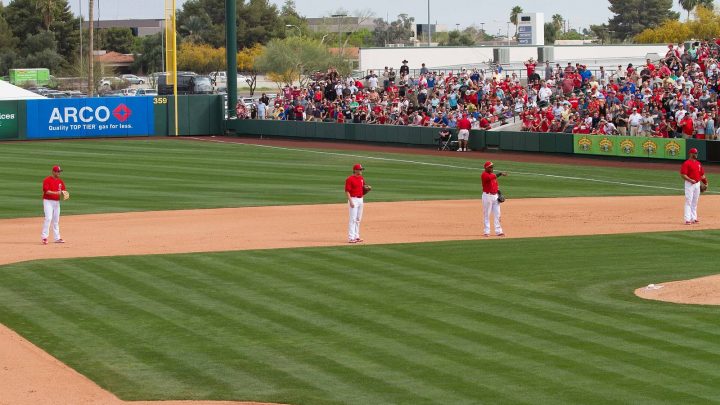
The 2022 collective bargaining agreement brought the designated hitter to both leagues. Starting in 2023, MLB introduced a pitch clock, limits on pickoff attempts, bigger bases and restrictions on infield shifts, while a balanced schedule meant every team played every other team at least once each season. Average game times dropped sharply, and stolen bases surged. In 2026, an automated ball-strike challenge system arrived in the majors after years of minor league testing.
Franchise geography is still evolving as well. MLB owners approved the Athletics’ move from Oakland to Las Vegas in November 2023; the team is playing in West Sacramento from 2025 through 2027 while its new ballpark is built.
Constants Through the Eras
For all the change, some things have stayed the same. The two leagues founded in 1876 and 1901 still form the structure of MLB. The World Series, first played in 1903, is still the goal of every season, and the New York Yankees, with 27 titles, have won it more than any other franchise. The bases are still 90 feet apart, and three strikes still make an out.
What changes is how the game is played within those rules, from the bunts and steals of the dead-ball era to the power game of the live-ball era, and from the strategic arguments of the analytics age to the faster tempo of the pitch-clock years. If you are new to the sport and want the current shape of the season, start with our guide to how the MLB season works.
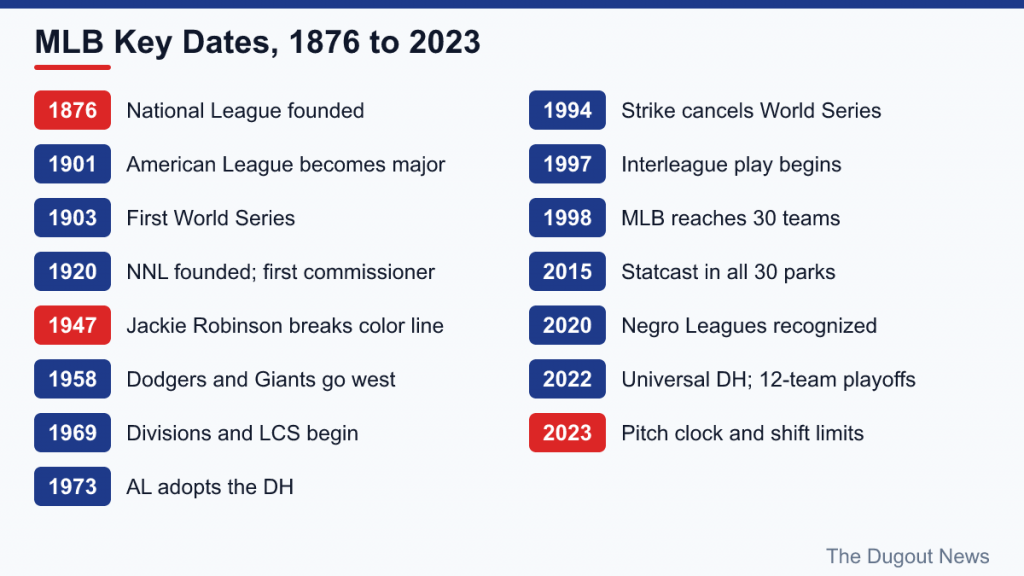
Key Dates at a Glance
| Year | Event |
|---|---|
| 1876 | National League founded |
| 1901 | American League becomes a major league |
| 1903 | First World Series |
| 1920 | Negro National League founded; Landis named first commissioner |
| 1947 | Jackie Robinson breaks the color line |
| 1958 | Dodgers and Giants move to California |
| 1969 | Division play and League Championship Series begin |
| 1973 | AL adopts the designated hitter |
| 1994 | Strike cancels the World Series |
| 1997 | Interleague play begins |
| 1998 | MLB reaches 30 teams |
| 2015 | Statcast in all 30 ballparks |
| 2020 | Negro Leagues recognized as major leagues |
| 2022 | Universal DH; 12-team postseason |
| 2023 | Pitch clock, bigger bases, shift limits, balanced schedule |