How Baseball Hall of Fame Voting Works
Who votes for the Baseball Hall of Fame, who is eligible, the 75% and 5% rules, the 10-year ballot limit and how Era Committees work.
Every January, baseball holds its breath for a vote count. A few hundred sportswriters have mailed in their ballots, and the results decide which retired players will have bronze plaques hung in Cooperstown, New York. Few honors in any sport are as hard to earn or as fiercely debated.
The process looks mysterious from the outside, but it follows a published set of rules. Once you understand who votes, who qualifies and what the thresholds are, the annual arguments make a lot more sense. This guide walks through the writers’ ballot, the Era Committees that offer a second path, and the museum that sits behind it all.
The Hall and Its First Class
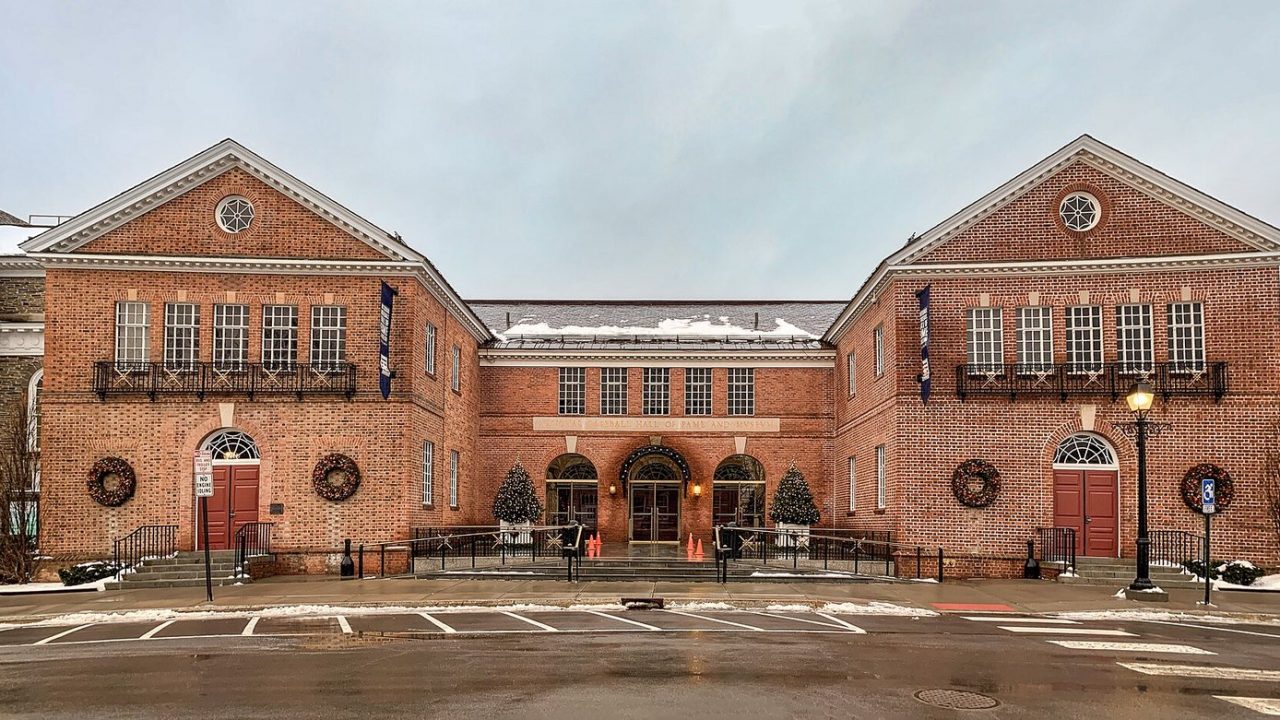
The National Baseball Hall of Fame and Museum is located in Cooperstown, a small village in upstate New York. Its building was dedicated on June 12, 1939, but the first election came three years earlier. In 1936 the writers elected five players as the inaugural class: Ty Cobb, Babe Ruth, Honus Wagner, Christy Mathewson and Walter Johnson. Ruth’s place in that group is a big part of his legend; our feature on Babe Ruth’s legacy tells that story.
The Hall has grown steadily since then. According to Wikipedia’s member list, 354 people will have been inducted through the 2026 elections: 281 former players, 40 executives and pioneers, 23 managers and 10 umpires. That is a tiny fraction of everyone who has played in the major leagues, which is exactly the point.
Who Votes: The BBWAA Electorate
The main route into the Hall is an annual vote of the Baseball Writers’ Association of America (BBWAA), an organization founded in 1908 for journalists who cover Major League Baseball. Not every member gets a ballot. Under the Hall’s rules, a voter must be an active or honorary BBWAA member who has been an active baseball writer for at least ten years.
A later change added a recency requirement. Since the 2016 election, voters must also have actively covered the game at some point in the previous ten years. Former beat writers get that ten-year grace period after they leave the beat, and then their voting privileges lapse. The idea was to keep the electorate made up of people still close to the sport.
Voters complete a registration form and sign a code of conduct. The Hall publishes voters’ names with the results, but individual ballots are not revealed by the Hall itself. Many writers choose to make their ballots public anyway, which is why fans can track running tallies before the official announcement.
Who Is Eligible for the Writers’ Ballot
A player has to clear several bars before his name appears on a ballot. The Hall’s BBWAA rules set them out:
- Ten seasons. The player must have played in ten major league championship seasons.
- Five years retired. He must have stopped playing in the majors at least five calendar years before the election. This waiting period has been in place since 1954; earlier, the rules had no wait or a one-year wait.
- A time window. His career must have touched the period beginning 15 years before and ending five years before the election. In practice, this means a player can appear on the writers’ ballot during roughly years six through fifteen of retirement.
- Not on the ineligible list. Anyone on baseball’s ineligible list cannot be a candidate.
There is a special provision for players who die while active or shortly after retiring. If that happens, the player becomes eligible at the next regular election held at least six months after his death, or after the end of the five-year period, whichever comes first.
The screening committee
Meeting the basic requirements does not automatically put a player on the ballot. A six-member BBWAA screening committee prepares the list. First-time eligible players make the ballot if any two committee members nominate them. Returning candidates are carried over only if they received votes on at least 5 percent of ballots the previous year. This step keeps ballots manageable; a typical ballot lists somewhere between 25 and 40 names.
How the Vote Works: 10 Names, 75 Percent
Ballots go out in late November and must be returned by December 31. Results are announced in January, and inductions take place the following summer in Cooperstown.
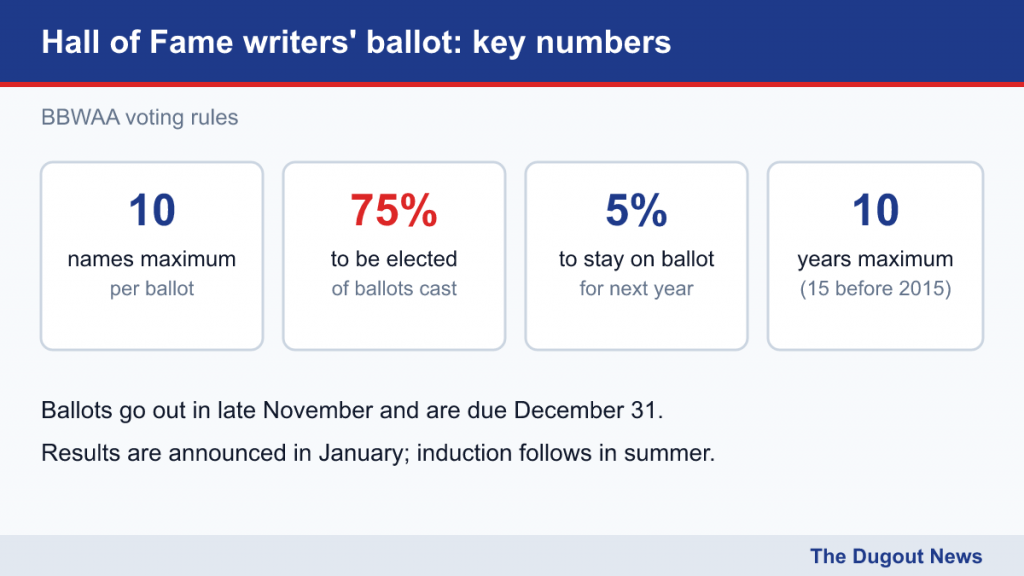
The core rules are short:
- Up to ten votes. Each voter may select as many as ten candidates, or as few as zero. Write-in votes are not allowed.
- 75 percent to get in. Any candidate named on at least 75 percent of ballots cast is elected. There is no limit on how many people can be elected in a year, and in some years nobody reaches the line.
- 5 percent to stay. Candidates who fall below 5 percent drop off future writers’ ballots.
- Ten years maximum. A candidate who stays between 5 and 75 percent can remain on the ballot for up to ten years. The limit used to be fifteen; it was cut to ten starting with the 2015 election.
The rules also tell voters what to consider: the player’s record, playing ability, integrity, sportsmanship, character and contributions to the teams he played for. The Hall explicitly states that no single feat, such as a .400 season or a perfect game, guarantees election.
The ten-vote ceiling and crowded ballots
The ten-name maximum causes some of the most heated debates. In years when many strong candidates are eligible at once, some voters say they would like to vote for more than ten players but cannot. Candidates near the bottom of crowded ballots can lose support simply because voters ran out of slots. Others argue that the limit forces voters to make real distinctions.
Recent Elections as Examples
Real results show how the thresholds play out.
In the 2025 election, 394 ballots were cast. Ichiro Suzuki received 393 votes (99.7 percent) in his first year, missing a unanimous selection by a single ballot. CC Sabathia was also elected on his first try, with 86.8 percent. Billy Wagner got in with 82.5 percent in his tenth and final year of eligibility, a vivid illustration of how the ten-year clock works: one more shortfall and his candidacy would have moved to the Era Committee process.
Unanimity is extraordinarily rare. Mariano Rivera, in 2019, was the first player elected unanimously on the writers’ ballot.
The 2026 class, announced over the 2025–26 winter, brought in Carlos Beltrán, Andruw Jones and Jeff Kent, a reminder that the writers’ ballot and the committee process often produce new members in the same year.
Era Committees: The Second Path
Many players never reach 75 percent with the writers, and many important figures, such as managers, umpires and executives, were never eligible for the writers’ ballot at all. For them, the Hall uses committees that have gone by several names over the years, from the Veterans Committee to today’s Era Committees.
Under the current structure described on the Hall’s website, history is split into two timeframes:
- Classic Baseball Era: before 1980, including Negro Leagues and pre-Negro Leagues stars.
- Contemporary Baseball Era: 1980 to the present, with separate ballots for players and for non-players (managers, umpires and executives).
Each committee meets once every three years at baseball’s Winter Meetings, so the three ballots rotate on an annual cycle. The rules are tighter than the writers’ ballot:
- A committee has 16 voting members, with the Hall’s board chairman serving as a non-voting chair.
- Each ballot lists no more than eight candidates.
- Each committee member may vote for up to three candidates.
- Election still requires 75 percent, which with 16 voters means at least 12 votes.
- A 2025 provision requires a candidate to receive at least five of the 16 votes to stay eligible for future Era Committee ballots.
Players who exhausted their writers’ eligibility are not considered immediately. The Hall reinstated a waiting period so that a player must be retired at least 16 seasons before an Era Committee can consider him, putting a little distance between the two processes.
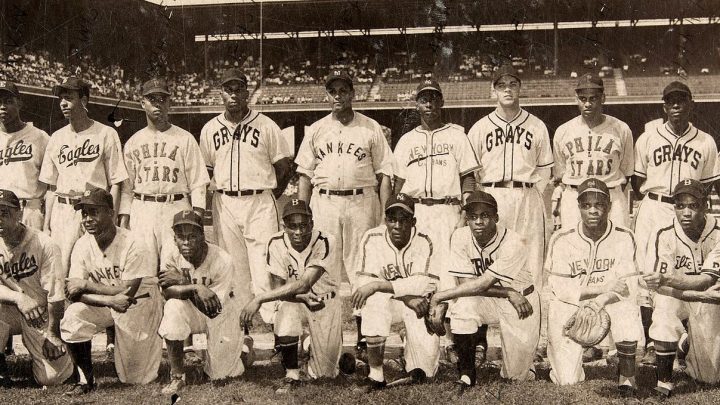
The committees have produced some notable classes. In December 2024, the Classic Baseball Era Committee elected Dick Allen and Dave Parker. Special elections have also corrected historical gaps; in February 2006, a special committee elected seventeen Negro Leagues and pre-Negro Leagues figures. Our history of the Negro Leagues explains why that recognition mattered.
The Big Debates
Because voting depends on judgment, it generates constant argument. A few themes come up year after year:
- Statistics versus narrative. Some voters lean on advanced metrics like WAR; others put more weight on peak dominance, postseason moments or a player’s reputation in his era.
- The character clause. The instruction to consider integrity, sportsmanship and character has been central to debates over players linked to performance-enhancing drugs. Several players with historic statistics never reached 75 percent on the writers’ ballot.
- Positional fairness. Relief pitchers, designated hitters and catchers have historically faced tougher standards, partly because their value is harder to compare with everyday players and starting pitchers.
- The ineligible list. Because players on the ineligible list cannot appear on the ballot, figures banned from the game have been kept out regardless of their playing records.
None of these debates have simple answers, which is part of why Hall of Fame season is so popular. Every ballot is, in effect, one writer’s argument about what greatness means.
Common Misconceptions
- “Fans vote.” They do not. Election is limited to qualified BBWAA writers and the Era Committees.
- “There is a quota.” There is no fixed number per year. Several players can be elected at once, or none.
- “Records guarantee induction.” The rules say otherwise. No milestone automatically qualifies a player.
- “Dropping off the ballot ends a candidacy forever.” Not necessarily. Players who fall off the writers’ ballot, or use up their ten years, can later be considered by an Era Committee.
Visiting Cooperstown
The vote is only half of the experience. The museum in Cooperstown holds the Plaque Gallery, where every inductee is honored, along with exhibits on the game’s history, from its early professional era through integration, which you can read about in our piece on Jackie Robinson, and on to the present day. Induction Weekend each summer draws large crowds of fans who come to watch the new class give their speeches.
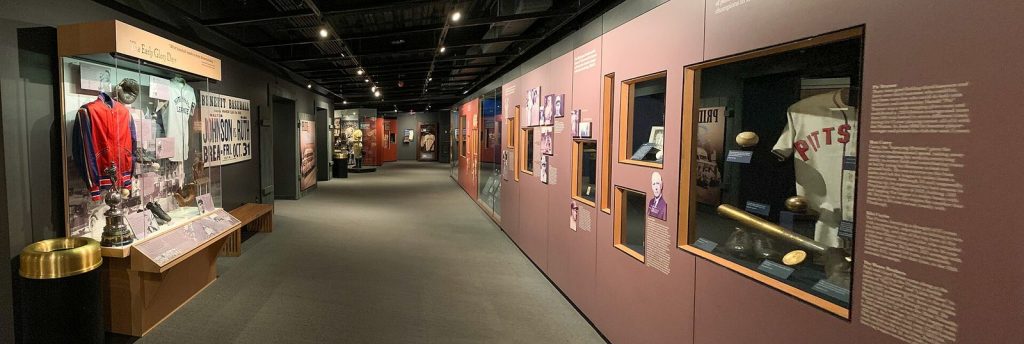
If you follow the vote closely, it is worth visiting at least once. Seeing the plaques of the 1936 class and the newest inductees in the same room makes clear how much the standard of greatness has stayed constant across very different eras of the game.