How Minor League Baseball Works: From Complex Leagues to Triple-A
How MLB's farm system is built: the 2021 restructuring, the five levels from complex leagues to Triple-A, the 40-man roster, options and call-ups.
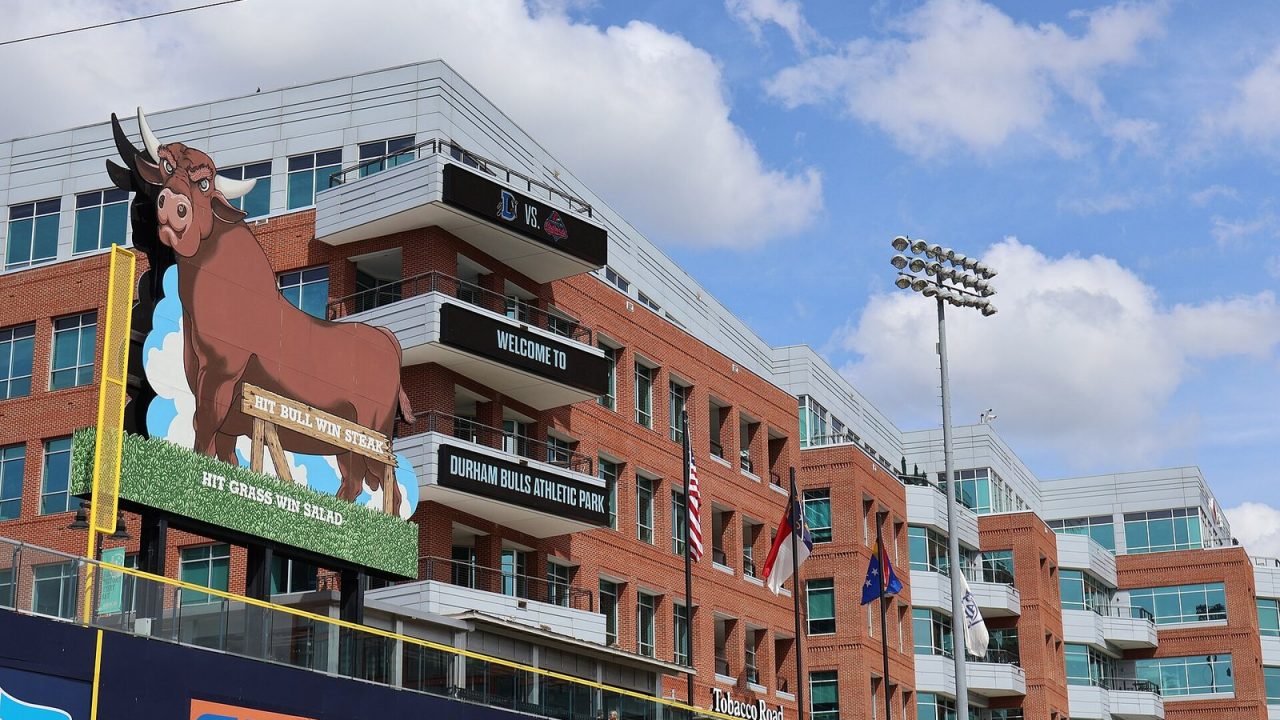
Almost every player who reaches the major leagues gets there by climbing a ladder. That ladder is Minor League Baseball, the network of affiliated clubs where drafted and signed players learn to hit, pitch, field and handle a professional schedule. For fans, the minors are also a cheap and close-up way to watch the game, and a chance to see future stars before anyone knows their names.
The system can look confusing from the outside: league names that change, players who shuttle between cities several times in a season, and roster terms like “optioned,” “outrighted” and “designated for assignment.” This guide explains how the structure fits together and how players move through it.
What the Minor Leagues Are For
The affiliated minor leagues exist to develop players for the 30 MLB organizations. A minor league team in, say, Double-A sells its own tickets and has its own local identity, but the players on the field belong to the MLB parent club. The major league organization signs them, pays them, staffs the coaching and decides when they move up, move down or are released.
That arrangement shapes everything about minor league baseball. Winning matters, but development matters more. A top prospect might be promoted in the middle of a hot streak, a pitcher might be limited to a set number of innings, and a team leading its league can lose its best players overnight to a call-up. Fans who understand that the goal is producing major leaguers tend to enjoy the minors more.
Players arrive through several routes. Most come from the MLB Draft, which covers high school, junior college and four-year college players (our guide to how the MLB Draft works covers eligibility and bonus pools). International amateur free agents, many of them from Latin America, sign with organizations as teenagers. Others are minor league free agents or veterans signed to depth contracts.
The 2021 Restructuring
For decades, the relationship between MLB and the minor leagues was governed by an agreement called the Professional Baseball Agreement. When that agreement expired after the 2020 season, MLB reorganized the system and took direct control of it.
The key changes, which took effect in 2021, were:
- Fewer affiliates. The number of affiliated clubs was cut from 160 to 120, giving each MLB organization four full-season affiliates, one at each full-season level. More than 40 clubs lost their affiliation.
- Fewer levels. The old Short-Season A and Advanced Rookie levels were eliminated.
- Licenses instead of the old agreement. Affiliated clubs now operate under Professional Development League licenses with their parent organizations.
- Renamed leagues, then renamed back. In 2021 the leagues were given temporary, region-based names such as Triple-A East. In March 2022, MLB announced it had acquired the historic league names, and the familiar names returned. At the same time, the level called Low-A in 2021 was renamed Single-A.
The restructuring was controversial, especially in towns that lost teams.
The Levels, From Bottom to Top
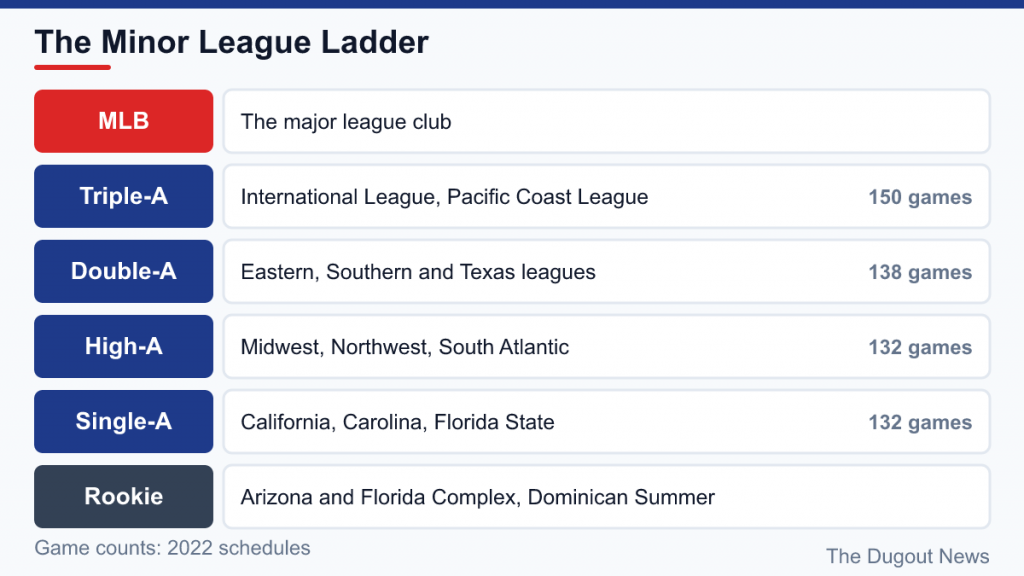
Today’s affiliated system has four full-season levels plus rookie-level leagues. Here is how it is organized, based on the current league alignment.
| Level | Leagues | Typical players |
|---|---|---|
| Triple-A | International League, Pacific Coast League | Players close to the majors, depth for injuries, veterans |
| Double-A | Eastern League, Southern League, Texas League | Top prospects being tested against advanced competition |
| High-A | Midwest League, Northwest League, South Atlantic League | Second- and third-year pros, advanced college draftees |
| Single-A | California League, Carolina League, Florida State League | Recent draftees, younger international signees |
| Rookie | Arizona Complex League, Florida Complex League, Dominican Summer League | The youngest players, new signees, rehabbing veterans |
Rookie and complex leagues
The Arizona Complex League and the Florida Complex League (formerly the Arizona League and Gulf Coast League) are played at MLB teams’ spring training facilities. Seasons are short, roughly 60 games, and these games are mostly about instruction. Many recently drafted high school players start here, as do international prospects arriving in the United States for the first time. Injured major leaguers also turn up on rehab assignments.
The Dominican Summer League is a rookie-level circuit in the Dominican Republic and is where many teenage international signees play their first professional games.
Single-A and High-A
These are the first full-season levels. Players face a long schedule for the first time, ride buses, and deal with the daily grind. College draftees often start in Single-A or High-A, depending on their polish.
Double-A
Double-A is widely considered the biggest jump in competition. Pitchers there command multiple pitches, and hitters can punish mistakes. Many organizations promote their best prospects directly from Double-A to the majors.
Triple-A
Triple-A is the final stop. Rosters mix top prospects with experienced players who have major league time and serve as injury replacements. Because the parent club needs these players to be ready on short notice, Triple-A clubs see the most roster movement of any level.
Season lengths vary by level. As of the 2022 schedules, Triple-A teams played 150 games, Double-A 138, and High-A and Single-A 132 each, while complex leagues play far fewer.
Roster Rules: 26, 28 and 40
To understand how players move between the minors and majors, you need two numbers: the 26-man active roster and the 40-man roster.
The 26-man active roster
The active roster is the group of players eligible to play in a given MLB game. It has been 26 players since the 2020 rule changes, with a limit of 13 pitchers. From September 1 through the end of the regular season, active rosters expand to 28. Before 2020, teams could expand all the way to 40 in September, which made late-season games look very different.
The 40-man roster
The 40-man roster includes the 26 active players plus up to 14 others, usually players in the minors, who are under major league contracts. Being on the 40-man roster matters for three reasons:
- Only players on the 40-man roster can be called up to the active roster. A minor leaguer who is not on it must first be added, which means another player may have to come off.
- Players on the 40-man roster are protected from the Rule 5 draft.
- Players on the 40-man roster who are sent to the minors use “options” (explained below).
Players on the 10-day or 15-day injured list still count toward the 40-man roster. Players moved to the 60-day injured list do not, which is why teams often transfer a long-term injury to the 60-day list to open a spot.
Minor league roster limits
The minors have their own limits. Each organization can have a set number of players under contract on its domestic affiliates during the season (165), and each level has an active roster size, such as 28 at Triple-A and Double-A and 30 at High-A and Single-A. Lower levels also limit how many veterans with long minor league experience can play there, to keep those leagues focused on younger players.
Options, Call-Ups and Waivers
How options work
A player on the 40-man roster can be “optioned” to the minors without being exposed to other teams. Each player has three option years. An option year is used in any season in which the player spends at least 20 days in the minors on optional assignment; within that year, he can be sent up and down multiple times. Some players with fewer than five full seasons of professional experience can qualify for a fourth option year under specific conditions.
The collective bargaining agreement that took effect in 2022 added a limit: a player can be optioned no more than five times in a single season. There is also a minimum stay after being optioned: a position player generally must spend 10 days in the minors before being recalled, and a pitcher 15 days, unless he is replacing an injured player or filling a doubleheader roster spot.
Options do not reset when a player is traded, and time on an injury rehab assignment does not count as an option.
Out of options
Once a player has used all his options, he cannot be sent to the minors without first being placed on waivers, which gives every other team a chance to claim him. This is why a player who is out of options sometimes stays on a major league roster even when he is struggling: the team does not want to lose him for nothing.
Designated for assignment
When a team needs a 40-man roster spot, it can designate a player for assignment (DFA). That removes him from the 40-man roster immediately, and the team then has seven days to trade him, release him, or pass him through waivers and outright him to the minors.
The call-up itself
A call-up, or promotion, usually happens because a major league player is injured, slumping or needs rest, or because a prospect has simply forced the issue. The player is “recalled” if he was already on the 40-man roster and optioned down, or “selected” if his contract is being added to the 40-man roster for the first time. A first-time selection often means a corresponding move elsewhere on the roster.
The Rule 5 Draft: Why Teams Protect Prospects
Teams cannot stash prospects in the minors forever. Each December, at the Winter Meetings, MLB holds the Rule 5 draft, in which teams can select eligible players who are not on another organization’s 40-man roster.
Eligibility depends on age at signing. A player who was 18 or younger on the June 5 before he signed becomes eligible for the fifth Rule 5 draft after signing; a player who was 19 or older becomes eligible for the fourth. That timing is why every November there is a wave of prospects being added to 40-man rosters “to protect them from the Rule 5 draft.”
The selecting team pays $100,000 and must keep the player on its major league active roster for the entire following season. If it does not, the player must be offered back to his original club for $50,000. The rule keeps organizations from hoarding talent in the minors.
How to Follow a Prospect Through the System
If you want to track a player’s rise, a few habits help:
- Look at age relative to level. A 20-year-old holding his own in Double-A is far more impressive than a 25-year-old dominating Single-A. Context matters more than raw numbers.
- Read strikeout and walk rates. For both hitters and pitchers, these tend to translate up the ladder better than batting average or ERA.
- Watch the transactions. Options, 40-man additions and Rule 5 protection decisions reveal how an organization values a player.
- Expect setbacks. Promotions are not always linear. Players get demoted, repeat levels and still become major leaguers.
For an overview of the big league calendar, see our guide to how the MLB season works.
Common Questions
Is Triple-A always the last stop before the majors?
No. Many players jump from Double-A straight to the majors, and occasionally a player debuts with little or no minor league experience. Triple-A is the most common final stop, not a required one.
Are minor league players paid by the minor league team?
Players on affiliated clubs are under contract with the MLB organization, which pays them. The local club handles business operations like the ballpark, tickets and promotions.
What is a rehab assignment?
An injured major leaguer can play a set of games in the minors to get back into game shape before returning. It does not use an option.