MLB’s Competitive Balance Tax Explained
How MLB's luxury tax works: tax payroll and AAV, thresholds, repeat-offender rates, the "Cohen tax" tier, draft-pick penalties and why there is no cap.

Every winter, a few headlines pop up about teams writing enormous checks that have nothing to do with player salaries. In December 2025, for example, the Associated Press reported that the Los Angeles Dodgers owed a record $169.4 million in luxury tax for the 2025 season, on top of their payroll. Nine teams paid tax that year, tying the record.
That bill comes from the competitive balance tax, or CBT, which most fans simply call the luxury tax. It is the main tool Major League Baseball uses to slow down spending by its richest clubs. It is also widely misunderstood. This guide explains what counts toward a team’s tax payroll, how the thresholds and rates work, what extra penalties come with heavy spending, and why baseball still has no salary cap.
Why Baseball Has a Tax Instead of a Cap
Several other major North American leagues limit team spending with salary caps. MLB has never had one. The MLB Players Association has resisted a cap for decades, and the issue has history: in June 1994, the owners’ bargaining proposal tied revenue sharing to a salary cap. The players went on strike on August 12, 1994, the rest of the season including the World Series was canceled, and the strike ended on April 2, 1995, with no cap in place.
The competitive balance tax is the compromise that grew out of that history. There is no hard limit on what a team can spend. Instead, teams pay a tax on the amount by which their payroll exceeds a set threshold, and the tax gets steeper the farther and the longer they go over. The idea is to create a financial brake that discourages the biggest-market teams from simply outspending everyone, while still letting a team spend if it is willing to pay.
The AP describes the modern penalty as dating back to 2003; since then, through the 2025 season, more than $1.63 billion has been assessed to 15 different teams.
How Tax Payroll Is Calculated
The number that matters for the CBT is not the same as a team’s cash payroll for the season. It is a special figure known as tax payroll (or CBT payroll), and it is calculated differently in several important ways.
- Average annual value (AAV). Each contract counts at its average annual value, not the salary actually paid that year. A ten-year, $300 million deal counts as $30 million every year for tax purposes, even if the actual salary is backloaded or frontloaded.
- The 40-man roster. Everyone on the 40-man roster counts, not just the 26 players on the active roster.
- Earned bonuses. Performance and award bonuses that a player actually earns are added in.
- Benefits. Each team is charged a share of player benefits; the AP put that at just over $17 million per team for 2025.
- The pre-arbitration bonus pool. Each club is charged its share (about $1.67 million) of the $50 million pool for pre-arbitration players created in the 2022 agreement.
- Deferred money. Deferred salary is discounted to present value, so a contract that pays a lot of money years in the future counts for less in tax payroll than its headline figure suggests.
Even small items count. The AP noted that the Dodgers’ 2025 tax payroll included $949,244 in noncash compensation for Shohei Ohtani, covering a suite and an interpreter.
The AAV rule is why front offices care so much about contract structure. Two deals with the same total value can have very different effects on tax payroll depending on length and deferrals.
The Thresholds
The CBA sets a base threshold for each season, along with higher tiers above it. Under the agreement ratified in March 2022, the base threshold was $230 million for the 2022 season and climbs each year. It was $241 million in 2025, and the initial threshold for 2026 is $244 million.
Above the base, there are three more tiers, each $20 million apart:
| Tier | Amount over base threshold | 2025 payroll range |
|---|---|---|
| Base | $0–$20 million over | $241M–$261M |
| Second | $20–$40 million over | $261M–$281M |
| Third | $40–$60 million over | $281M–$301M |
| Fourth (“Cohen tax”) | $60 million or more over | Above $301M |
The fourth tier was new in the 2022 agreement. It quickly earned the nickname “Cohen tax,” after New York Mets owner Steve Cohen, whose spending was widely seen as the reason it was added.
Tax Rates: First-Time Payors vs. Repeat Offenders
The tax is marginal, like an income tax. Each dollar is taxed at the rate for the bracket it falls in, not the whole payroll at the top rate. And the rates depend on how many consecutive years a team has been over the threshold.
Using the 2025 rates as reported by the AP:
| Amount over threshold | First-time payor | Third straight year or more |
|---|---|---|
| First $20 million | 20% | 50% |
| $20–$40 million | 32% | 62% |
| $40–$60 million | 62.5% | 95% |
| $60 million or more | 80% | 110% |
A second-year payor sits in between; the AP noted that the Astros, in their second straight year over, paid 30 percent on their overage. The structure makes repeated heavy spending far more expensive than a one-year splurge. At the top rate, a third-time payor in the highest bracket pays more than a dollar in tax for every additional dollar of payroll.
The reset
A team that drops below the threshold for a season resets its status. The next time it goes over, it is treated as a first-time payor again. That is why you sometimes see a team that has paid tax for years make a determined effort to get under the line for one season, even if it means trading away useful players. The reset can save tens of millions of dollars in future years.
Penalties Beyond the Tax Bill
Money is not the only cost. Spending far above the threshold also damages a team’s ability to add young talent:
- Draft position. A team whose tax payroll exceeds the base threshold by $40 million or more has its top draft pick moved back ten spots. CBS Sports noted that a team picking in the top six has its second-highest pick moved back instead. In 2025, that line was $281 million.
- Free-agent compensation. Teams over the threshold give up more when they sign free agents who rejected qualifying offers, including draft picks and international bonus pool money.
For how qualifying offers fit into free agency, see our explainer on free agency, arbitration and service time, and for how picks are ordered, our guide to the MLB draft.
A Real Example: The 2025 Tax Bills
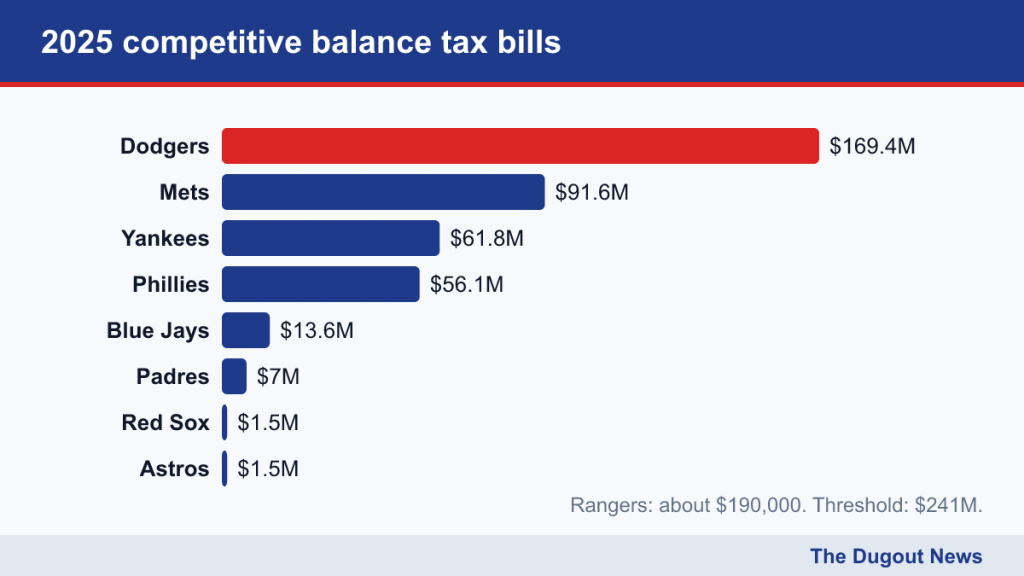
The AP’s report on the 2025 season shows how the rules play out in practice. Nine teams exceeded the $241 million threshold:
| Team | 2025 tax bill (approx.) |
|---|---|
| Los Angeles Dodgers | $169.4 million |
| New York Mets | $91.6 million |
| New York Yankees | $61.8 million |
| Philadelphia Phillies | $56.1 million |
| Toronto Blue Jays | $13.6 million |
| San Diego Padres | about $7 million |
| Boston Red Sox | about $1.5 million |
| Houston Astros | about $1.5 million |
| Texas Rangers | about $190,000 |
The Dodgers’ tax payroll was a record $417.3 million, far beyond the top tier. As a repeat payor, most of their overage was taxed at 110 percent. With that bill, their total tax since 2003 ($519.4 million) passed the Yankees’ ($514.2 million) for the most of any team. The Atlanta Braves, by contrast, finished just under the line and owed nothing.
At the other end of the scale, the AP listed the Miami Marlins with the lowest tax payroll, at $86.9 million. The gap between top and bottom is one reason the debate over competitive balance never goes away.
Where the Money Goes
MLB does not simply split the tax money evenly among the clubs that stayed under the line. According to the AP’s description of the current rules, the first $3.5 million goes to player benefits. Half of the remainder goes to players’ individual retirement accounts, and the other half to a commissioner’s discretionary fund distributed among teams that receive revenue sharing and have grown their non-media local revenue. Payments are due to MLB in January.
Common Misconceptions
- “The luxury tax is a cap.” It is not. Teams can spend as much as they like; they just pay more.
- “Teams are taxed on their whole payroll.” Only the amount above the threshold is taxed, in brackets.
- “A player’s tax hit equals his salary this year.” It is the contract’s AAV, adjusted for deferrals.
- “Only the active roster counts.” The whole 40-man roster counts, plus benefits.
- “Paying tax once is a big deal.” First-time rates are relatively mild. The real cost comes from staying over year after year.
Frequently Asked Questions
Does the tax apply during the season or at the end?
Tax payroll is tracked throughout the season, and final figures are calculated after it ends. That is why trade-deadline moves matter: shedding a contract in July lowers a team’s final number, as the AP noted the Blue Jays did before the deadline in a way that cut their bill.
Can a cheap team be forced to spend more?
The CBT only penalizes high spending. It does not require low-payroll teams to spend more, which is one reason critics argue it addresses only one side of the competitive balance question.
Why do some teams go far over the line anyway?
For the richest clubs, the extra cost of a top player can be worth it if it improves their chances of winning a title, which also brings revenue. The tax raises the price of that strategy without forbidding it.
What to Watch Going Forward
The numbers in this guide come from the collective bargaining agreement ratified in March 2022, with thresholds scheduled through the 2026 season. The thresholds, rates and penalties are all bargained, so any new agreement could change them significantly, and the question of whether baseball should move toward a salary cap remains one of the central issues between owners and players. When reading about future tax bills, check which agreement’s rules apply.