Starters, Relievers, Closers and Openers: How Pitching Staffs Work
How MLB pitching staffs are built: the five-man rotation, bullpen roles from long relief to closer, openers and bulk pitchers, and the rules that limit them.
A baseball team does not have one pitcher. It has a staff, and over a 162-game season that staff is managed like a resource. Who starts, how long he goes, who comes in next and when, and how many arms are available tomorrow are questions managers answer every day. The way teams answer them has changed dramatically over the past century, and rule changes since 2020 have changed it again.
This guide walks through how pitching staffs are organized today, what each role does and which rules limit a manager’s choices.
The Starting Rotation
Starting pitchers begin the game and are expected to pitch the largest share of innings. Teams use a rotation, a set order of starters who take turns, so that each pitcher gets several days of rest between outings.
From four men to five
In baseball’s early decades, starters threw enormous workloads. Pitchers regularly worked 300 or more innings in a season, and some started on consecutive days or in both games of a doubleheader. Over the decades, teams moved toward shorter, more frequent rest cycles, and today the five-man rotation is the most common setup, typically giving starters four days of rest between turns. Off days in the schedule let teams occasionally skip the fifth starter or give everyone an extra day.
How deep do starters go?
Modern starters are typically limited to around 100 pitches, and outings beyond 125 pitches are rare. Most regular starters are expected to go at least five innings, and few are asked to go past seven or eight. Complete games, once routine, have become uncommon.
Two reasons explain the shift. First, pitch counts and workload management aim to reduce injuries and keep pitchers effective over a long season. Second, analysts documented that hitters perform better the more times they see the same pitcher in a game. A starter facing a lineup for the third time is often less effective than a fresh reliever, so teams frequently remove starters before that point.
Key terms
- Ace: a team’s best starter, usually first in the rotation.
- Quality start: a start of at least six innings with three or fewer earned runs allowed.
- Swingman: a pitcher who moves between the rotation and the bullpen as needed.
The pitches starters rely on, and how they sequence them over multiple trips through a lineup, are covered in our guide to types of pitches.
The Bullpen and Its Roles
Relief pitchers enter after the starter or another reliever leaves, whether because of fatigue, pitch count, injury, poor performance or strategy. Bullpen roles are informal. They are not defined in the rulebook, and each team uses them a little differently, but the common ones are:
| Role | Typical job |
|---|---|
| Long reliever | Covers several innings when a starter exits early or in extra innings; often a former or future starter |
| Middle reliever | Handles the middle innings, often bridging from the starter to the late-inning arms |
| Setup man | Pitches the inning before the closer, often the eighth, in close games |
| Closer | Pitches the final inning to protect a lead, usually in save situations |
| Specialist | Faces specific batters, traditionally left-handed relievers brought in to face left-handed hitters |
| High-leverage “fireman” | The best reliever used at the most important moment, whatever the inning |
Closers and the Save
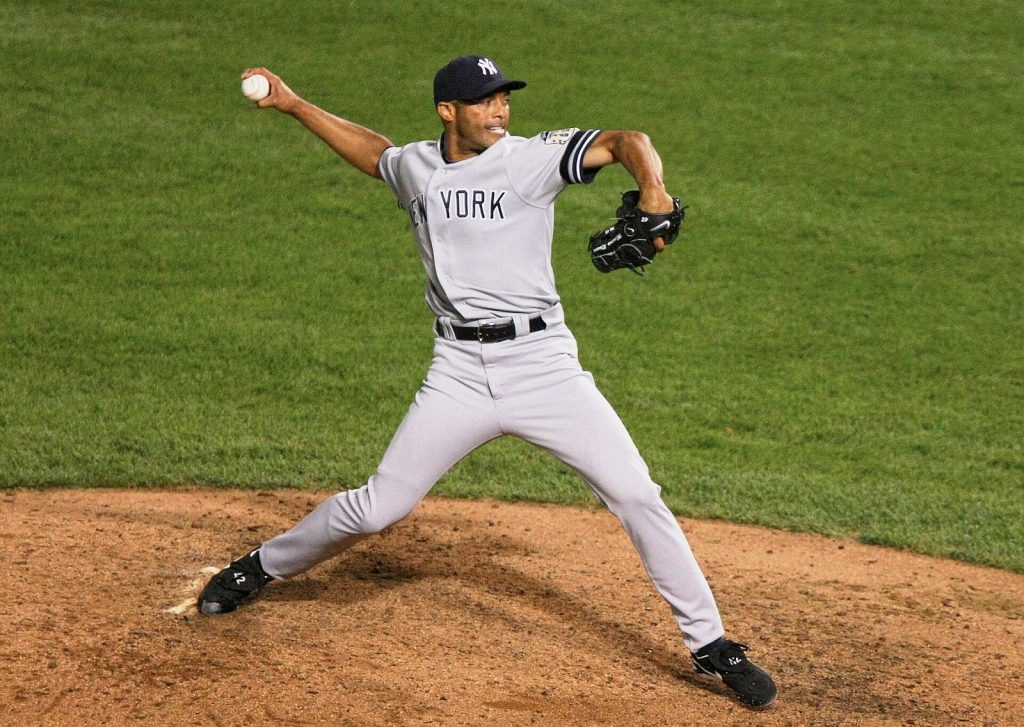
Teams began relying on dedicated closers in the 1970s, and by the 1980s saves outnumbered complete games. Dennis Eckersley, used almost exclusively in ninth-inning situations by the Oakland Athletics, is often described as the first modern closer; he won the 1992 Cy Young Award in that role.
How the save works
The save statistic was devised by journalist Jerome Holtzman and became an official MLB statistic in 1969. Under the current rule (Rule 9.19), a pitcher earns a save when he finishes a game his team wins, is not the winning pitcher, records at least one out, and meets one of these conditions:
- He enters with a lead of no more than three runs and pitches at least one inning;
- He enters with the tying run on base, at bat or on deck; or
- He pitches at least three innings.
Mariano Rivera holds the career record with 652 regular-season saves, ahead of Trevor Hoffman’s 601. Francisco Rodríguez set the single-season record with 62 saves in 2008.
Holds and blown saves
A hold is credited to a reliever who enters in a save situation, keeps the lead and leaves without finishing the game, which is the setup man’s equivalent of a save. A blown save is charged when a reliever in a save situation allows the tying or go-ahead run to score. Neither is an official MLB statistic, but both are widely tracked.
Closer versus fireman
The save rule shaped how teams use relievers. Because the statistic rewards the ninth inning, managers long reserved their best reliever for it, even when the biggest threat of the game came earlier, such as bases loaded in the seventh with a one-run lead. Analysts argue that the most important outs should go to the best pitcher, regardless of inning. Many teams now use their top relievers more flexibly, though the traditional closer role remains common.
Openers and Bulk Pitchers
In 2018, the Tampa Bay Rays introduced a strategy that challenged the definition of a starting pitcher. In May of that season, they began starting games with a reliever, Sergio Romo, who would pitch only the first inning or so before handing the ball to a pitcher who would cover most of the game. The first pitcher became known as the opener, and the pitcher who followed as the follower or bulk pitcher.
Why it works
The first inning is the only inning in which a team is guaranteed to send the top of its lineup to the plate, which makes it one of the highest-scoring innings. A hard-throwing reliever can face those top hitters once, and the bulk pitcher then faces the top of the order fewer times than a traditional starter would. Teams can also use the approach when a rotation is short on healthy starters.
How widespread it became
Other clubs quickly experimented, including the Athletics, who used Liam Hendriks as an opener in the 2018 AL Wild Card Game. Openers were used at least 80 times in every season from 2018 to 2024, peaking at 165 in 2019, but their use fell sharply in 2024. Related to the opener is the bullpen game, in which a team uses a series of relievers for an inning or two each, with no pitcher expected to work deep.
The Rules That Shape Pitching Staffs
The three-batter minimum (2020)
Beginning in 2020, MLB required every pitcher to face at least three batters, or finish the half-inning, before being removed. The only other exception is an injury or illness that, in the umpire crew chief’s judgment, prevents the pitcher from continuing.
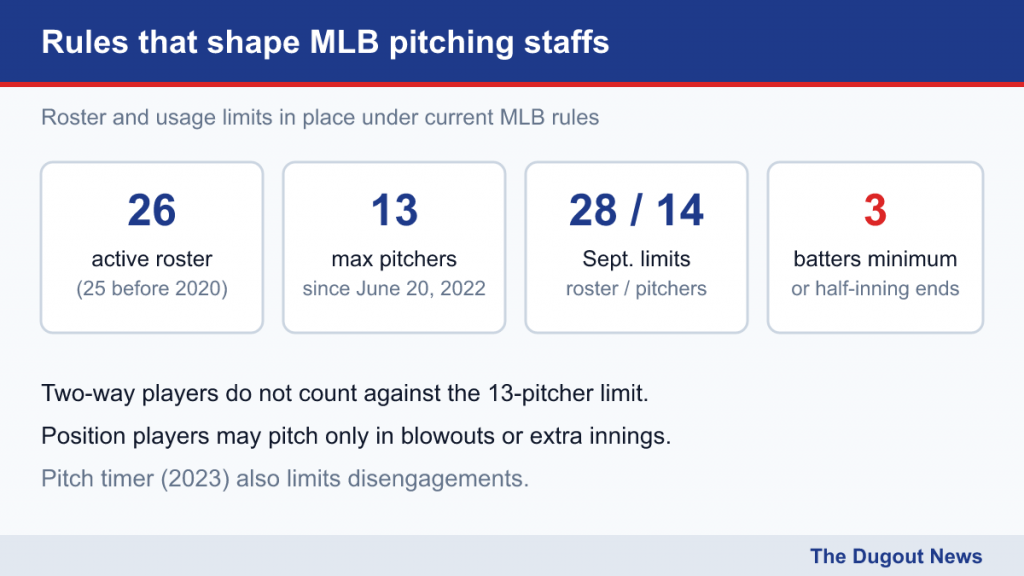
The rule was aimed at the parade of pitching changes in the late innings, especially one-batter matchups. It effectively ended the role of the pure left-handed specialist, the reliever brought in to face a single left-handed hitter. Managers now have to plan their bullpen moves further ahead, because the pitcher they bring in will also face the next two hitters, whoever they are.
The 13-pitcher limit
The same 2020 rule changes expanded active rosters from 25 to 26 and capped the number of pitchers on the active roster at 13. Because of the COVID-19 pandemic, enforcement of the cap was delayed several times; it finally took effect on June 20, 2022. From September 1 through the end of the regular season, when rosters expand to 28, teams may carry up to 14 pitchers.
Two-way players and position players pitching
The pitcher cap created a need to define who counts as a pitcher. A player who meets the two-way player criteria (at least 20 major league innings pitched and at least 20 games started as a position player or designated hitter, with at least three plate appearances in each, in the current or previous season) does not count against the limit. Position players without that designation may pitch only in specific situations: under the rules in place since 2023, when their team trails by eight or more runs, in the ninth inning or later with a lead of at least 10 runs, or in extra innings.
The pitch clock
The pitch timer introduced in 2023 affects pitchers in a different way, shortening the time between pitches and limiting disengagements. It has changed how pitchers manage their energy and tempo; our guide to the MLB pitch clock explains those rules.
How a Manager Plans a Game’s Pitching
Putting it together, a typical game plan involves several decisions made before the first pitch:
- How long can the starter go? Based on his pitch count history, rest and how many times through the order the team is comfortable with.
- Who is available in the bullpen? Relievers who pitched on consecutive days, or threw many pitches recently, may be unavailable.
- Who are the dangerous hitters, and when will they come up? Because of the three-batter minimum, managers think in groups of three hitters rather than single matchups.
- Who is the long man tonight? Every team needs a pitcher ready to cover several innings if the starter is knocked out early or the game goes long.
Evaluating how well each pitcher does his job calls for the right statistics. ERA tells only part of the story for relievers, who often inherit runners. Our explainer on ERA, WHIP and FIP covers the stats that best isolate a pitcher’s own performance.
Common Questions
Can the same pitcher start and close?
Yes, there is no rule against it, though it is rare in the modern regular season. In the postseason, starters sometimes pitch in relief between starts.
Does an opener get credit for a win?
Under the scoring rules, a starting pitcher must pitch at least five innings to be credited with a win. Because openers rarely do, wins in opener games usually go to a reliever, often the bulk pitcher, at the official scorer’s direction.
Why do teams carry so many relievers?
Because starters pitch fewer innings than in the past, the bullpen covers a larger share of each game. That is precisely why MLB introduced a cap on the number of pitchers.