The Sacrifice Bunt: When Giving Up an Out Makes Sense
Sacrifice, squeeze and drag bunts explained, why run expectancy turned teams against bunting, when it still helps, and how sacrifices are scored.
Few plays in baseball reveal a generation gap like the sacrifice bunt. To older fans, a well-placed bunt that moves a runner into scoring position is fundamental baseball, the kind of selfless play that wins close games. To many analysts, it is a gift to the defense: a free out in exchange for 90 feet. Both views contain some truth, and the interesting part is figuring out when each one applies.
This guide covers the different kinds of bunts, how sacrifices are scored, what run expectancy says about giving up outs, and the situations where bunting still makes sense.
The Types of Bunts
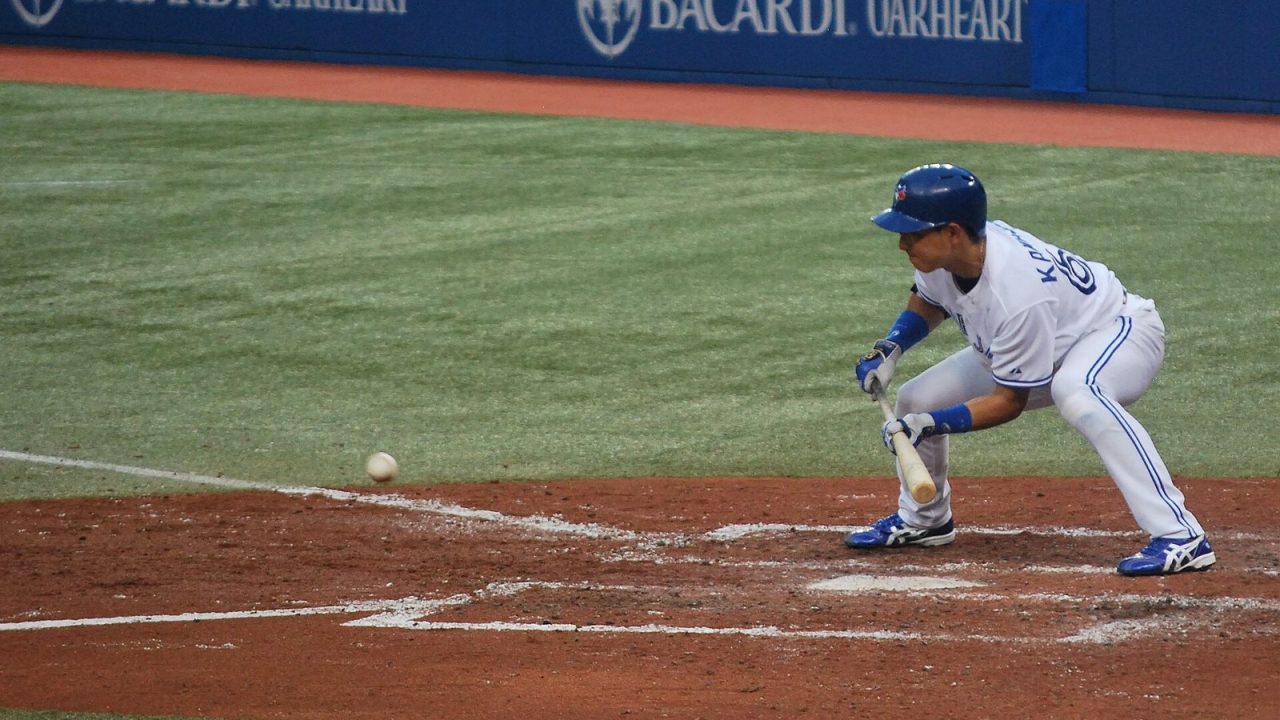
A bunt is any batted ball that the hitter deliberately taps with a loosely held bat, rather than swinging. The purpose of the bunt determines what kind it is.
Sacrifice bunt
The batter squares to bunt with fewer than two outs, accepting that he will probably be thrown out at first in exchange for advancing one or more runners. The classic version moves a runner from first to second, putting him in scoring position for the next hitter.
Squeeze play
A bunt with a runner on third, designed to score that runner. There are two versions:
- Safety squeeze: the runner on third takes a lead but only breaks for home once he sees the ball bunted on the ground. If the bunt is poor, he can stay put.
- Suicide squeeze: the runner breaks as the pitcher begins his delivery. If the batter gets the ball down in fair territory, the run almost always scores. If he misses or pops it up, the runner is usually tagged out or doubled off, which is where the name comes from.
Squeezes are most common late in close games, typically with one out, when a single run matters a great deal. Pitchers who read a suicide squeeze coming may throw a high pitch that is hard to bunt down, or a pitchout to give the catcher a chance at the runner.
Bunting for a hit
Sometimes the batter is not sacrificing anything; he is trying to reach base. A drag bunt, usually by a left-handed hitter pulling the ball toward first while already moving out of the box, or a push bunt past the pitcher, relies on surprise and speed. Fast hitters can use the threat of a bunt to pull infielders in, which opens up holes for ground balls.
How a Sacrifice Is Scored
The official scoring rules treat a sacrifice bunt generously, which is one reason players accept them:
- A successful sacrifice bunt is not charged as an at-bat, so it does not lower the batter’s batting average. It does count as a plate appearance.
- Sacrifice bunts are also left out of the on-base percentage formula, unlike sacrifice flies, which do count against OBP.
- If the official scorer judges that the batter was really bunting for a hit, and he is thrown out, the scorer charges an at-bat instead of crediting a sacrifice.
- If the batter bunts and the defense tries but fails to retire a lead runner, while the runners still advance, it is scored as a sacrifice plus a fielder’s choice. If he simply beats the throw to first, it is a hit.
In a scorebook, a sacrifice is usually marked SH, SAC or simply S. If you keep score yourself, our guide to keeping score with a paper scorecard shows where it goes.
Sacrifice bunts and sacrifice flies were tracked in the same statistical category until 1954. Eddie Collins holds the MLB career record for sacrifice hits with 512, a mark from an era when the bunt was a central part of offense.
Run Expectancy: Why Bunting Fell Out of Favor
The modern argument against the sacrifice bunt comes from a tool called run expectancy. Run expectancy is the average number of runs that score from a given situation through the end of the inning. There are 24 base-out states: eight combinations of runners on base times three out counts (zero, one or two). Analysts calculate the average runs scored from each one using large samples of real games.
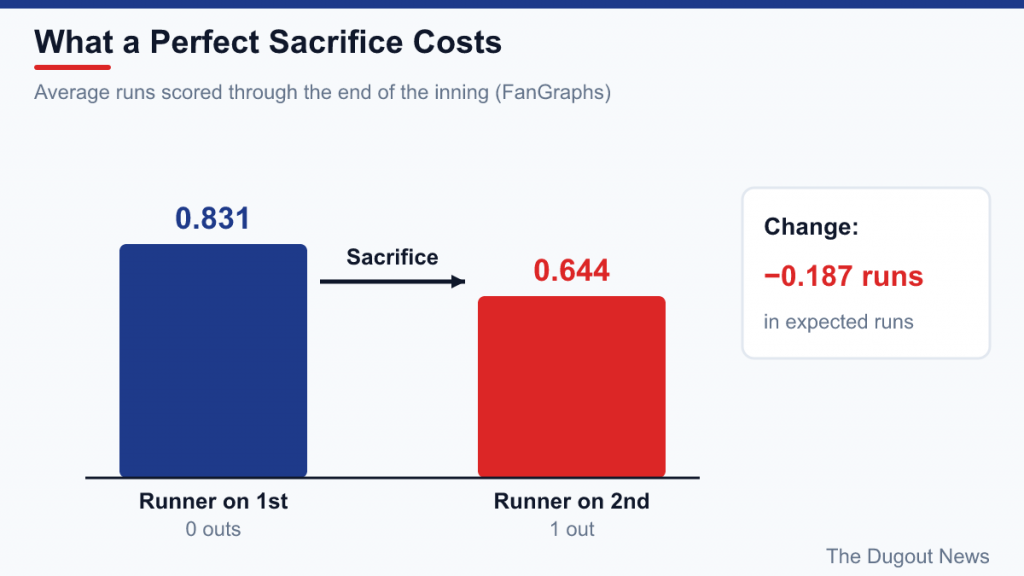
Once you have those averages, you can compare the situation before and after a play. Here is a slice of the neutral run expectancy matrix published in the FanGraphs Library, built for a run environment of about 4.15 runs per game (roughly the 2014 level):
| Runners | 0 outs | 1 out | 2 outs |
|---|---|---|---|
| Bases empty | 0.461 | 0.243 | 0.095 |
| Runner on first | 0.831 | 0.489 | 0.214 |
| Runner on second | 1.068 | 0.644 | 0.305 |
| Runners on first and second | 1.373 | 0.908 | 0.343 |
| Runner on third | 1.426 | 0.865 | 0.413 |
Read the table as a before-and-after. A runner on first with nobody out is worth about 0.83 runs on average. A perfect sacrifice turns that into a runner on second with one out, worth about 0.64. In other words, the “successful” bunt lowers the team’s expected runs for the inning. Different data sets give slightly different values (one commonly cited 1993–2010 sample shows a similar drop, from about .94 to .72), but the direction is always the same.
The reason is simple: outs are the scarcest resource in baseball. Each team gets 27 in a regulation game, and an out given away is gone forever. Moving a runner 90 feet rarely makes up for it, especially when the hitter at the plate could instead have produced a walk, a hit or an extra-base hit.
Expected runs versus the chance of scoring one run
There is an important nuance. Run expectancy measures average runs scored, but sometimes a team only needs one run. The probability of scoring at least one run is a different question, and in some base-out states a sacrifice can slightly raise that probability even while lowering total expected runs. This is why the late-and-close situation is where bunting has its strongest case.
When the Bunt Still Makes Sense
Analysts have never argued that a bunt is always wrong. Research summarized on Wikipedia, including work by James Click in 2004, concluded that bunting helps mostly in narrow circumstances. Here are the situations where it can be a sound choice:
- One run decides the game. Late in a tie game, especially when the home team needs one run to win, maximizing the chance of scoring once matters more than maximizing total runs.
- The hitter is weak. The worse the batter, the less he gives up by bunting. Historically this meant pitchers, who in leagues without a designated hitter were the most frequent bunters. With the universal DH in place since 2022 (see our guide to the designated hitter rule), that use case has largely disappeared in MLB.
- The bunt is a hit attempt. A fast runner bunting for a hit against an infield playing deep is not giving up an out; he is trying to reach base, and a well-executed bunt can have a high success rate.
- The defense is out of position. When a shift or deep positioning leaves one side of the infield open, a bunt can be a high-percentage play. Shift restrictions have made this less common, but third basemen playing back still invite it.
- A squeeze with a strong bunter. With a runner on third, one out and a late, close game, a squeeze can be an efficient way to push home a single run, provided the batter is a reliable bunter.
- Specific matchups. Against an overpowering pitcher whom the batter is unlikely to hit, a bunt that at least advances the runner can be a reasonable alternative to a probable strikeout.
Why Bunts Are Harder Than They Look
Even when the math is close, execution decides whether a sacrifice works. Many bunts fail in ways that make the outcome much worse than the run expectancy table assumes:
- The lead runner is thrown out. An aggressive corner infielder can charge and throw to second or third, leaving the offense with a runner on first and one out, the same base situation with an extra out.
- A pop-up. A bunt popped into the air can become a double play if the runner has already broken.
- Fouls into strike two. A batter who fouls off two bunt attempts often has to swing away with two strikes, while a foul bunt with two strikes is a strikeout.
- Lost practice time. Modern hitters spend less time practicing bunts, which lowers success rates and makes the strategy worse in turn.
The defense also gets a say. Teams practice bunt defenses with corners charging and middle infielders rotating to cover bases, and they can call pitches that are hard to bunt, such as high fastballs.
The Decline of Bunting in MLB
Sacrifice bunting has fallen sharply in the major leagues over the past few decades. Several forces combined:
- The spread of run expectancy analysis through front offices made the cost of an out more visible.
- Rising home run rates increased the value of letting hitters swing; a runner on first scores on any extra-base hit to the gap or over the fence.
- The universal designated hitter removed pitchers, historically the most common bunters, from National League lineups.
- Fewer position players developed elite bunting skills because they were rarely asked to bunt.
The bunt has not disappeared, though. Fast players still bunt for hits, and managers still call squeezes and sacrifices in specific late-game spots. Watching for those moments and asking whether they fit the situations above is a good way to judge a manager’s strategy in real time.
Bunting at Lower Levels
In youth, high school and college baseball, the calculation changes. Fielding is less reliable, so a bunt puts pressure on the defense and can lead to errors. Hitters vary more in ability within the same lineup, so some batters really are better off bunting. And the gap between a strong offensive inning and a weak one depends heavily on whether a team can avoid strikeouts. That is why coaches at amateur levels still teach and use the sacrifice much more than MLB teams do.
For young players, learning to bunt also teaches bat control and pitch tracking. Even if a player rarely bunts later, the skill keeps defenders honest.
Quick Answers
Does a sacrifice bunt hurt batting average?
No. A successful sacrifice is not an at-bat, so batting average is unaffected.
Can a batter sacrifice with two outs?
Not by definition. With two outs, a bunt that retires the batter ends the inning, so no runner benefits. A two-out bunt is always an attempt to reach base.
Is the squeeze play the same as a sacrifice?
A squeeze is a type of bunt with a runner on third. If the batter is out but the run scores, he is generally credited with a sacrifice, and he also earns an RBI.
For more scoring terms like SH, FC and RBI, our baseball glossary is a handy reference.