Free Agency, Arbitration and Service Time in MLB Explained
How MLB service time is counted, when players reach arbitration and free agency, what Super Two means, and how the reserve clause era ended.
Why does a 24-year-old star earn close to the league minimum while a 33-year-old veteran signs for hundreds of millions? Why do teams sometimes keep a top prospect in the minors for a couple of extra weeks in April? And why do fans talk about a player being “under team control” through a certain year?
All of those questions lead back to the same system: service time, salary arbitration and free agency. These rules, set by the collective bargaining agreement (CBA) between Major League Baseball and the MLB Players Association, shape nearly every contract in the sport. This guide explains how they work and how baseball got here, from the reserve clause of the 1800s to the modern market.
Service Time: The Clock Behind Every Contract
Service time measures how long a player has been in the major leagues. It is counted in days spent on a major league active roster or the major league injured list during the championship season.
The key number is 172. A player earns one full year of service by spending at least 172 days on the big-league roster, out of a regular season that typically spans about 187 days. Anything beyond 172 days in a season does not count extra; a player cannot earn more than one year of service per season.
Service time is usually written in a years-and-days format. A player listed at 3.050 has three full years plus 50 days. Those numbers might look like trivia, but they decide when a player can negotiate for more money and when he can test the open market.
Why teams care about a few days
Because a full year requires 172 days, a team that keeps a prospect in the minor leagues for the first couple of weeks of a season can prevent him from reaching a full year of service that season. That can delay his free agency by an entire year. The practice, often called service-time manipulation, has been a long-running source of tension between players and owners and was a major talking point in recent CBA negotiations.
The Three Stages of a Player’s Contract Status
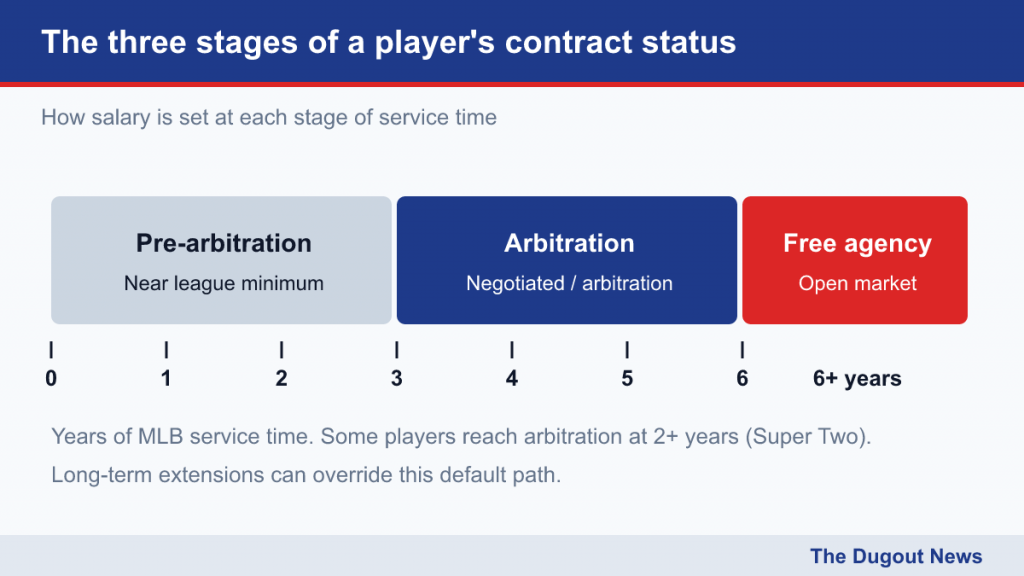
A player who comes up through a team’s system typically moves through three stages before he can sign with any club he wants.
| Stage | Service time | How salary is set |
|---|---|---|
| Pre-arbitration | Under 3 years (most players) | Team largely decides, at or near the league minimum |
| Arbitration-eligible | 3 to under 6 years (some at 2+) | Negotiated, with arbitration as a fallback |
| Free agency | 6 or more years | Open market |
Through all of this, players can and often do sign long-term extensions that override the default path, trading some future earning power for guaranteed money now. But the default stages set the leverage on both sides of the table.
Pre-Arbitration: The Minimum-Salary Years
In his first years, a player has very little bargaining power. His team can renew his contract each season at a salary it chooses, as long as it meets the league minimum. Under the CBA ratified in March 2022, the minimum salary rose from $570,500 to $700,000 for the 2022 season, with scheduled increases of $20,000 per year after that.
That agreement also added something new: a pre-arbitration bonus pool of $50 million. The pool is shared among top-performing players who have not yet reached arbitration, so that young stars receive some reward beyond the minimum during their cheapest years.
Many players entering the majors spent years in the minors first. For how that system is structured, see our guide to how Minor League Baseball works.
Salary Arbitration and Super Two
Once a player reaches three years of service, he usually becomes eligible for salary arbitration, provided his team tenders him a contract and the two sides cannot agree on a salary for the next season.
How a hearing works
Baseball uses what is often called final-offer arbitration. The player’s side and the team each submit a single salary figure. If they still cannot settle, the case goes to a hearing, and the arbitrator must pick one of the two numbers, with no splitting the difference. The decision is based largely on how the player compares with similar players’ salaries.
Because the arbitrator cannot choose a figure in between, both sides have an incentive to submit reasonable numbers, and many eligible players settle before ever reaching a hearing. Hearings that do happen can be awkward: a team must argue to a neutral party why its own player is worth less than he is asking.
Super Two
Some players reach arbitration a year early. A player with at least two but fewer than three years of service qualifies as a “Super Two” if he ranks in the top 22 percent of his service class in cumulative playing time (ties included) and spent at least 86 days on the active roster in the previous season. A Super Two player gets four years of arbitration instead of three, which can add significantly to his career earnings.
Non-tenders
Arbitration-eligible players are not guaranteed a raise. Before the tender deadline each offseason, teams must decide whether to offer contracts. A player who is not tendered a contract becomes a free agent immediately, known as a non-tender free agent. Teams use the non-tender to shed players whose projected arbitration salaries exceed their value.
Free Agency: Six Years and Out
A player with six or more years of major league service who is not under contract for the following season becomes a free agent and can negotiate with all 30 teams. That six-year threshold dates back to the 1976 collective bargaining agreement, signed shortly after the reserve clause fell.
The free agent market opens after the World Series. Many of the biggest contracts in baseball history were signed this way, because a player with six years of established performance and no draft-style restrictions can generate real bidding competition.
Qualifying offers
Teams losing a top free agent can try to recoup some value with a qualifying offer. It is a one-year contract offer set at the average of the game’s highest-paid salaries (the 125 richest contracts). The player can accept and return on that one-year deal or decline and enter the market. If he declines and signs elsewhere, his former team receives a compensatory draft pick. The qualifying offer does not restrict where the player can sign; it only attaches draft-pick consequences to the move. For more on how picks are awarded, see our explainer on the MLB draft.
The 10-and-5 rule
Veterans gain one more protection. A player with ten years of major league service, the last five with the same team, can veto any trade. This provision is sometimes called the Curt Flood rule, a nod to the player whose fight is described below.
Before Free Agency: The Reserve Clause
For most of baseball history, none of this existed. The National League made the reserve clause official in 1879. It allowed a team to keep a player’s rights even after his contract expired, so the player could not sign with another club unless he was released, traded or sold. Players’ main leverage was to hold out and refuse to play.
Legal challenges went nowhere for decades. In 1922, in Federal Baseball Club v. National League, the U.S. Supreme Court treated baseball as outside federal antitrust law, and it upheld that exemption in Toolson in 1953. Our short history of Major League Baseball gives the broader context of those eras.
Curt Flood’s challenge
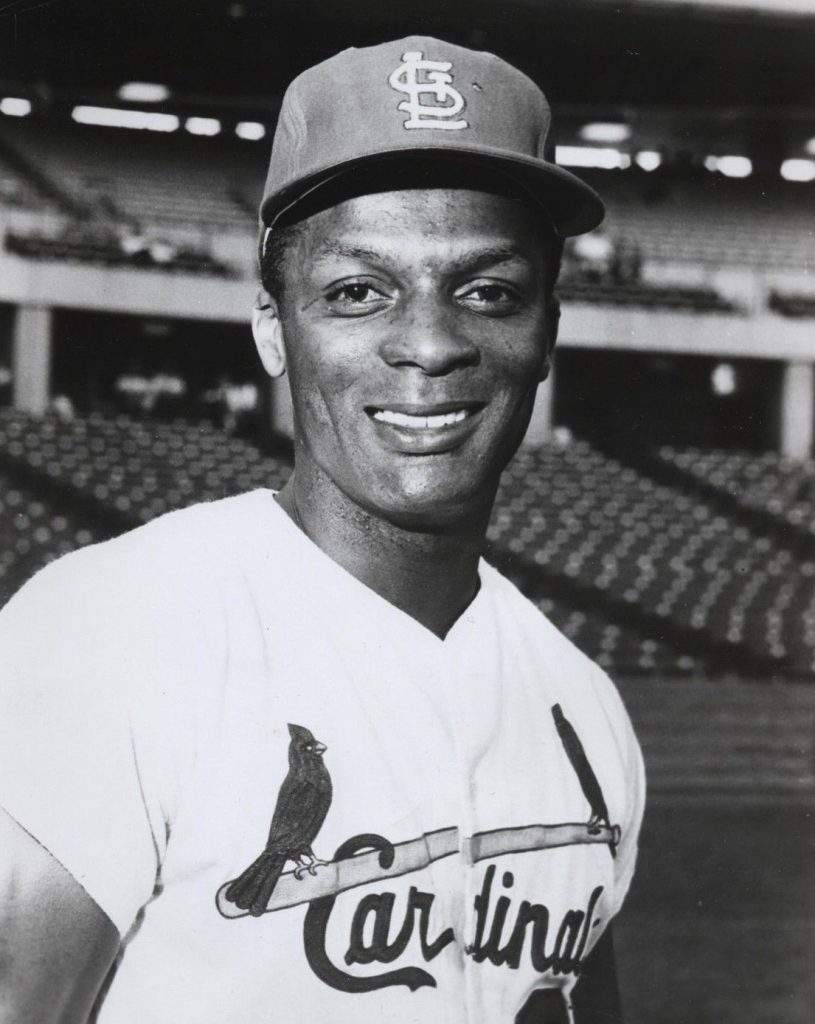
On October 7, 1969, the St. Louis Cardinals traded outfielder Curt Flood to the Philadelphia Phillies as part of a seven-player deal. Flood refused to report. On December 24, 1969, he wrote to Commissioner Bowie Kuhn: “I do not feel I am a piece of property to be bought and sold irrespective of my wishes.” He asked to be free to negotiate with other clubs.
Flood sued in January 1970. The case, Flood v. Kuhn, reached the Supreme Court, which ruled 5–3 against him on June 19, 1972, relying on the old precedent. Flood lost, but his case drew national attention to the reserve system. Much later, the Curt Flood Act of 1998 removed baseball’s antitrust exemption as it applies to major league players’ employment.
The Seitz decision
The real breakthrough came through arbitration rather than the courts. Pitchers Andy Messersmith and Dave McNally played the 1975 season without signing new contracts, and argued that the reserve clause allowed a team to renew a contract only for one additional year. In December 1975, arbitrator Peter Seitz agreed. The ruling effectively ended the perpetual reserve system.
A year earlier, in December 1974, Catfish Hunter had become a free agent when an arbitrator found that the Oakland A’s had breached his contract; his signing with the New York Yankees is often credited with ushering in the free agent era. After Seitz, owners and players negotiated the 1976 agreement that created the six-year path that, with modifications, still exists.
Common Misunderstandings
- “Service time is just years in the majors.” It is days on the major league roster or injured list. Time spent in the minors, even on the 40-man roster, does not count.
- “Arbitration is a punishment.” It is a normal salary-setting mechanism, and many cases settle before a hearing.
- “Players become free agents after six seasons.” They need six years of service, which is not the same as six calendar seasons if they spent parts of seasons in the minors.
- “A qualifying offer blocks free agency.” It does not. It only attaches draft-pick compensation if the player signs elsewhere.
Why It Matters for Fans
Understanding the service-time clock helps explain team decisions that otherwise seem strange: why a rebuilding team trades a player with two years of control left, why a contender pays a premium for an arbitration-eligible reliever, or why a club rushes to extend its young star before he reaches arbitration. It also explains why some of the best players in baseball are among the lowest paid. Their teams are simply using the years of control the system gives them.
Keep in mind that every detail described here, from minimum salaries to qualifying-offer rules, is set by the CBA and can change when a new agreement is negotiated. The figures in this article reflect the agreement ratified in 2022.