How the MLB Season Works: From Spring Training to the World Series
The full MLB calendar explained: spring training, the 162-game balanced schedule, All-Star break, trade deadline, postseason and offseason.
Major League Baseball runs on a calendar that barely stops. Pitchers and catchers report in February, the regular season stretches from late March to the end of September, the postseason fills October, and the offseason is crowded with free agency, trades and roster building. If you are new to following MLB, understanding that rhythm makes everything else, from standings to playoff races, much easier to read.
This guide covers how the league is organized, what happens in each phase of the year and why the schedule looks the way it does.
How MLB Is Organized: 30 Teams, Two Leagues, Six Divisions
MLB has 30 clubs: 29 in the United States and one in Canada, the Toronto Blue Jays. They are split evenly into two leagues, the American League (AL) and the National League (NL), with 15 teams each. The National League dates to 1876 and the American League declared itself a major league in 1901. They operated as separate organizations for most of the 20th century before merging under the Office of the Commissioner in 2000, but the AL/NL identity remains central to the standings and the postseason.
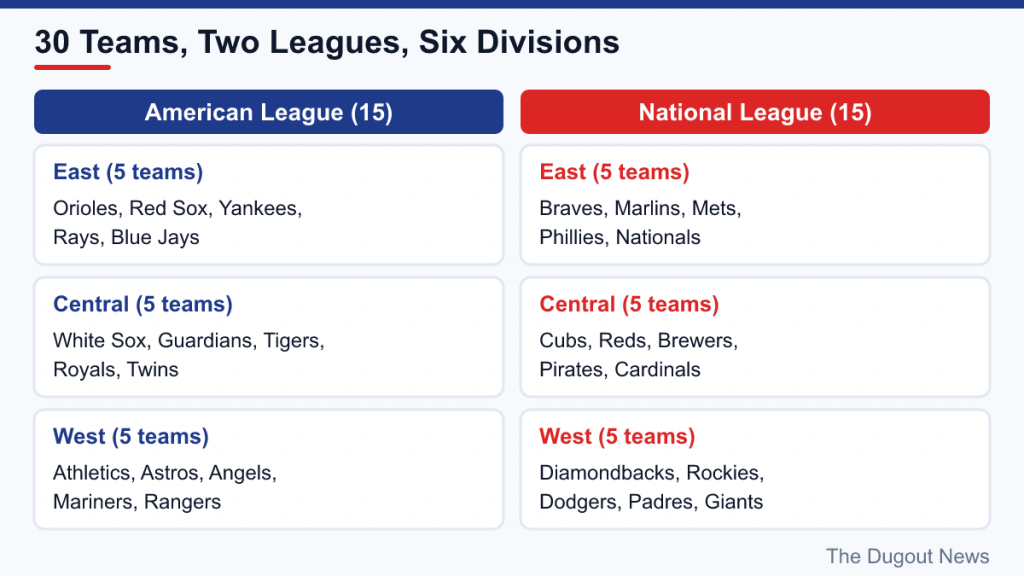
Each league has three divisions of five teams:
| League | East | Central | West |
|---|---|---|---|
| American League | Orioles, Red Sox, Yankees, Rays, Blue Jays | White Sox, Guardians, Tigers, Royals, Twins | Athletics, Astros, Angels, Mariners, Rangers |
| National League | Braves, Marlins, Mets, Phillies, Nationals | Cubs, Reds, Brewers, Pirates, Cardinals | Diamondbacks, Rockies, Dodgers, Padres, Giants |
The Athletics left Oakland after the 2024 season and are playing in West Sacramento while a ballpark is built in Las Vegas, which MLB owners approved in November 2023. They remain in the AL West.
The six-division structure has been in place since 1994. Before that, from 1969 through 1993, each league had two divisions, and before 1969 there were no divisions at all: the team with the best record in each league simply won the pennant.
Spring Training: Cactus League and Grapefruit League
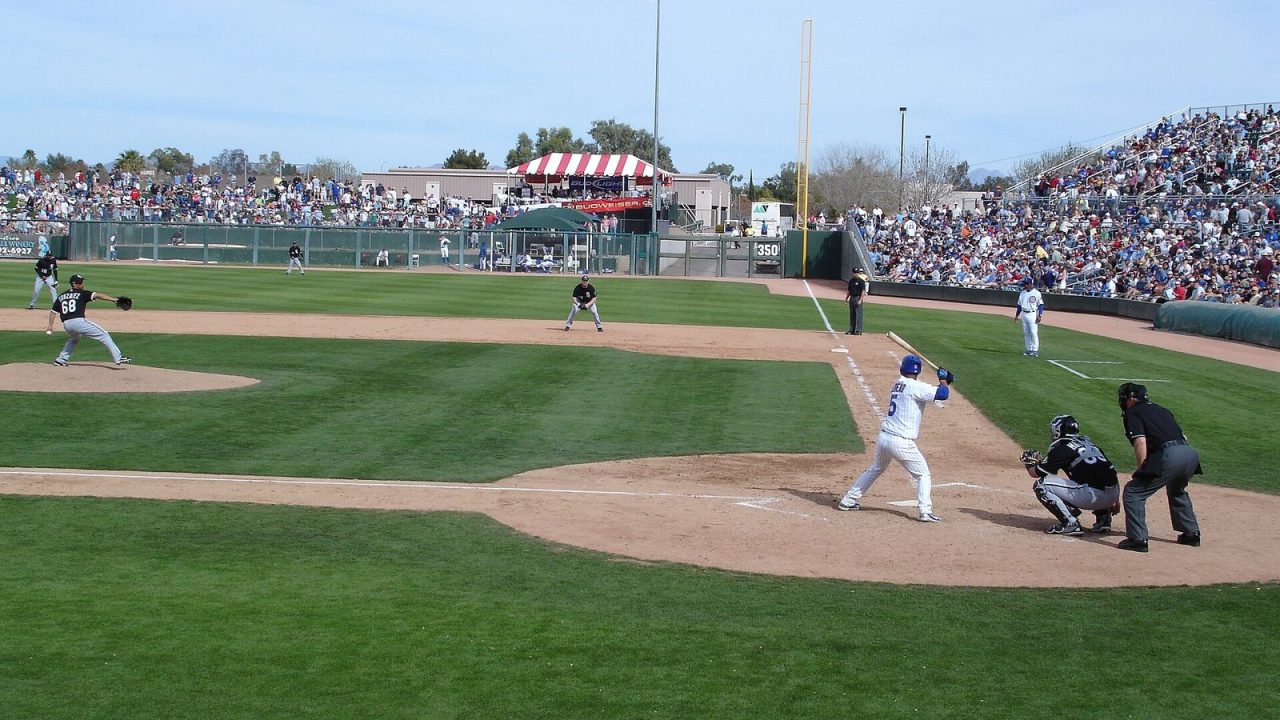
The baseball year begins in mid-February, when pitchers and catchers report to spring training, followed a few days later by the full squad. Spring training lasts roughly six weeks and takes place in two warm-weather regions:
- The Cactus League in the Phoenix area of Arizona, home to 15 clubs, mostly from the West and Midwest.
- The Grapefruit League in Florida, home to the other 15 clubs, mostly from the East and South.
Spring games, usually starting in late February, do not count in the standings. Their purpose is to get pitchers built up to full workloads, let hitters see live pitching again, and give managers and front offices a look at prospects and players competing for roster spots. Teams often split their squads and play two games on the same day, and veterans frequently play only a few innings at a time.
For fans, spring training is the most accessible part of the season. Ballparks are smaller, tickets are generally easier to get and players are closer. It is also when many rule changes get their first test in front of major league players.
In some years, spring training overlaps with the World Baseball Classic, the international tournament in which many MLB players represent their countries. The 2026 edition was held in March, so some players spent part of camp with national teams.
The 162-Game Regular Season and the Balanced Schedule
The regular season typically opens in late March or the first days of April and ends in late September or the first days of October. Each team plays 162 games, 81 at home and 81 on the road, a length that has been standard since the AL expanded in 1961 and the NL followed in 1962. The only modern seasons that fell short were those shortened by labor stoppages and the pandemic-shortened 60-game season of 2020.
Games are played in series, usually of three or four games against the same opponent in the same city. Teams typically get only a handful of off days per month, so the season becomes a test of depth and endurance as much as talent.
From 2023, MLB moved to what it calls a balanced schedule. For the first time since interleague play began in 1997, every team plays every other team at least once a season. The 2023 template broke down like this:
- 52 division games: 13 against each of the four division rivals.
- 64 games against the other 10 teams in the same league.
- 46 interleague games: four against a designated “natural rival” (such as Yankees–Mets or Cubs–White Sox) and three-game series against each of the other 14 clubs in the opposite league.
Before 2023, teams played 19 games against each division rival, which made division races highly dependent on head-to-head results and meant some stars rarely visited certain cities. The balanced format spreads the schedule more evenly, though MLB itself acknowledged that it is not balanced in the strictest sense, since division opponents still appear most often.
Midseason Milestones: All-Star Game and Trade Deadline
The All-Star break
Around the middle of July, the season pauses for the All-Star break, usually four days long. The centerpiece is the All-Star Game, an exhibition between AL and NL stars that has been played since 1933. Fans vote for the starting position players, while the pitchers and reserves are chosen through player balloting and selections by the league office. The night before, the Home Run Derby is held. The break has also become the home of the MLB Draft, which moved to All-Star week in 2021.
From 2003 to 2016, the All-Star Game decided which league had home-field advantage in the World Series. That link ended in 2017, and home field now goes to the pennant winner with the better regular-season record.
The trade deadline
The trade deadline falls in late July or the first days of August. Teams in contention “buy,” adding players for the stretch run, while teams out of the race “sell,” trading veterans for prospects. Since 2019, there has been a single deadline; before that, players could still be traded in August after clearing waivers. After the deadline, teams can still sign free agents or claim released players, but trades are essentially done until the offseason.
Players must be in a team’s organization by August 31 to be eligible for its postseason roster. On September 1, active rosters expand from 26 to 28 players, giving teams extra depth for the final month.
Reading the Standings in September
As the season winds down, standings pages fill with shorthand. Games behind (GB) measures how far a team trails the leader: add the difference in wins to the difference in losses and divide by two. A team that is 85-70 trails a 88-67 leader by three games. The wild-card standings rank all non-division-leaders in a league together, because division doesn’t matter for those three spots.
The magic number tells a leading team how many combined wins by itself and losses by the chasing team it needs to clinch. When it reaches zero, the team has clinched, and you will usually see the celebration in the clubhouse that night. The “elimination number” is the same idea from the trailing team’s point of view.
The Postseason: October Baseball
The regular season decides which teams qualify for the postseason. Since 2022, 12 teams make it, six from each league: the three division winners and three wild-card teams with the best records among the rest. There are no tiebreaker games anymore; ties in the standings are broken by formulas, starting with head-to-head record.
The bracket has four rounds:
- Wild Card Series (best-of-three): the third-seeded division winner and the three wild cards play, with the higher seed hosting every game. The top two division winners in each league get a bye.
- Division Series (best-of-five).
- League Championship Series (best-of-seven), deciding the AL and NL pennants.
- World Series (best-of-seven), between the two pennant winners.
The postseason usually runs from the first days of October until the end of the month, sometimes reaching into early November. Because playoff series are short, a hot pitching staff can carry an underdog, which is why the team with the best regular-season record does not always win the title.
The Offseason: Free Agency, Trades and Awards
The offseason is busy. Shortly after the World Series ends, eligible players become free agents and can sign with any team after a brief exclusive window for their former club. Teams decide whether to extend qualifying offers, exercise contract options and tender contracts to arbitration-eligible players.
Key events in a typical winter include:
- Awards announcements in November, including MVP, Cy Young, Rookie of the Year and Manager of the Year, voted on by members of the Baseball Writers’ Association of America.
- The Winter Meetings in early December, a gathering of executives and agents that often produces signings and trades. The Rule 5 Draft, which lets teams select certain unprotected minor leaguers from other organizations, is held at the end of the meetings.
- Salary arbitration in January and February for players with between three and six years of service time (and some “Super Two” players with slightly less).
- Hall of Fame voting results in January, with induction in Cooperstown, New York, the following summer.
By mid-February, rosters are mostly set, and the cycle begins again in Arizona and Florida.
Common Questions About the MLB Calendar
Why is the season so long?
Baseball’s daily rhythm developed in an era when ballclubs earned most of their revenue from gate receipts, and more home dates meant more income. The long season also smooths out luck: over 162 games, a strong team’s quality usually shows in the standings, even if any single game is close to a coin flip.
Do teams play doubleheaders?
Yes, but mostly to make up games postponed by rain. A “split” doubleheader has separate admissions for each game, while a traditional doubleheader lets one ticket cover both.
What happens to the minor leagues during the season?
The affiliated minor leagues play their own schedules from spring to September. Teams move players between the majors and their affiliates throughout the year, which is why rosters change constantly.