MLB Postseason Format Explained: Wild Cards, Byes and Series Lengths
How MLB's 12-team postseason works: seeding, wild cards, first-round byes, series lengths, home-field rules and how standings ties are broken.
Every October, Major League Baseball’s regular season of 162 games narrows to a bracket of 12 teams. The format can be confusing at first: some division winners skip the first round, some play right away, wild-card teams host games, and there are no longer any extra tiebreaker games. This guide lays out how the current postseason works, round by round, and how it got to this shape.
If you need a refresher on how leagues, divisions and the regular season fit together, our guide to how the MLB season works covers the full calendar.
Who Qualifies: Six Teams per League
The current format has been in place since 2022. Twelve teams qualify, six from the American League and six from the National League. In each league:
- The three division winners (East, Central and West) qualify automatically.
- The three wild cards are the three teams with the best records among all the non-division winners in that league, regardless of division.
Because the wild-card race spans the entire league, a team can finish second or even third in its own division and still make the postseason. It also means that two or three teams from the same strong division can qualify in a single year.
Seeding and the First-Round Byes
Teams are seeded one through six in each league, and the seeding rules strongly favor winning a division:
- Seeds 1, 2 and 3 go to the three division winners, ordered by regular-season record.
- Seeds 4, 5 and 6 go to the wild cards, ordered by record.
This means a division winner is always seeded above every wild card, even if a wild-card team had a better record. A 100-win wild card can be the No. 4 seed behind a division winner with far fewer wins.
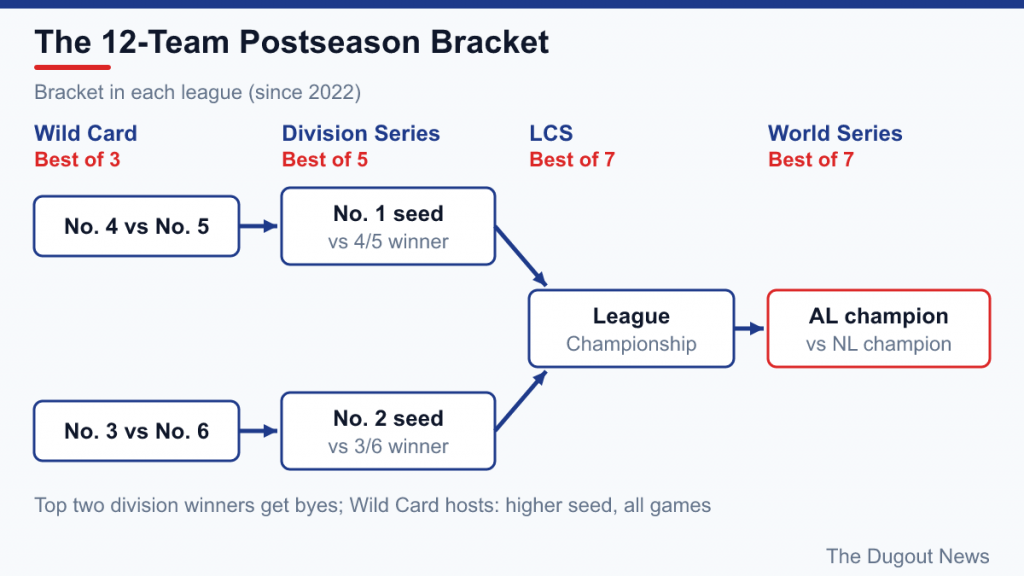
The biggest reward goes to the top two seeds. The No. 1 and No. 2 seeds in each league receive a bye past the first round and go straight to the Division Series. That gives them rest and lets them line up their starting rotations, though it also means a layoff of several days while the first round is played, a trade-off that managers and fans debate every year.
Round by Round: The Bracket
| Round | Format | Matchups | Home games |
|---|---|---|---|
| Wild Card Series | Best-of-three | No. 3 vs. No. 6; No. 4 vs. No. 5 | Higher seed hosts all games |
| Division Series | Best-of-five | No. 1 vs. 4/5 winner; No. 2 vs. 3/6 winner | 2-2-1 |
| League Championship Series | Best-of-seven | Division Series winners in each league | 2-3-2 |
| World Series | Best-of-seven | AL champion vs. NL champion | 2-3-2 |
Wild Card Series
The first round is a best-of-three series, and all three games are played at the higher seed’s ballpark. That gives the No. 3 and No. 4 seeds a meaningful edge and makes the race for those spots matter even among teams already assured of a postseason berth. The short format also makes the round the most volatile in the bracket, since a single great pitching performance can swing it.
Division Series
The Division Series is a best-of-five in a 2-2-1 format: two games at the higher seed, two at the lower seed and a deciding Game 5, if needed, back at the higher seed. The bracket is fixed, with no reseeding. The No. 1 seed always plays the winner of the 4 vs. 5 series, and the No. 2 seed always plays the winner of the 3 vs. 6 series, even if the 6 seed pulls an upset.
League Championship Series
The ALCS and NLCS are best-of-seven in a 2-3-2 format. The team with the better regular-season record generally holds home-field advantage, with an important exception: a wild card does not get the extra home game over a division winner. A wild card only hosts Games 1, 2, 6 and 7 if both LCS teams are wild cards and it has the better record.
World Series
The World Series is also best-of-seven, 2-3-2. Since 2017, home-field advantage goes to the pennant winner with the better regular-season record. From 2003 through 2016, it was decided by the result of the All-Star Game, and before that it alternated between leagues.
How Ties in the Standings Are Broken
One of the most significant changes in the 2022 format was the elimination of tiebreaker games, often called “Game 163.” In the past, if two teams finished tied for a division title or a playoff spot, they played an extra game to decide it. Now, ties are settled by formula.
The criteria are applied in order:
- Head-to-head record between the tied teams.
- Record within the division.
- Record within the league against teams outside the division.
- Record in the last half of intra-league games, extending back one game at a time if still tied.
The same rules determine seeding among teams that are already in. In practice, head-to-head record decides most ties, which gives regular-season series between contenders extra weight in September. Because of the balanced schedule introduced in 2023, teams in different divisions play each other fewer times, so a handful of games in April or May can end up deciding a playoff spot.
How the Format Evolved
The 12-team bracket is the product of more than a century of expansion:
- 1903–1968: The postseason was just the World Series, between the American League and National League pennant winners. The first World Series, in 1903, was a best-of-nine won by Boston of the AL over Pittsburgh. Because that first series was an arrangement between the clubs rather than the leagues, there was none in 1904; it became a permanent fixture from 1905.
- 1969: With expansion, each league split into two divisions, and the League Championship Series was added as a best-of-five. It became a best-of-seven in 1985.
- 1981: A strike split the season in half, producing a one-time extra round.
- 1994–1995: Leagues moved to three divisions, and a wild card and Division Series were added, creating an eight-team postseason. The 1994 postseason was canceled by the players’ strike, so the format debuted in 1995.
- 2012: A second wild card was added in each league, with the two wild cards meeting in a single-elimination Wild Card Game. That created a 10-team field.
- 2020: In the pandemic-shortened 60-game season, a one-time 16-team postseason was used, with best-of-three first-round series. The league returned to 10 teams in 2021.
- 2022: The current 12-team format, with byes and best-of-three Wild Card Series, was introduced.
Recent Champions Under the 12-Team Format
Through the 2025 postseason, the champions under the current format have been:
- 2022: Houston Astros
- 2023: Texas Rangers
- 2024: Los Angeles Dodgers
- 2025: Los Angeles Dodgers, who beat the Toronto Blue Jays in a seven-game World Series that ended in 11 innings in Game 7, becoming the first team to win back-to-back titles since the New York Yankees of 1999 and 2000.
The 2025 bracket also illustrated how the seeding rules work in practice. The Dodgers won the NL West but were the No. 3 seed, so they had to play in the Wild Card Series, which they swept, before going on to win the pennant and the title. The top seeds that year, Toronto in the AL and Milwaukee in the NL, both used their byes to reach the League Championship Series.
Strategy: How the Format Shapes Teams’ Decisions
The race for a bye
Because the top two seeds skip a best-of-three coin flip, the gap between finishing second and third among division winners is huge. Contending clubs often keep playing their regulars hard into late September for this reason.
Pitching depth
Short series reward teams that can lean on a few top starters and a strong bullpen. Off days between postseason games also allow managers to use their best pitchers more often than in the regular season, which is why rotations sometimes shrink to three or four starters in October.
Roster construction
Postseason rosters are 26 players, and teams can adjust them between rounds. Players generally must have been in the organization by August 31 to be eligible. Clubs often carry extra relievers in short series and add a starter back for longer ones.
Common Questions
Can a wild card win the World Series?
Yes. Wild cards have won several titles since the format was introduced in 1995. A wild card has a longer road, especially the No. 5 and No. 6 seeds, who must win four rounds, but short series make upsets common.
Does the team with the best record get home-field advantage throughout?
In the Wild Card Series, the higher seed hosts every game. After that, home-field advantage goes to the higher seed in the Division Series and generally to the better record in the LCS and World Series, with the wild-card exception noted above for the LCS.
What happens if a game is rained out?
If weather prevents play, the game is postponed and the rest of the schedule shifts, which can wipe out a planned off day and change how managers line up their pitchers for the rest of the series.
Do the top seeds always advance?
No. Teams coming off a bye have sometimes struggled after several days without a game, while lower seeds arrive with momentum from the Wild Card Series. Over a best-of-five, the gap between a 95-win team and an 88-win team is small, and pitching matchups often matter more than season records.
Why are there no reseedings?
A fixed bracket lets teams and broadcasters plan travel and schedules in advance. The trade-off is that a top seed cannot be guaranteed the lowest-remaining opponent.
Is the format permanent?
It was agreed under the collective bargaining agreement that took effect in 2022. Any future change to the number of teams or rounds would need agreement between MLB and the players’ union.