The Strike Zone Explained: Official Definition and How It Is Called
What the rulebook says the strike zone is, how it moves with each batter, why umpires' zones differ, and how pitch tracking and ABS measure it.
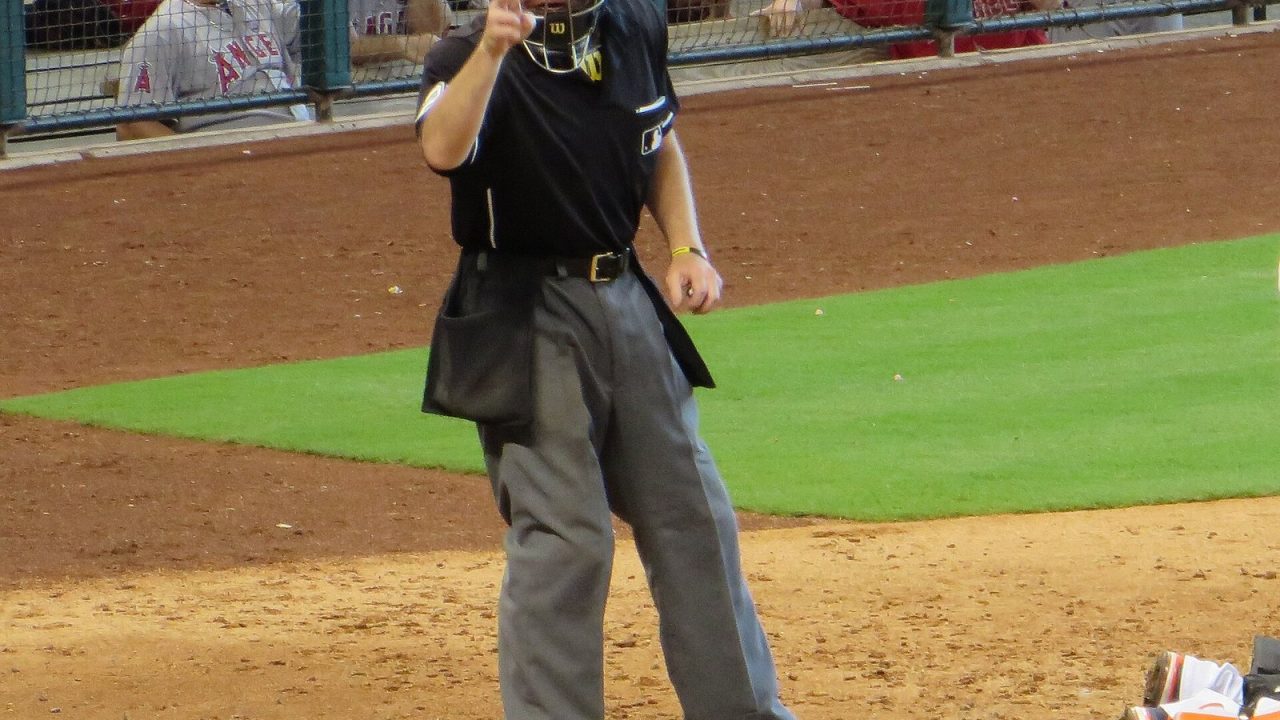
Every pitch in a baseball game is judged against an invisible box. If the batter does not swing, the home plate umpire has a fraction of a second to decide whether the ball passed through it. Yet the strike zone is one of the most misunderstood parts of the sport: broadcasters draw a rectangle on screen that is not quite the umpire’s, and the rulebook definition is shorter than most people expect.
This guide walks through the official wording, how the zone changes from batter to batter, why the zone that gets called on the field does not perfectly match the one in the book, and how modern pitch tracking measures it. If you are new to balls, strikes and counts in general, start with our baseball rules for beginners guide first.
The Official Definition in the Rulebook
The Official Baseball Rules define the strike zone in the “Definitions of Terms” section. The wording is:
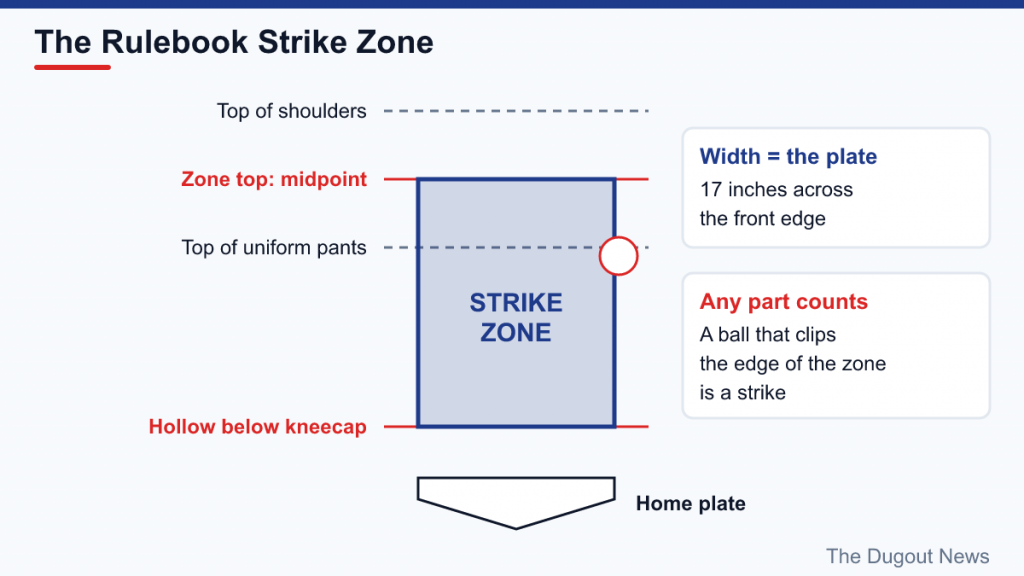
“The STRIKE ZONE is that area over home plate the upper limit of which is a horizontal line at the midpoint between the top of the shoulders and the top of the uniform pants, and the lower level is a line at the hollow beneath the kneecap. The Strike Zone shall be determined from the batter’s stance as the batter is prepared to swing at a pitched ball.”
Three pieces of that sentence matter most:
- Over home plate. The width of the zone is the width of the plate. Home plate is a five-sided slab of whitened rubber that is 17 inches across the front edge facing the pitcher.
- The top. Not the letters on the jersey and not the armpits, but the midpoint between the top of the shoulders and the top of the pants. On most hitters this falls somewhere around the middle of the torso.
- The bottom. The “hollow beneath the kneecap,” the soft spot just below the knee, not the top of the knee.
The rule defining a strike adds a crucial detail: a pitch that is not swung at is a strike “if any part of the ball passes through any part of the strike zone.” The ball does not have to be fully inside. A pitch that merely clips the edge of the zone is, by rule, a strike.
A Three-Dimensional Zone, Not a Flat Box
Television graphics show the strike zone as a flat rectangle, but the rulebook describes an area over home plate. Because the plate has depth (it is 17 inches from the front edge to the point at the back), the real zone is a three-dimensional volume shaped like the plate, extending upward from the knee hollow to the midpoint of the torso.
That has practical consequences. A breaking ball that is above the zone as it crosses the front of the plate can still drop through the top of the zone before it leaves the back of the plate, and by rule that is a strike. A sinker that crosses the front corner and then runs off the plate has still passed through the zone. This is one reason pitches that “looked low” or “looked outside” on a center-field camera can be legitimate strikes.
The size of the ball also matters. A regulation baseball is a little under three inches in diameter. Since any part of the ball touching any part of the zone counts, the effective width for the center of the ball is the 17-inch plate plus roughly half a ball’s width on each side, close to 20 inches in total. The same logic stretches the effective top and bottom by a ball’s radius.
Why the Zone Changes With Every Batter
The last sentence of the definition is the one that causes the most debate: the zone is “determined from the batter’s stance as the batter is prepared to swing at a pitched ball.” In other words, there is no single strike zone in baseball. There is a zone for each hitter, and it depends on how he stands.
- Tall hitters have taller zones, because their shoulders, belt and knees are higher off the ground.
- Hitters who crouch shrink their own zones. A deep crouch lowers the midpoint of the torso and the knees at the same time.
- Hitters who stand upright present a larger target than a hitter of the same height with a bent stance.
Note the phrase “as the batter is prepared to swing.” The umpire is not supposed to judge the zone from how a batter stands while waiting for the pitcher, or from how he ducks away from an inside pitch. It is the stance at the moment he is ready to hit. That is a moving target, which is part of why calling balls and strikes is so difficult.
How the Definition Has Changed Over Time
The strike zone has been rewritten several times as baseball tried to balance hitting and pitching.
- The early game. In the 1840s, a strike was simply a swing and a miss; called strikes and called balls came later.
- 1887. The National League established a zone running from the batter’s knees to his shoulders.
- Early 1960s. After a burst of home runs, the top of the zone was raised to the top of the shoulders.
- 1969. After the pitching-dominated 1968 season, the zone was shrunk to run from the armpits to the top of the knees, and the mound was lowered from 15 inches to 10 inches.
- 1980s. The top was lowered to the midpoint between the shoulders and the top of the pants, the wording still used today.
- Later revisions moved the bottom from the top of the knee to the hollow beneath the kneecap, which is where it sits in the current rulebook.
The written zone is one thing; the enforced zone is another. History shows that how umpires call pitches has often moved more than the rulebook itself.
The Rulebook Zone vs. the Called Zone
Ask any player and they will tell you the zone that matters is the one the umpire calls. Several factors make that zone differ from the rulebook version:
Human perception
The plate umpire sets up behind the catcher, usually looking over his shoulder from the slot between the catcher and the batter. From that angle he has to judge a ball moving at high speed, often with late movement, passing through a three-dimensional space over a plate he cannot see clearly once the catcher is set. The top and bottom of the zone are also not marked on anything; they have to be estimated from the batter’s body.
Rounded corners and edges
Pitch-tracking data has shown for years that the called zone is not a perfect rectangle. Pitches in the corners are called strikes less often than pitches on the edges near the middle, giving the called zone a rounded shape. Pitches right on the borderline are called inconsistently, which is exactly what you would expect from a human making a split-second judgment.
Context and the catcher
How the catcher receives a pitch influences the call. Catchers who catch borderline pitches quietly, without jerking the glove, tend to get more of them called strikes; this skill is known as framing. Count and game situation have also been studied as influences on borderline calls.
Individual umpires
Each umpire has tendencies, some slightly wider, some tighter. Because the zone shifts with every hitter’s stance and every umpire’s eye, no two games are called exactly alike.
How Pitch Tracking Measures the Zone
For most of baseball history, no one could prove whether a pitch was a strike. Technology changed that.
- QuesTec. In the early 2000s, MLB used the QuesTec system in a number of ballparks to evaluate umpires. It was controversial with players; in 2003, pitcher Curt Schilling famously damaged a QuesTec camera after a loss. Many observers believed the enforced zone grew closer to the rulebook definition during the QuesTec years.
- PITCHf/x. First used in the 2006 postseason, this camera-based system measured each pitch’s speed, movement and location and made pitch-by-pitch data public for the first time.
- Zone Evaluation. In 2009, MLB replaced QuesTec with Zone Evaluation in all 30 parks. It tracks the ball many times before it reaches the plate and is used to grade umpires, which feeds into decisions such as postseason assignments.
- Statcast. Rolled out to all 30 ballparks in 2015, Statcast combined radar and optical tracking. TrackMan radar took over official pitch-speed measurement in 2017, and the system now uses high-speed Hawk-Eye cameras.
Broadcast graphics built on this data usually draw a flat, standardized box, while the rulebook zone is three-dimensional and tied to the batter’s stance, so a pitch that looks a hair outside on screen can still be a correct call.
ABS: The Automated Strike Zone
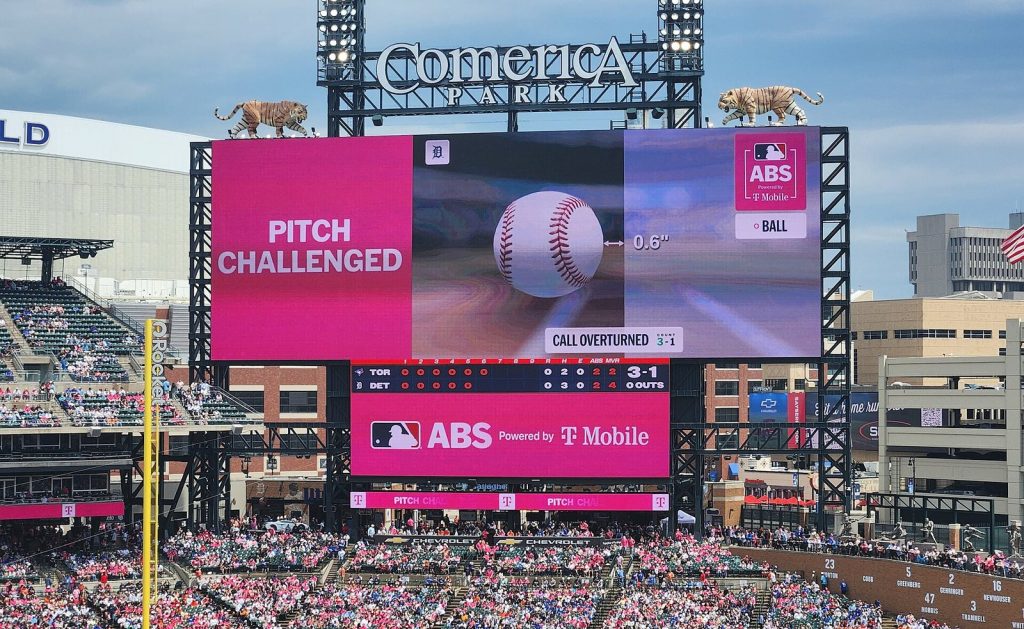
The newest chapter is the Automated Ball-Strike system, often called “robot umpires.” Rather than reading the batter’s stance, ABS uses a standardized zone based on each player’s height. In its current form:
- The zone is 17 inches wide, the width of the plate.
- The top is set at 53.5% of the batter’s height and the bottom at 27%.
- The call is made based on where the ball is as it crosses the midpoint of the plate, 8.5 inches from the front, rather than anywhere in a three-dimensional volume.
ABS was tested extensively in the minors, including all Triple-A parks from 2023, and in MLB spring training before the 2025 season. In September 2025, MLB’s competition committee approved the ABS Challenge System for the 2026 regular season. Human umpires still call every pitch, but each team gets two challenges per game, keeps a challenge when it is successful, and only the batter, pitcher or catcher can challenge, by tapping the cap or helmet immediately after the call. Managers cannot challenge balls and strikes.
That means that, as of the 2026 season, two definitions coexist: the rulebook zone the umpire is judging, and the height-based ABS zone used to resolve challenges. Most pitches are still called by a human; only the borderline ones a player is confident about get sent to the computer.
Common Misconceptions About the Strike Zone
“The ball has to be completely inside the zone.”
No. Any part of the ball passing through any part of the zone is enough.
“It is measured where the catcher catches it.”
No. Where the catcher’s glove ends up does not matter by rule. A curveball that crosses the zone and is caught at the catcher’s shins is still a strike. This is also why catchers try to receive low pitches without letting the glove sag, so the umpire’s eye is not fooled in the other direction.
“The zone is the same for everyone.”
Not under the rulebook. It is built around each batter’s stance. Under ABS, it is built around each batter’s height, which is more consistent but still differs between hitters.
“A strike is any pitch the batter swings at.”
A swing and miss is a strike no matter where the pitch is, and so is a foul ball with fewer than two strikes. The strike zone only matters on pitches the batter takes. A pitch that touches the batter while it is in the zone is also a strike, not a hit by pitch.
The strike zone is a deceptively simple rule: a box over the plate between the knee hollow and the midpoint of the torso. Calling it consistently, pitch after pitch, is one of the hardest jobs in sports.