Types of Pitches in Baseball: Fastballs, Breaking Balls and Offspeed
A guide to baseball's main pitches, from four-seamers and sinkers to sliders, sweepers, curveballs, changeups, splitters and the knuckleball.
Every pitch in baseball is a small deception. The pitcher’s goal is not just to throw hard or make the ball move, but to make different pitches look the same out of his hand for as long as possible, so the hitter has to decide whether to swing before he knows what is coming.
Pitches fall into three broad families: fastballs, breaking balls and offspeed pitches. This guide covers the main pitches in each group: how they are generally gripped, how they move and how pitchers use them together. One caveat runs through all of it: grips and movement vary from pitcher to pitcher, and two pitches with the same name can behave quite differently depending on arm angle, spin and release.
How Pitches Move: A Quick Primer
Pitch movement comes mostly from spin. A ball spinning through the air pushes air unevenly around it, and that pressure difference nudges the ball in a direction determined by the spin’s axis. Seams add another layer, because their orientation affects how air flows off the ball.
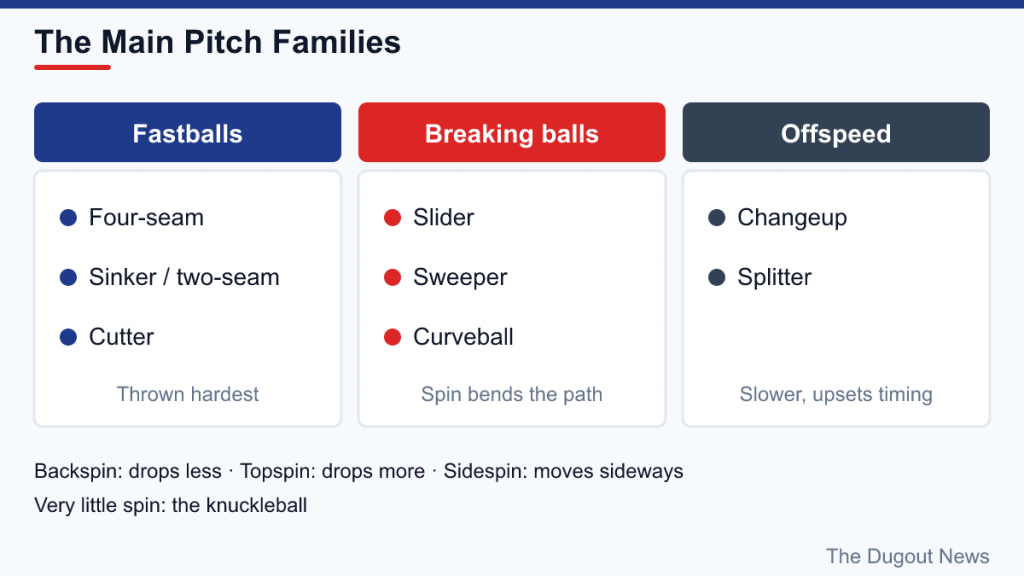
- Backspin, typical of a fastball, makes a pitch fall less than gravity alone would cause. Hitters often describe a high-backspin fastball as “rising,” although it is really just dropping less than expected.
- Topspin, typical of a curveball, adds to the drop.
- Sidespin moves the ball horizontally.
- Very little spin, the goal of the knuckleball, leaves the ball at the mercy of the seams and air currents.
A pitch’s speed matters as much as its movement. Breaking and offspeed pitches are slower than fastballs, and the difference in speed disrupts a hitter’s timing.
Throughout this guide, “arm side” means the side of the plate where the pitcher’s throwing arm is, and “glove side” means the opposite direction. For a right-handed pitcher, a glove-side pitch moves toward the third-base side of the plate as he sees it, which means away from a right-handed batter.
Fastballs
Fastballs are generally thrown as hard as a pitcher can while keeping control. They are the foundation of most pitchers’ repertoires, and the pitch everything else plays off.
Four-Seam Fastball
The four-seamer is the most common pitch in baseball. It is gripped across the wide part of the horseshoe seam so that four seams rotate through the air on every turn, producing a lot of backspin and the straightest, usually fastest, flight of any pitch a pitcher throws. Pitchers often use it up in the strike zone, where its “carry” makes hitters swing under it.
Sinker and Two-Seam Fastball
The sinker and two-seamer are gripped along or with the narrow seams. They are usually thrown with a slightly different spin axis than the four-seamer, so they run toward the pitcher’s arm side and drop more. Statcast groups them as sinkers. The pitch is designed to induce ground balls: hitters make contact on the top of the ball and pound it into the dirt.
Cutter
The cut fastball sits between a fastball and a slider. Thrown with slightly off-center pressure, it breaks a few inches toward the pitcher’s glove side late in its flight. Against opposite-handed hitters, a cutter that moves in on the hands can break bats; against same-side hitters, it moves away from the barrel.
Breaking Balls
Breaking balls are spun pitches that move sideways, downward or both. They are slower than fastballs and make hitters guess on both location and timing.
Slider
The slider is generally one of the faster breaking balls, usually thrown somewhere around 80 to 90 mph. For a right-handed pitcher, it typically breaks to his glove side, away from a right-handed hitter, and it shows more lateral movement than a curveball. Some sliders have more vertical than horizontal break, depending on arm slot, the pitcher’s wrist action and preference.
Sweeper
The sweeper is a variation of the slider that is generally a bit slower but has much more lateral movement. Rather than diving down, it “sweeps” across the plate. It became so widely used that Baseball Savant, MLB’s Statcast data site, lists it as a separate pitch type from the traditional slider in its pitch-arsenal tools.
Curveball
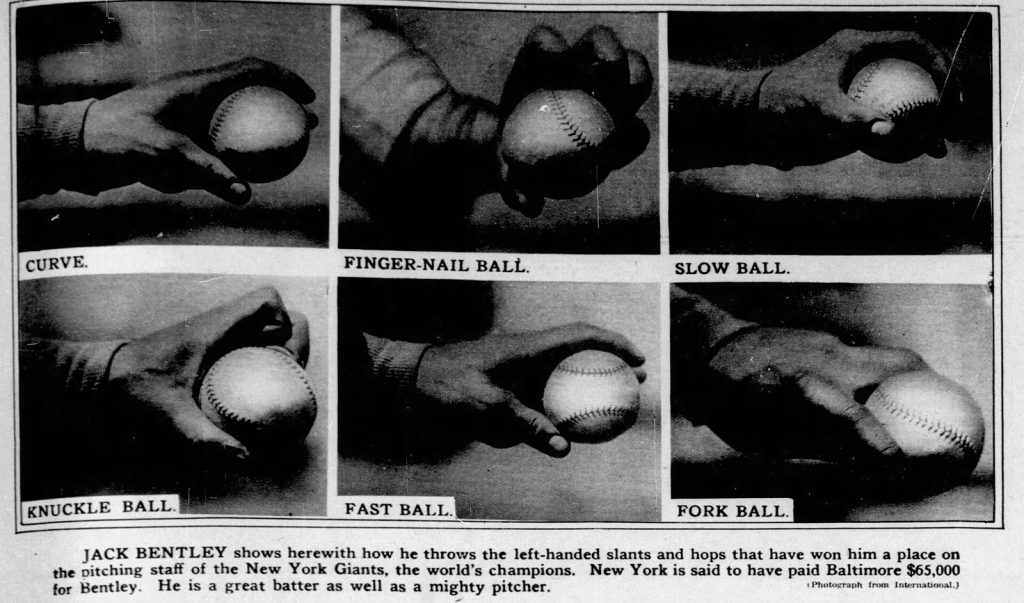
The curveball is held somewhat like holding a cup, with the middle finger along a seam and the thumb on the opposite seam. The pitcher snaps his wrist and arm downward to create topspin, the opposite of a fastball’s backspin, so the pitch dives. Compared with the same pitcher’s fastball, a curveball can break roughly 7 to 20 inches.
- A 12-6 curveball, thrown from a nearly vertical arm slot, drops straight down, like a clock’s hands pointing from 12 to 6.
- The knuckle curve is a curveball variant thrown with one or more fingers tucked on the ball.
- A slurve blends slider and curveball characteristics, with both sweep and depth.
Curveballs are much slower than fastballs. At the college level and above, they typically sit in the mid-60s to around 80 mph, and the MLB average in 2025 was roughly 80 mph. The pitch has deep roots: Candy Cummings, a star of the 1860s and 1870s, is widely credited with inventing it.
Offspeed Pitches
Offspeed pitches are designed to look like fastballs out of the hand but arrive much slower. They depend on deception: the arm speed should match the fastball, so the hitter’s brain reads “fastball” and swings too early.
Changeup
The changeup is thrown with a fastball motion but held further back in the hand, which reduces its speed. It is typically 8 to 15 mph slower than a pitcher’s fastball. Common varieties include:
- Circle changeup: thumb and index finger form a circle on the side of the ball; often fades toward the arm side.
- Straight changeup: a simple palm-deep grip.
- Vulcan changeup and palmball: less common variations named for their unusual grips.
The changeup is especially effective against opposite-handed hitters, because it fades away from them.
Splitter
The split-finger fastball, or splitter, is gripped with the index and middle fingers spread apart around the ball. It is thrown with fastball arm action but comes out with reduced spin and tumbles downward late, often appearing to “fall off the table.” It is a strikeout pitch, often thrown below the zone with two strikes. The forkball is an older, more extreme version with the ball jammed deeper between the fingers.
Screwball
Once a signature pitch for a few famous pitchers, the screwball breaks toward the pitcher’s arm side, the opposite of a slider or curveball. It is rarely seen today but still appears as a category in Statcast’s pitch lists.
The Knuckleball and Other Oddities
The knuckleball is baseball’s great outlier. Despite the name, modern knuckleballers usually grip the ball with their fingertips, sometimes digging in their fingernails. The goal is to throw it with almost no spin. Without spin, airflow around the stitched seams becomes uneven and unpredictable, and the ball darts and flutters on its way to the plate. Not even the pitcher knows exactly where it will go, which makes it hard to catch as well as hard to hit.
The knuckleball typically travels around 60 to 70 mph, far slower than a typical big-league fastball. Famous practitioners include Hall of Famer Phil Niekro and longtime Red Sox pitcher Tim Wakefield. R.A. Dickey won the 2012 National League Cy Young Award, the first knuckleballer to win the award.
The eephus is a rare, very slow, high-arcing lob thrown mainly for surprise.
How Pitchers Combine Pitches
A single great pitch is rarely enough. What makes pitchers effective is how their pitches work together.
Tunneling
If two pitches come out of the hand on the same path for the first part of their flight, the hitter cannot tell them apart until it is too late. A four-seamer up in the zone and a curveball that starts on the same line but drops below the zone are a classic pairing. Analysts call this “tunneling.”
Changing Speeds
Hitting is timing. A changeup after a fastball, or a fastball after a run of breaking balls, forces the hitter to adjust by a fraction of a second. Even a modest speed difference can produce weak contact or an awkward swing.
Changing Eye Levels and Sides
Pitchers move hitters’ eyes up and down (fastball high, splitter low) and in and out (cutter in, sweeper away). The rulebook strike zone, explained in our strike zone guide, defines the target, but pitchers spend much of their time just off its edges.
Platoon Matchups
Breaking balls that move away from same-handed hitters are a major reason right-handed pitchers tend to do better against right-handed hitters, and lefties against lefties. Pitchers counter opposite-handed hitters with changeups, splitters and cutters that move in useful directions.
Pitch Count and Situation
Early in the count, many pitchers try to get ahead with fastballs or a breaking ball for a called strike. With two strikes, they turn to “chase” pitches: a slider off the plate, a splitter in the dirt, a high fastball above the hands. With runners on base, a ground-ball sinker can set up a double play. Since 2023, pitchers also have to manage all of this within the pitch clock, which leaves less time to shake off signs.
How to Identify Pitches While Watching
- Check the speed. The broadcast’s radar reading is the easiest clue. A pitch well below the pitcher’s usual fastball velocity is a breaking ball or offspeed pitch.
- Watch the shape. Big, looping drop suggests a curveball; hard, late sideways break suggests a slider or cutter; wide horizontal movement suggests a sweeper; late downward dive at near-fastball speed suggests a splitter.
- Watch the catcher. A catcher reaching across his body or dropping his glove to the dirt tells you where the pitch moved.
- Learn the pitcher. Broadcasts and Statcast pages list each pitcher’s arsenal. Knowing that a pitcher throws four pitches narrows the guessing.
Common Misconceptions
- “Fastballs rise.” They do not; a backspinning fastball simply drops less than hitters expect.
- “Curveballs ruin young arms.” Youth arm health is a complicated topic with many factors, including overall workload. Young pitchers and parents should follow their league’s pitch-count guidelines and consult qualified coaches or medical professionals.
- “A slider and a cutter are the same.” They are related, but a cutter is closer to a fastball in speed with smaller, later break, while a slider is slower with more break.
- “Every pitcher throws every pitch.” Most pitchers rely on two to four pitches, and relievers often fewer.
To see where pitchers fit into the defense as a whole, our guide to the nine baseball positions covers the pitcher’s other responsibilities, from fielding bunts to covering first.