What Is a Balk? The Balk Rule Explained Simply
What a balk is, why the rule exists, the most common balks, the penalty, and why it only matters when runners are on base. Based on Rule 6.02(a).
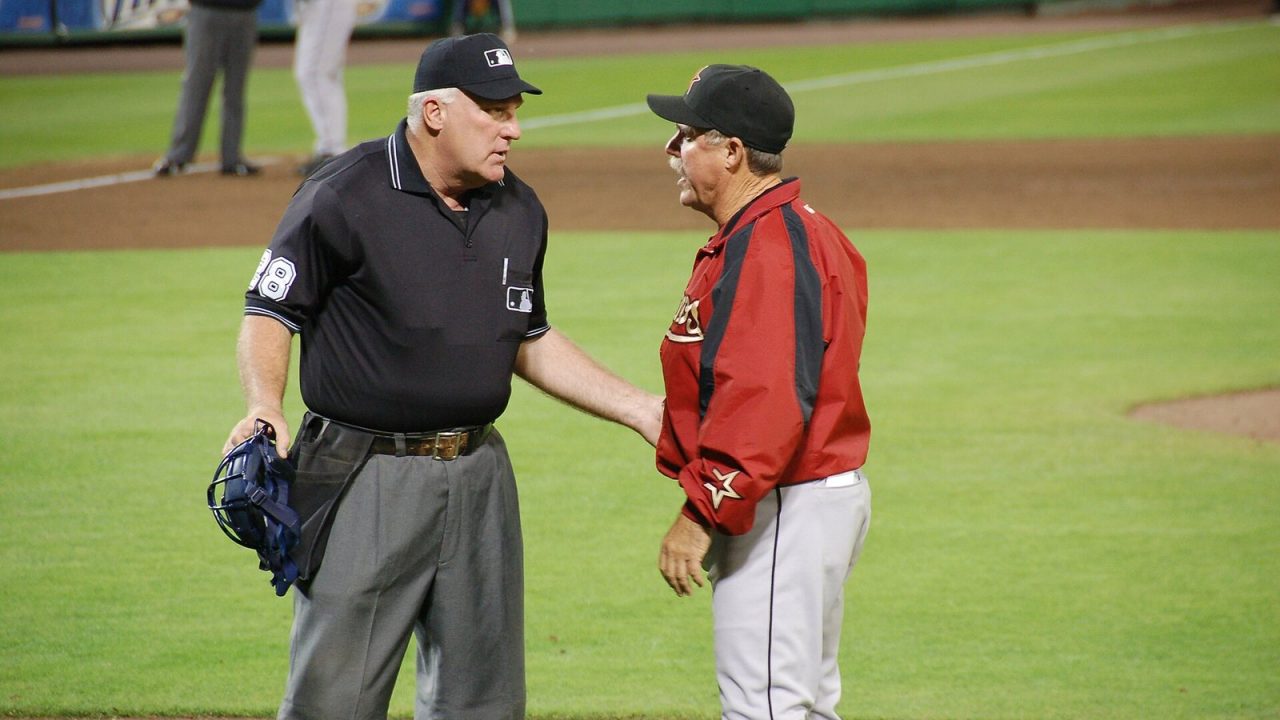
The balk might be the most misunderstood call in baseball. A pitcher twitches on the mound, the umpire points and shouts, runners trot to the next base, and half the crowd has no idea what happened. Even players and managers argue about balks regularly.
The good news is that the core idea is simple. Once you know what the rule is trying to prevent, most balk calls make sense. This guide explains the purpose of the rule, the most common ways pitchers balk, the penalty and a few unusual cases, based on Rule 6.02(a) of the Official Baseball Rules.
The Purpose: No Deceiving the Runner
The rulebook says it directly: the purpose of the balk rule is “to prevent the pitcher from deliberately deceiving the base runner.” If an umpire is in doubt, the rule tells him that “the ‘intent’ of the pitcher should govern.”
Think about what a baserunner is doing. He takes a lead off his base and watches the pitcher closely. The moment he is sure the pitcher is throwing home, he can run or extend his lead. If the pitcher could start his delivery and then suddenly throw to first, or fake a pitch to freeze the runner, the runner would have no fair chance. The balk rule creates a set of clear commitments: once the pitcher starts certain motions, he must follow through.
That is also why balks only apply with runners on base. With the bases empty, there is no runner to deceive. The same illegal actions with nobody on base are generally treated as an “illegal pitch,” and the penalty is a ball added to the batter’s count, as described in Rule 6.02(b).
A Quick Primer: Windup and Set Positions
Most balks involve the two legal pitching positions defined in Rule 5.07(a):
- The Windup Position: the pitcher faces the batter with his pivot foot on the rubber and his other foot free. Once he makes any natural motion associated with his delivery, he is committed to pitching without interruption.
- The Set Position (the stretch): the pitcher stands with his pivot foot on the rubber and his other foot in front of it, holds the ball in both hands in front of his body and comes to a complete stop. From the set, he can pitch, throw to a base or step back off the rubber with his pivot foot.
Most pitchers use the set position with runners on base because it is quicker and makes it easier to hold runners. The rules say that with runners on, a pitcher standing with his pivot foot on and parallel to the rubber and his other foot in front of it is presumed to be in the set position unless he tells the umpire he is using the windup.
The key: a pitcher who steps off the rubber with his pivot foot becomes an infielder. He can then throw anywhere or fake a throw without risk of a balk.
The Thirteen Balks in the Rulebook
Rule 6.02(a) lists 13 specific balks. With a runner or runners on base, it is a balk when the pitcher:
- While touching the rubber, makes any motion naturally associated with his pitch and fails to deliver it.
- While touching the rubber, feints a throw to first or third base and fails to complete the throw.
- While touching the rubber, fails to step directly toward a base before throwing to that base.
- While touching the rubber, throws or feints a throw to an unoccupied base, except to make a play.
- Makes an illegal pitch (a quick pitch, for example).
- Delivers the ball while not facing the batter.
- Makes any motion naturally associated with his pitch while not touching the rubber.
- Unnecessarily delays the game.
- Stands on or astride the rubber without the ball, or feints a pitch while off the rubber.
- After coming to a legal pitching position, removes one hand from the ball other than in an actual pitch or throw to a base.
- While touching the rubber, accidentally or intentionally drops the ball.
- While giving an intentional walk, pitches when the catcher is not in the catcher’s box.
- Delivers the pitch from the set position without coming to a stop.
The Most Common Balks, in Plain English
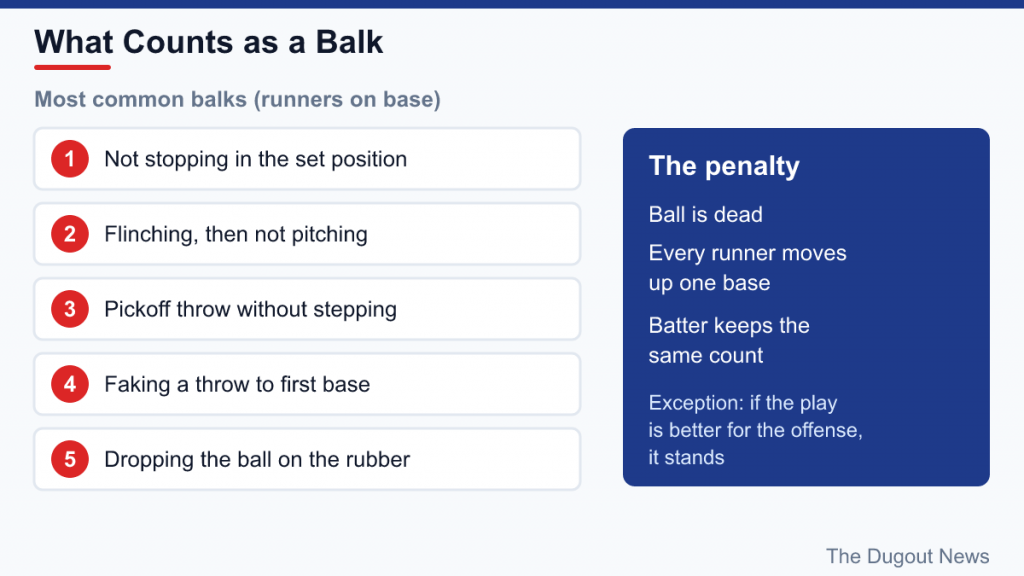
Not Stopping in the Set
This is the classic. From the stretch, the pitcher must come to a complete stop before delivering. The rulebook stresses that “this must be enforced” and that pitchers “are constantly attempting to ‘beat the rule'” when trying to hold runners. If the pitcher’s hands come together and he goes straight into his delivery without a discernible pause, the umpire should call a balk.
Flinching or Starting and Stopping
If a pitcher on the rubber starts his motion, a shoulder dip, a knee bend or a hand movement associated with his pitch, and then does not pitch, it is a balk. Even a small flinch can be enough if it is the kind of motion that would fool a runner.
Not Stepping Toward the Base
On a pickoff throw from the rubber, the pitcher must step directly toward the base before throwing. If he spins and throws without stepping, or throws before stepping, it is a balk. This is why left-handed pitchers’ pickoff moves to first are scrutinized so closely: their front leg lifts facing first base, and they must clearly step toward first rather than toward home.
Feinting to First
A pitcher on the rubber may fake a throw to second or third base in certain cases, but faking to first and not throwing is a balk. Since the 2013 season, the old “fake to third, throw to first” move has also been a balk in MLB. Previously, the move was legal if the pitcher’s pivot foot came off the rubber after the initial feint.
Dropping the Ball
If the ball slips out of a pitcher’s hand or glove while he is touching the rubber with runners on, it is a balk, whether it was intentional or not. With the bases empty, a ball that slips and crosses the foul line is called a ball; otherwise, it is no pitch.
The Penalty
When a balk is called, the ball is dead and each runner advances one base without risk of being put out. The batter stays at the plate with the same count.
There is one important exception. If the pitcher completes the pitch despite the balk and the batter reaches first base on a hit, an error, a walk, a hit-by-pitch or otherwise, and every other runner advances at least one base, the play stands and the balk is ignored. In other words, the offense gets whichever outcome is better. Umpires often signal a balk but let the play continue for this reason.
Two approved rulings fill in details:
- If a pitcher balks and throws wildly, runners may advance beyond the base they are entitled to, at their own risk.
- A runner who misses the first base he is advancing to and is called out on appeal is still considered to have advanced one base for the purpose of the rule.
For scoring, a run that scores because of a balk is an earned run, just like one that scores on a walk or wild pitch. The official scorer lists balks in the pitching notes of the box score; see our guide to reading a box score for where they appear.
Balks and the Pitch Clock
The rule changes of 2023 created a new kind of balk. Under the disengagement limit, a pitcher may step off or attempt a pickoff only twice per plate appearance without penalty. A third disengagement that does not result in an out is a balk, and all runners advance one base. Our guide to the MLB pitch clock explains how that rule reshaped the battle between pitchers and runners.
One more balk involves the catcher rather than the pitcher’s motion. Rule 5.02(a) requires the catcher to keep both feet within the catcher’s box until the ball leaves the pitcher’s hand when a batter is being intentionally walked with pitches. The penalty for violating it is a balk.
Odd Cases and Famous Balks
- Straddling the rubber without the ball. The rulebook says this is to be interpreted as intent to deceive, as in a hidden-ball trick, and ruled a balk.
- The complete turn to second. With a runner on first, a pitcher may make a complete turn without hesitating toward first and throw to second. That is not considered throwing to an unoccupied base.
- A second step. A pitcher may not take a second step toward home or reset his pivot foot during his delivery. With runners on base, that is a balk.
Balk History
MLB’s balk rule dates to 1898. Its enforcement has surged at times when umpires were told to call it strictly:
- On May 4, 1963, Bob Shaw of the Milwaukee Braves was called for five balks in one game against the Chicago Cubs, the major league record. The National League had begun strictly enforcing the full stop that season.
- In 1988, umpires again emphasized a full stop in the set position. In a March exhibition game that spring, Charlie Hough was called for nine balks, seven in a single inning. That season Dave Stewart of the Oakland Athletics set the single-season record with 16 balks.
- Steve Carlton holds the career record with 90 balks.
How to Spot a Balk From the Stands
- Watch the hands come together. In the set position, look for a clear pause. No pause, no stop.
- Watch the front foot on pickoffs. It should land clearly toward the base he throws to.
- Watch for twitches. A shoulder or knee movement on the rubber that is not followed by a pitch is suspicious.
- Know whether he stepped off. Once the pivot foot is off the rubber behind it, the pitcher can do almost anything.
Common Misconceptions
- “A balk adds a ball to the count.” Only with the bases empty, where it is an illegal pitch. With runners on, it advances the runners.
- “Balks are about being sneaky, so honest mistakes don’t count.” Intent matters when the umpire is in doubt, but some balks, like dropping the ball while on the rubber, apply even if accidental.
- “The batter gets a free base.” No. Only runners advance; the batter remains at the plate.
- “The play is always dead.” The ball is dead, but if the pitch is delivered and every runner, including the batter, advances at least one base, the play stands.
For the basics of runners, bases and outs that the balk rule protects, see our baseball rules for beginners.